A prima vista, 2022-24
GPE-0164
At First Sight
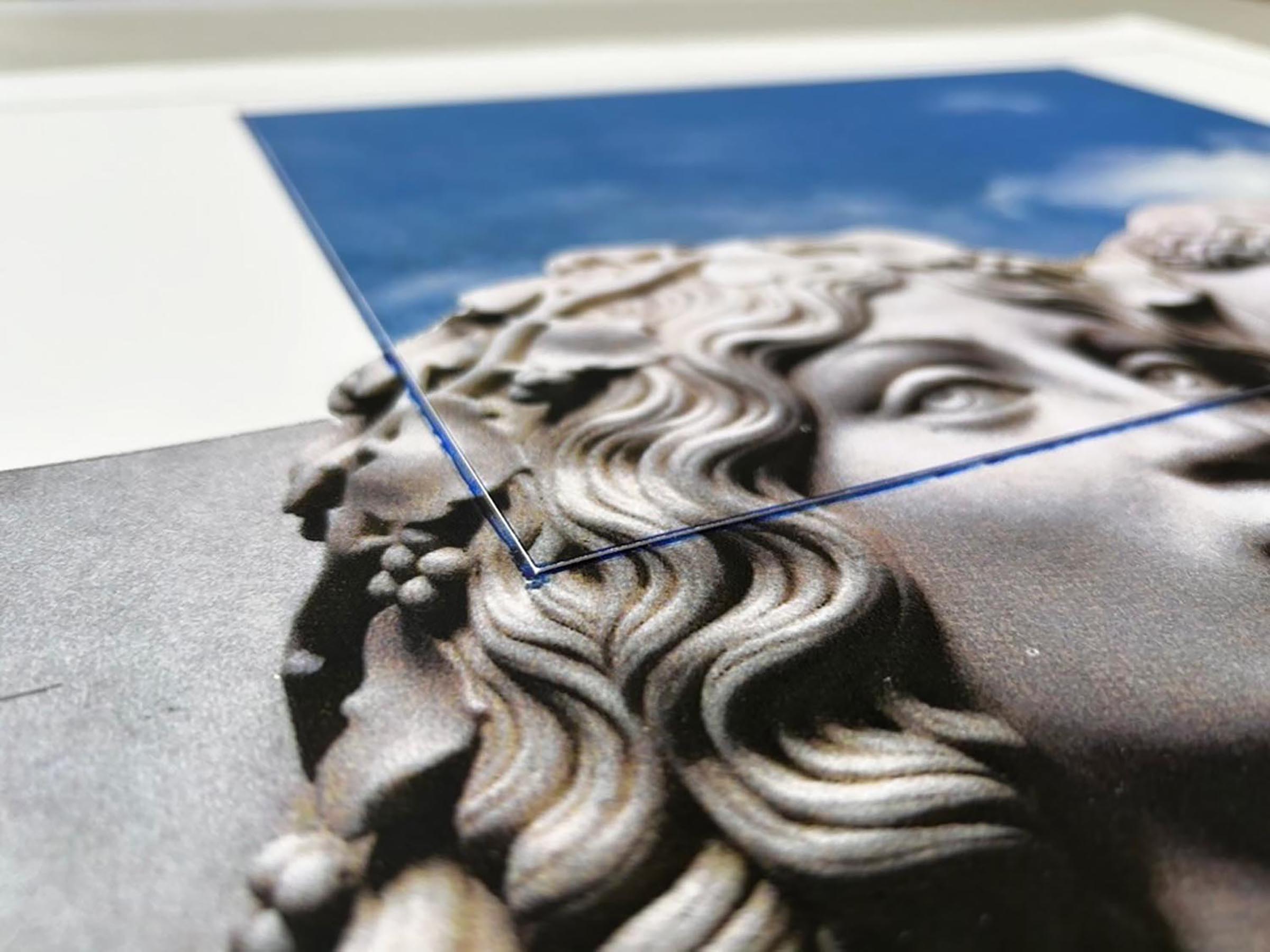
Digital pigment print with collage
Hahnemühle cotton rag paper 300 g, hand-torn
60 x 50 cm
Signed on the verso, centre, on a printed label with caption: "Giulio Paolini"
Handwritten numbering, not by the artist, on the verso, bottom left
45 in Arabic numerals from 1/45 to 45/45
8 artist's proofs in Arabic numerals from A. P. 1/8 to A. P. 8/8
Schellmann Art, Munich
This work is part of the project titled Faces, created in 2024 by the German publisher Schellmann Art, and dedicated to the theme of the face. The series of editions includes fourteen artworks – developed in single sheets, diptychs or triptychs, all using the same technique, format, and with the same print run – conceived by Cory Arcangel, Monica Bonvicini, Kerstin Brätsch, Liam Gillick, Mona Hatoum, Alfredo Jaar, Shirin Neshat, Tony Oursler, Giulio Paolini, Thomas Ruff, Thomas Scheibitz, Santiago Sierra, Rosmarie Trockel, and Luc Tuymans. One part of the print run is contained in portfolios of the complete series of works, while the remainder is presented individually.
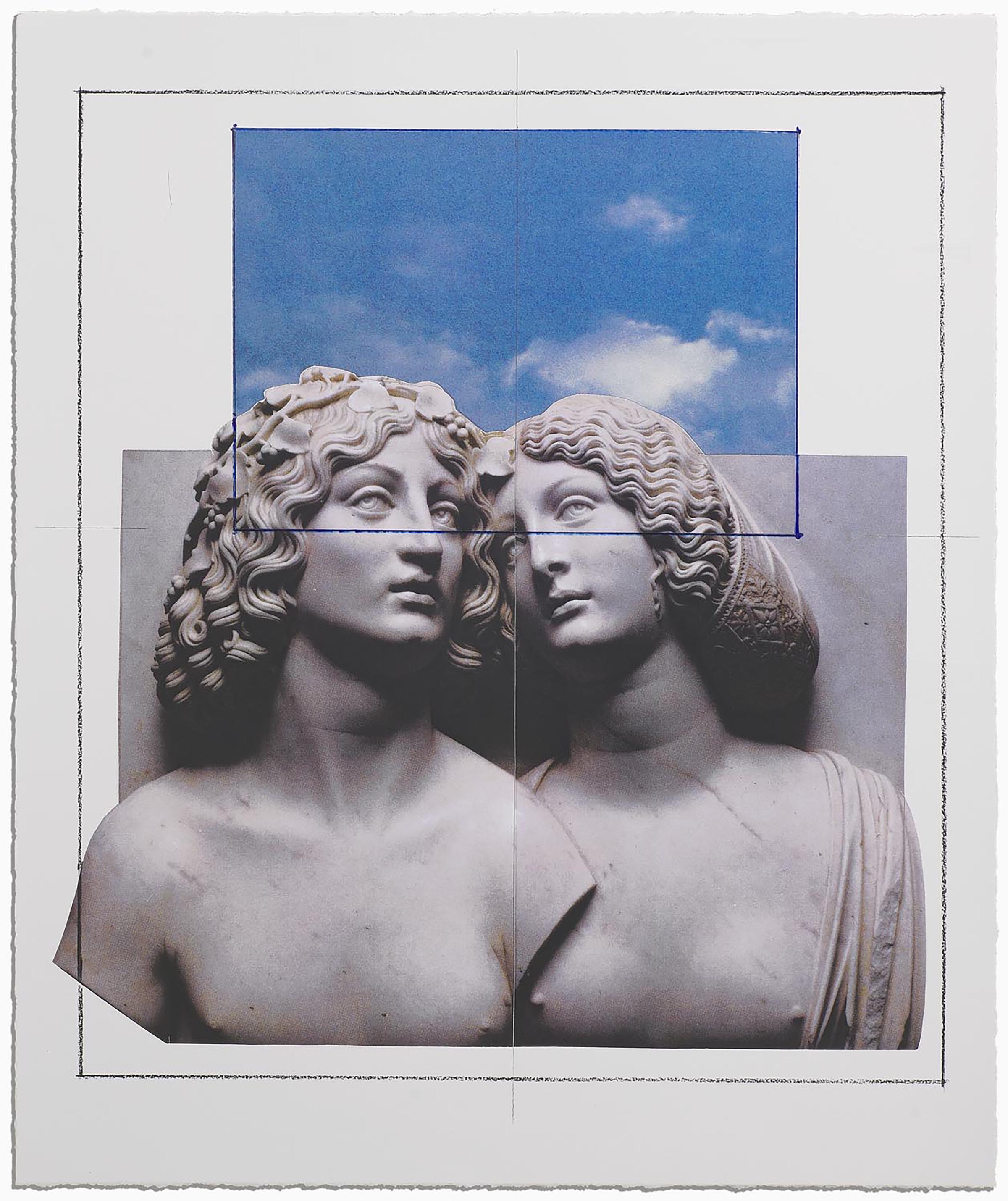
The black and white reproduction of Tullio Lombardo’s sixteenth-century black and white sculpture of Bacchus and Ariadne is associated with a patch of blue sky, applied by collage, continued by the blue line appearing at the two figures’ eye level. The composition is inscribed in a linear square marked by orthogonal axes.
The blue line that joins the foreground and the background acts as a key for interpreting the image: it emphasizes the two figure’s ecstatic gaze, so that it looks delighted in the sublime dimension represented by the sky.
The title implies a play on words between the Italian phrase "amore a prima vista" (love at first sight) – referring to the instantaneous passion that was sparked between Bacchus and Ariadne, represented in the marble sculpture – and the orientation of the two gazes towards an enigmatic dimension that actually transcends their view, moving beyond all appearance, beyond what seems to be “at first sight.”
The edition originates from the collage made in 2022 – hence, the double date "2022-24" – documented at number GPC-2170 of the online Catalogue Raisonné of works on paper.

