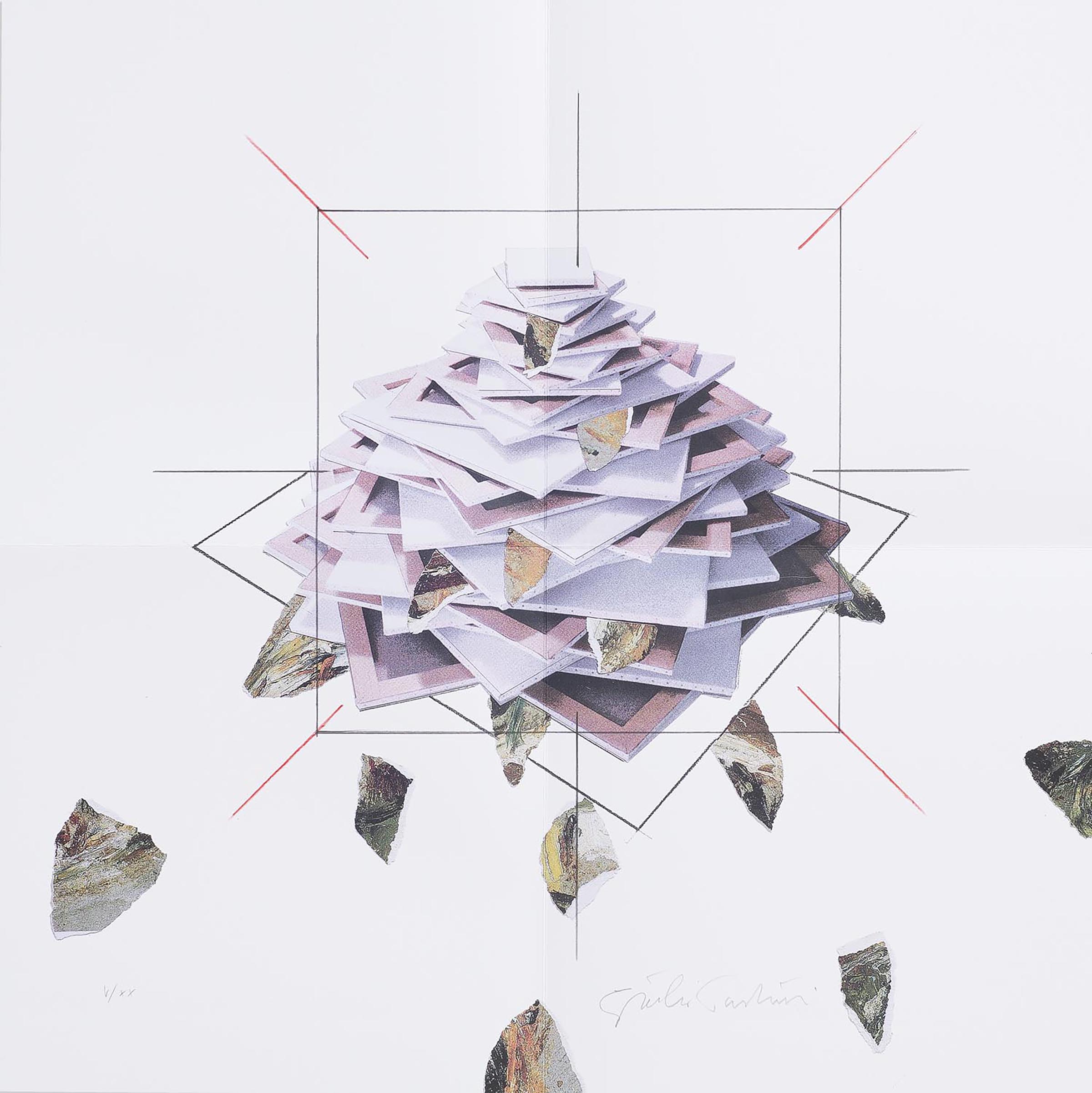
Con F. de P. (Villa degli enigmi), 2025
GPE-0165
With F. de P. (Villa degli enigmi)
Lithograph and drawing in black pencil and red pencil
Fedrigoni Arena
Plate 25 x 25 cm folded, 50 x 50 cm open
Signed on the recto, bottom right: “Giulio Paolini”
Handwritten numbering, not by the artist, on the recto, bottom left
35 in Arabic numerals from 1/35 to 35/35
20 in Roman numerals from I/XX to XX/XX
Edizioni l'Obliquo, Brescia
Grafica Sette Srl e Seven Media, Bagnolo Mella (Brescia)
The edition is part of the activity of Edizioni l’Obliquo, Brescia – founded in 1986 by Giorgio Bertelli – dedicated to the publication of artist books, graphic editions, unpublished non-fiction and poetry accompanied by a print or an original drawing conceived by a contemporary artist.
Double-sided white stock folder, with inside pocket, closed format 25.5 x 25.5 cm; cover with titles in red and black (author, title, publisher). Contains a title-page (on the recto the same as the cover, but with the title in black, on the verso acknowledgements and copyright), a note by the artist, the print and the colophon.
Includes information regarding the printer, edition size, printing technique, type of paper, place and date of printing (Brescia, 30 March 2025). Numbering bottom centre.
Note by the artist, Villa degli enigmi, referring to the title and to the subject of the edition.
At the centre of the sheet, folded into four parts, is the reproduction of an ensemble of primed canvases of different sizes. The superimposed canvases are arranged from the smallest to the largest and alternatively from the recto or from the verso, progressively rotating.1 The pyramidal mound is inscribed at the base of the drawing in perspective of a square that is slightly larger, while another square, parallel to the plane of the image and sketched in pencil – with an indication of the orthogonal axes, also in pencil, and diagonals in red pencil – alludes to the framing of a painting. Some photographic fragments, borrowed from the reproduction of a painting by Filippo de Pisis (his initials are included in the title of the print), are arranged in random order, and in free fall, like traces of painting, echoes of other paintings, and at the same time clues of a still unknown painting.
As the artist himself put it: “In my print we see the traces – the ones I could find – left by de Pisis during his stay at the clinic of Villa Fiorita, where he painted in the park greenhouse: dry and very elegant flowers, born from his paintbrush shortly before his death. There is no point in avoiding their fall in a cascade on the many canvases arranged in a pyramid. That is how those scattered fragments, borrowed from his paintings and arranged in an orderly and symmetrical space, appear before our observation here”.2
The print is based on a collage made in 2024, documented in the online Catalogue Raisonné of works on paper at number GPC-2357.
1 The staggered succession of canvases is taken from a photograph of Paolini’s works titled Jamais vu, 2005 (GPO-0903).
2 G. Paolini, Villa degli enigmi, a text included in the folder that contains the print edition. Villa Fiorita in Brugherio (Lombardy), the site of the clinic for nervous diseases for several decades, hosted de Pisis from 1949 to 1956; the title Villa degli enigmi instead refers to the sobriquet that Giorgio de Chirico gave to Villa del Seminario in Ferrara, where in the spring of 1917 Carlo Carrà, Filippo de Pisis, and de Chirico himself were patients.
Fragments: unknown painting by Filippo De Pisis.

