Ni le soleil, ni la mort..., 1989
GPO-0637
Stretcher, clip-on spotlights, pencil on primed canvas, tempera and pencil on wall
Stretcher 400 x 600 cm, primed canvas 80 x 120 cm, overall dimensions variable
Collection of the artist
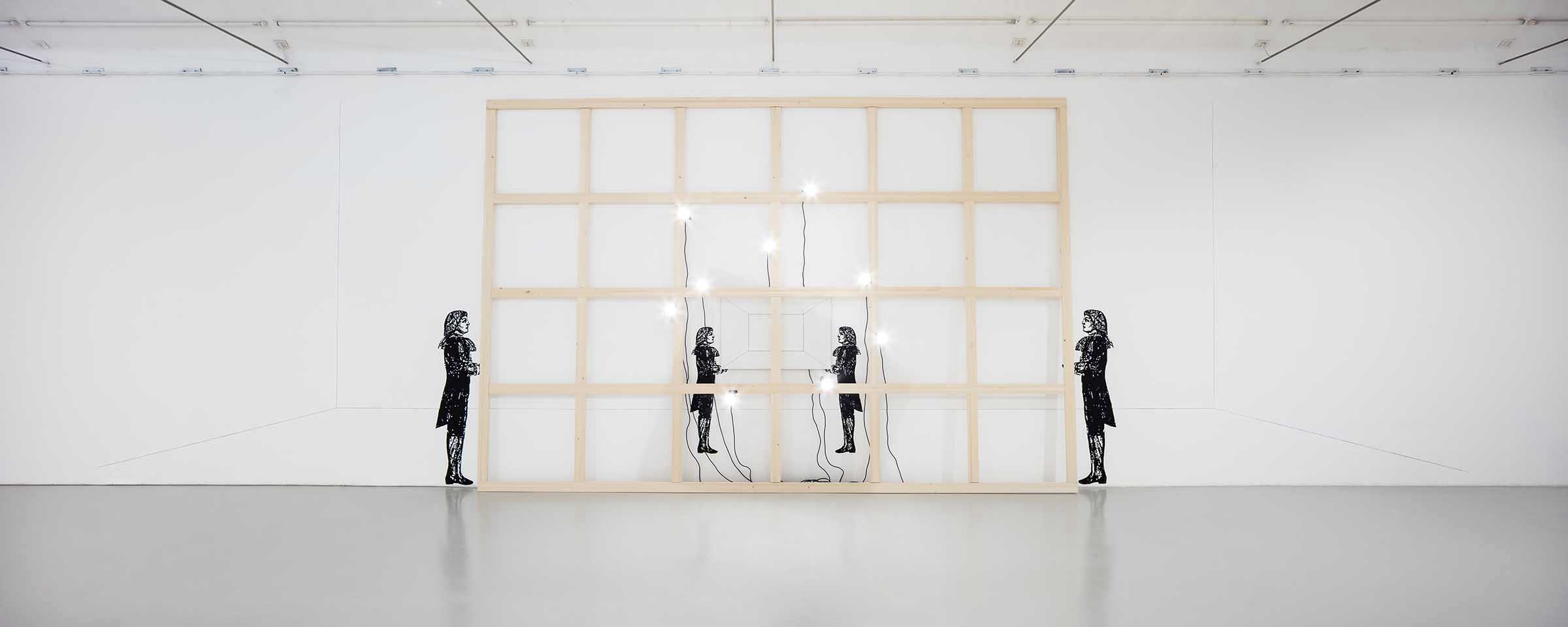
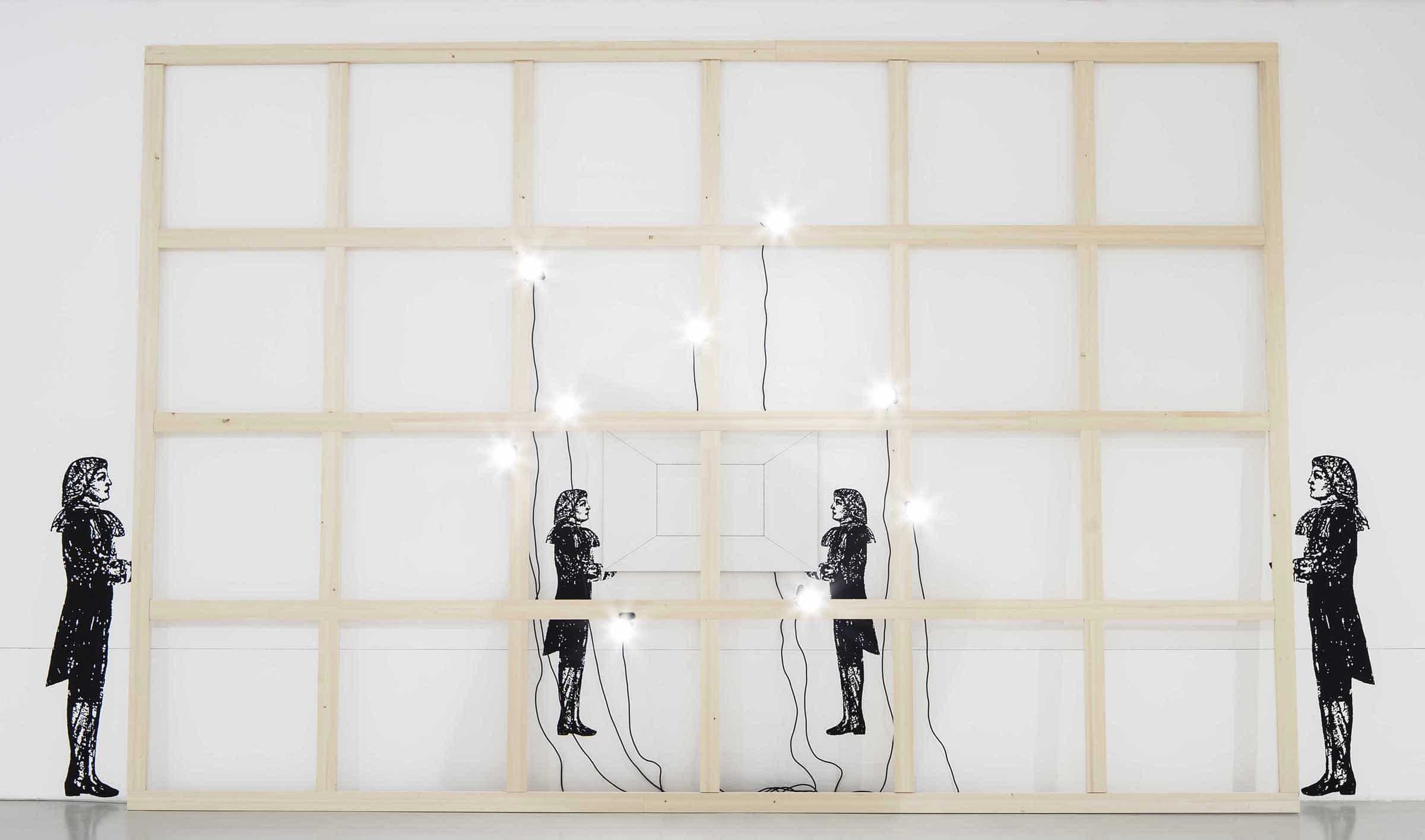
• 1989, Paris, Galerie Yvon Lambert: the pair of valets in the background was contained in a silver-enamel-painted construction on the wall, based on the multiplication of the image of the squaring of Disegno geometrico (the same construction would reappear in a three-dimensional form in the iron framework used to set up the artist's solo shows in Milan and Paris in 1992 and later in Padiglione dell'Aurora, GPO-0832). Several spotlights were attached to the wall, corresponding to several points of the painted structure, as if they were fastened to it.
Two pairs of life-size valets painted in tempera are contained in the perspectival drawing of a room outlined on the wall. The valets in the foreground "hold" a large stretcher, that is propped up against the wall. Attached to it are nine lit spotlights arranged at random, turned towards the viewer. The valets located in the background instead present a primed canvas hanging on the wall, which reiterates the perspectival drawing of a room.
Whereas the perspectival construction, the stretcher, the canvas, and the valets announce a painting or a work as it is being manifested, the blinding spotlights express the impossibility of grasping a dimension that is in itself fulfilled (their number refers to the nine planets, thereby symbolizing an extraordinary system in perfect balance). As suggested by the maxim by François de La Rochefoucauld recalled in the title – the whole phrase reads "Neither the sun nor death can be looked at with a steady eye" – the Absolute remains precluded to one’s direct gaze.
The valet de chambre, taken from eighteenth-century theatrical iconography and introduced in 1983-84 (cf. GPO-0507), represents a particularly significant character in Paolini's poetics. The gesture of offering or handing over that defines the valet – similar to that of presenting and observing which distinguishes other characters in their costumes that appeared in previous works – for Paolini symbolically corresponds to the very act of the representation, understood as a device that offers to the gaze the construction of an image (for instance, via the artifices of perspective). The anonymous, detached valets also refer to the role that Paolini attributes to the author: rather than inventing or demonstrating something, the author limits himself to elevating the gesture of the offer to the subject of the work itself. Through the stand-in of the valet, the author exits the scene and goes to sit among the audience, taking on the guise of the viewer, who before a work expects or listens, awaiting the offer that it announces to his gaze and that the gesture of the value makes evident. Abdicating his role as a creator, the author who becomes a spectator of the "theatre" of the artwork as such finds a way to emphasize and thus offer to our gaze the "miracles" of the representation itself, that is, to celebrate its "triumph".
Title from François de La Rochefoucauld, Maximes, 26 (“Le soleil [sic] ni la mort ne se peuvent regarder fixement”).
| 1989 | Paris, Galerie Yvon Lambert, Giulio Paolini, 15 April - 18 May. |
| 2016-17 | Milan, Galleria Christian Stein, Giulio Paolini. Fine, 10 November 2016 - 29 April 2017, cited in the checklist of exhibited works p. 157, col. repr. pp. 46-49, 58-59 (exhibition views), entry by M. Disch p. 157, referred to in the text by L. Conte p. 31; exhibited at the venue in Pero. |
| • | M. Castello, “Percezione e mito. Giulio Paolini”, in Tema Celeste 22-23 (Syracuse), October-November, 1989, col. repr. p. 26 (exhibition view Paris 1989). |
| • | F. Poli, “Note di lettura”, in Id., Giulio Paolini (Turin: Lindau, 1990), p. 29, col. repr. no. 138; republished in Giulio Paolini. Von heute bis gestern / Da oggi a ieri, exhibition catalogue, Graz, Neue Galerie im Landesmuseum Joanneum (Ostfildern-Ruit: Cantz Verlag, 1998), p. 47 (exhibition view Paris 1989). |
| • | Giulio Paolini. Il “Teatro” dell’opera, exhibition catalogue, Pesaro, Galleria Franca Mancini (Ravenna: Agenzia Editoriale Essegi, 1991), col. repr. p. 45 (exhibition view Paris 1989). |
| • | M. Bourel, “Giulio Paolini, contemplateur donc”, in Art press 164 (Paris), December, 1991, col. repr. p. 20 (exhibition view Paris 1989). |
| • | D. von Drathen, “Giulio Paolini. Der blinde Blick des Sehers”, in Künstler. Kritisches Lexikon der Gegenwartskunst 33, no. 7 (Munich: Weltkunst-Bruckmann Verlag, 1996), col. repr. p. 13 (exhibition view Paris 1989). |
| • | Giulio Paolini. Von heute bis gestern / Da oggi a ieri, op. cit. (Ostfildern-Ruit: 1998), repr. p. 285 (exhibition view Paris 1989). |
| • | M. Disch, Giulio Paolini. Catalogo ragionato 1960-1999, vol. 2 (Milan: Skira editore, 2008), cat. no. 637 p. 655, col. repr. (exhibition view Paris 1989). |
| • | G. Celant, Arte Povera. Storia e storie (Milan: Mondadori Electa, 2011), col. repr. p. 223 (exhibition view Paris 1989). |
| • | J. Lageira, “Giulio Paolini. Ut pictura poesis”, in Id., Regard oblique. Essais sur la perception (Brussels: La Lettre volée, 2013), pp. 119-120, repr. p. 117 (exhibition view Paris 1989). |
| • | E. Volpato, “L’Ile enchantée. La visione è cieca”, in E. Franz et al., Giulio Paolini. Vedo e non vedo. In tema 1 (Turin-Mantua: Fondazione Giulio e Anna Paolini and Corraini Edizioni, 2014), p. 58, col. repr. p. 58 (exhibition view Paris 1989). |
| • | Giulio Paolini. A come Accademia, exhibition catalogue, Rome, Accademia Nazionale di San Luca (Rome: Gangemi Editore, 2023), col. repr. pp. 276-277 (exhibition view Milan 2016). |

