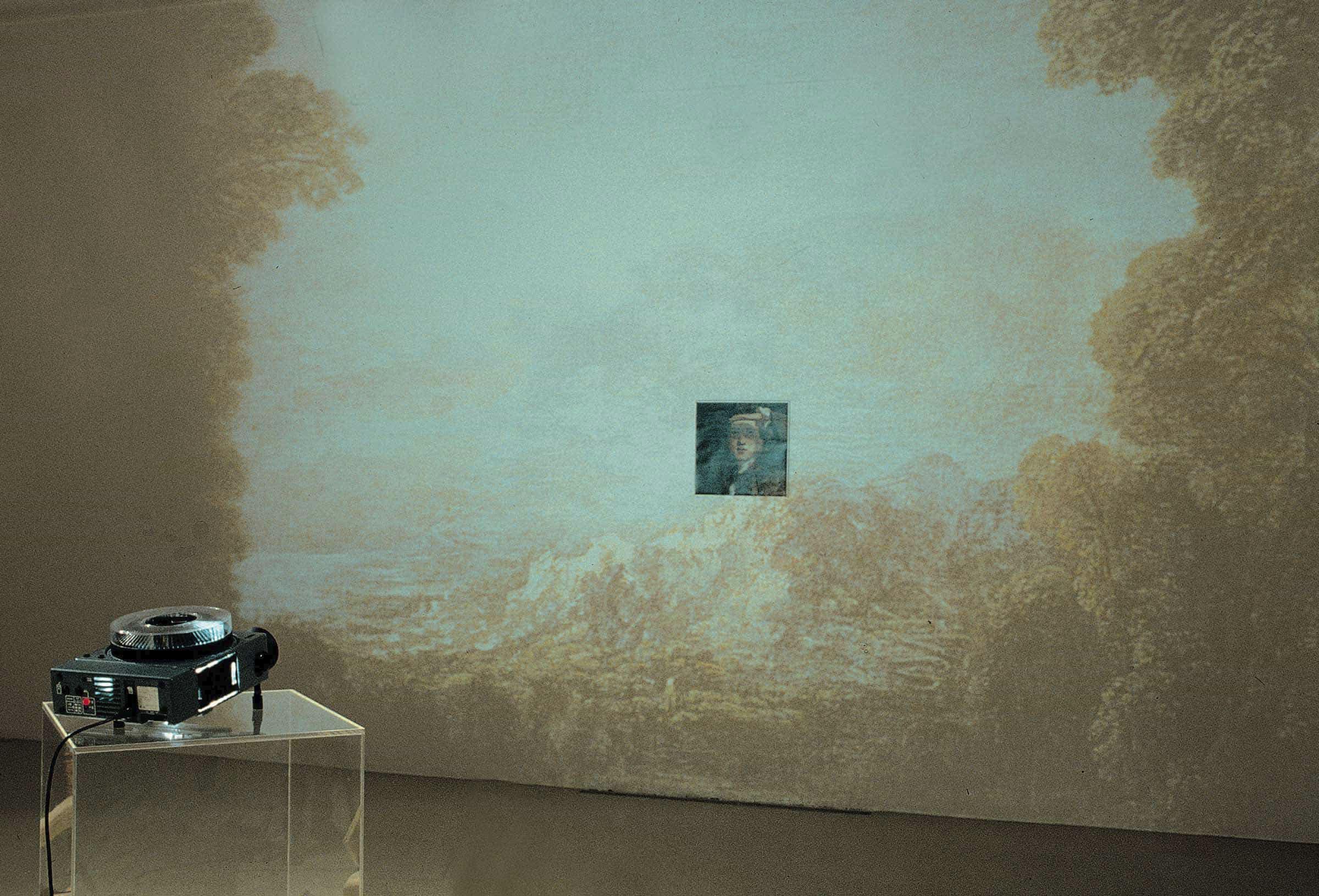
L’Île enchantée, 1995-96
GPO-0768
Photo print mounted in plexiglas case, slide, slide projector, plexiglas plinth
Plexiglas case 50 x 50 x 3 cm, overall dimensions variable
Dismantled work
• 1996, Paris, Galerie Yvon Lambert: in the solo exhibition named after the work itself, the case with Reynolds' face was located at the centre of the wide wall at the rear of the exhibition space, lit by the projection of the Watteau landscape, while in the central area of the display space, partially darkened, a group of other works formed an "island". By way of its inaccessibility and density it materializes the unapproachability or the inscrutability of the work towards which the author-viewer turns his gaze.
• 1998, Graz, Neue Galerie; 1999, Turin, GAM Galleria Civica d’Arte Moderna e Contemporanea; 2001, Verona, Palazzo Forti: the case was mounted at the centre of a large primed canvas, set down on an easel which was located at the edge of an inextricable ensemble of works. Furthermore, overlapping the fixed projection was a second slide projection featuring previous works, which in the background of the Watteau landscape dissolved in a flow of almost undecipherable images.
The projection taking up the entire wall reproduces the upper part of the famous painting by Jean-Antoine Watteau cited in the title (L’Île Enchantée, 1717). At the centre of the projection, a plexiglas case proposes the detail of an early self-portrait by Joshua Reynolds using his hand to shade his eyes (Self-portrait, 1747-48). The space in front of the projection – reserved for the viewers and eventually occupied by other works – becomes the “bank” which in Watteau’s painting is animated by the figures waiting to embark for the mythical island of Cythera.
The superimposition of Reynold’s face and Watteau’s landscape horizon “becomes the theatre of a coincidence and suggests a reversed vision", Paolini explains. "Our visual field is situated here in a specular and contrary sense: it is the artist’s gaze (Reynolds owned Watteau’s painting, which he preserved until the day he died) that observes our point of view. By finding ourselves in lieu of the original figures in the foreground, figures who are now absent from the scene, what we ‘look at’ is therefore the same gaze that is turned towards us, and which thus names us as eye witnesses, figures necessary for the ‘after’ that the work always awaits”.1
As the gazes cross between the author, who, blinded by the beam of light from the projector, shades his eyes with his hand in the attempt to glimpse something, and the viewer, who peers at the horizon in search of a yearned-for apparition, both measure the distance that separates them from the attainable destination: the approach to the fulfillment of the work, the absolute vision. Both the author and the viewer – as Paolini has repeatedly asserted – are just guests of the artwork, which always transcends them: the author offers nothing that is complete to the viewer, but rather, together they look out into the distance, towards the work's becoming.
1 G. Paolini in Giulio Paolini. Von heute bis gestern / Da oggi a ieri, exhibition catalogue, Graz, Neue Galerie im Landesmuseum Joanneum (Ostfildern-Ruit: Cantz Verlag, 1998), pp. 173, 175.
• Figure: Joshua Reynolds, Self-Portrait, 1747-48, oil on canvas, 63 x 74 cm, National Portrait Gallery, London.
• Landscape: Jean-Antoine Watteau, L'île enchantée, 1717, oil on canvas, 47.5 x 56.3 cm, Private collection, Switzerland.
| 1996 | Paris, Galerie Yvon Lambert, Giulio Paolini. L’Île enchantée, 6 January - 17 February. |
| 1998 | Graz, Neue Galerie im Landesmuseum Joanneum, Giulio Paolini. Von heute bis gestern / Da oggi a ieri, 4 April - 31 May, cited in the checklist of exhibited works no. 15 p. 181, col. repr. p. 326 (exhibition view Paris 1996), referred to in the text by M. Disch pp. 141, 143. |
| 1999 | Turin, GAM Galleria Civica d’Arte Moderna e Contemporanea, Giulio Paolini. Da oggi a ieri, 8 May - 25 July, cited in the checklist of exhibited works no. 41 p. 38, col. repr. pp. 96-97 (exhibition view Graz 1998), 115-117 (exhibition view). |
| 2001 | Verona, Galleria d’Arte Moderna e Contemporanea Palazzo Forti, Giulio Paolini. Premio Internazionale Koinè 2000 alla carriera, 15 September 2001 - 6 January 2002, cited in the checklist of exhibited works p. 74, col. repr. pp. 54-57 (exhibition view Paris 1996), 58-61 (exhibition views Turin 1999), text by M. Disch pp. 54-60. |
| • | G. Paolini in Giulio Paolini. Von heute bis gestern/Da oggi a ieri, Graz, Neue Galerie im Landesmuseum Joanneum (Ostfildern-Ruit: Cantz Verlag, 1998), pp. 173, 175. |
| • | G. Paolini, Quattro passi. Nel museo senza muse (Turin: Giulio Einaudi editore, 2006), plate no. X (exhibition view Graz 1998). |
| • | M. Disch, Giulio Paolini. Catalogo ragionato 1960-1999, vol. 2 (Milan: Skira editore, 2008), cat. no. 768 pp. 780-781, col. repr. (exhibition views Paris 1996 and Graz 1998). |
| • | Arte povera 2011, edited by G. Celant (Milan: Mondadori Electa, 2011), col. repr. no. 323 (exhibition view Paris 1996). |
| • | Giulio Paolini. Et in Arcadia ego, exhibition catalogue, Verona, Galleria d’Arte Moderna Achille Forti (Imola: Manfredi Edizioni, 2024), col. repr. p. 17 (exhibition view Verona 2001). |
| • | Giulio Paolini. A come Accademia, exhibition catalogue, Rome, Accademia Nazionale di San Luca (Rome: Gangemi Editore, 2023), col. repr. pp. 227 (exhibition view Graz 1998), 231 (exhibition view Turin 1999). |

