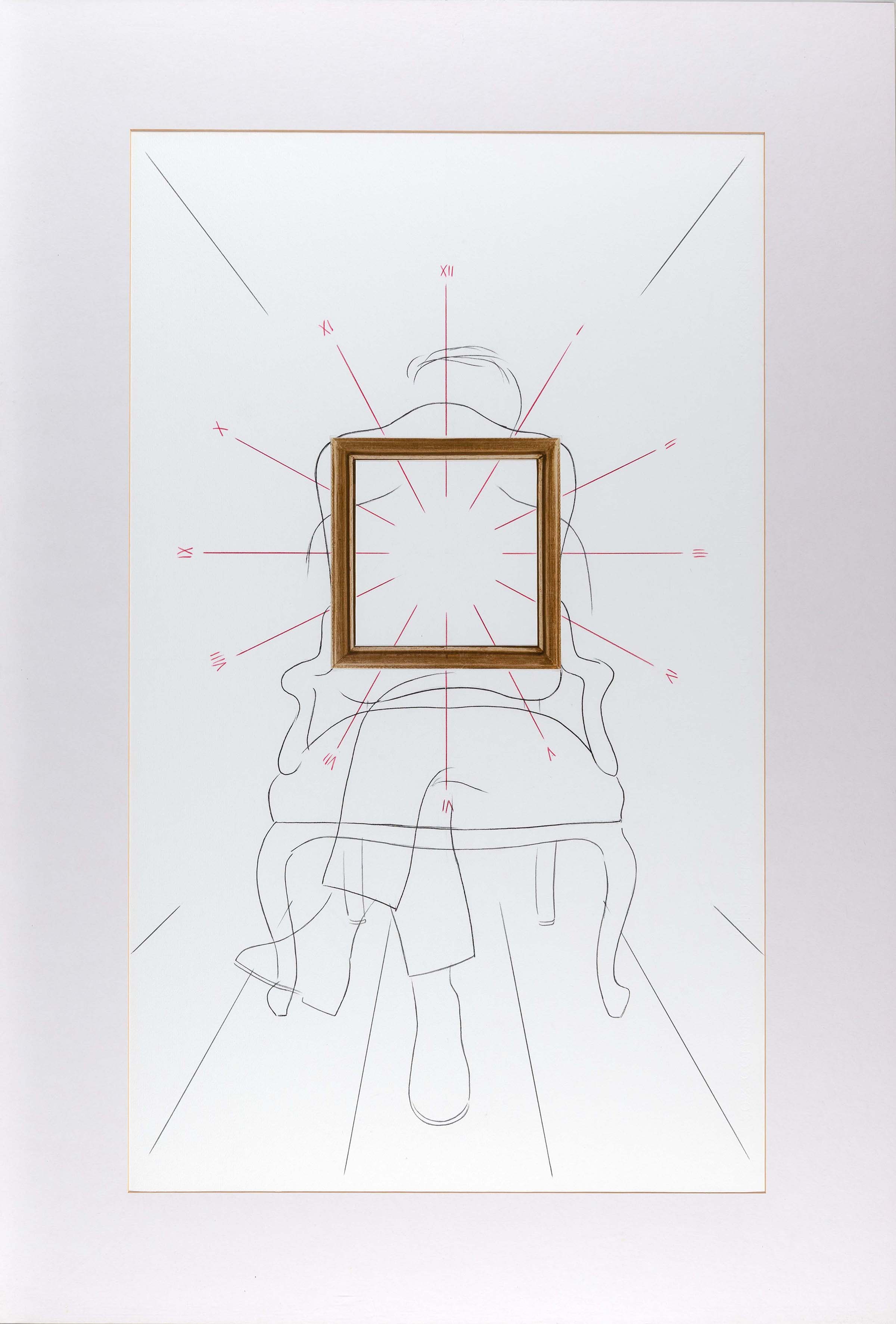
Martirio di San Sebastiano, 2002
GPO-0868
Martyrdom of Saint Sebastian
Pencil, red pencil and collage on paper, plexiglas case
127 x 86.5 cm
Titled, signed, and dated on the verso, centre: “”Martirio di / San Sebastiano” / Giulio Paolini / 2002”
Private collection, Rome
The male figure seated in an armchair and turned towards the viewer seems to be holding up a painting before his face, evoked by the reproduction of an empty gilded frame. He is either posing for a work that is in the process of being made, or else he is intent on observing a painting that is still unknown. Spreading out from the central part of the frame is a sunburst of “arrows” outlined in red pencil, whose tips are associated with the Roman numerals from I to XII developed clockwise, evoking the grip of the arrows and at the same time the clockwise succession on the face of a clock. The black lines in the lower part of the work and those at the top, corresponding to the upper vertices, allude to the floor and the ceiling of the room where the figure is located.
The key to interpretation is provided by the title, which by recalling the iconography of Saint Sebastian pierced by arrows, transforms the stand-in for the artist into a “martyr”.1 The twelve numbers indicate an absolute and iterative temporal dimension – the hours of the day, the months of the year – while the gilding of the frame, according to the artist, is the indication of a sublime and fulfilled dimension. In other words: the artist who always from scratch and endlessly tries to see or establish a dimension that escapes any attempt at representation ends up being a “martyr” of his own ambitions and illusions.
The theme was conceived in 1998-99 with Studio per “Martirio di San Sebastiano” (GPC-0939) and it was further formulated in two subsequent large-scale works entitled Estasi di San Sebastiano, made in 2009 (GPO-0978) and in 2018 (GPO-1064), respectively.
1 The work was made for a group exhibition in which the participating artists were invited to converse with an Old Master painting in the collection of the Galleria Borghese in Rome. Paolini chose the anonymous reproduction of San Sebastiano by Perugino.
| 2002-03 | Rome, Galleria Borghese, Incontri, 10 March 2002 - 9 March 2003, col. repr. pp. 63, 127 (exhibition view), with entry by L. Pratesi pp. 32-33. |
| • | G. Paolini in the interview with L. Pratesi, in Incontri, exhibition catalogue, Rome, Galleria Borghese (Milan: Edizioni Charta, 2002), p. 96. |

