A come Accademia, 2009-10
GPO-1005
A as in Academy
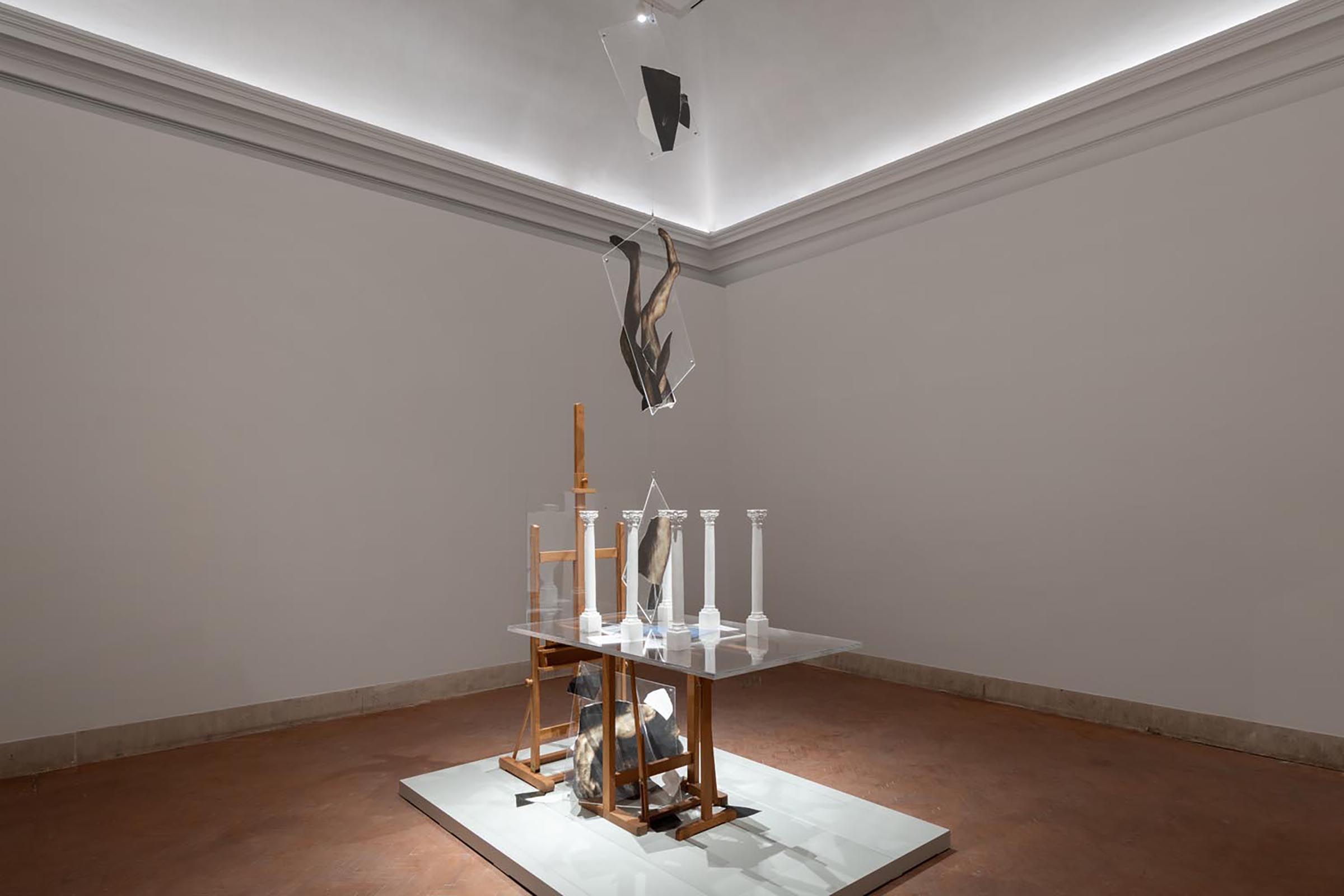
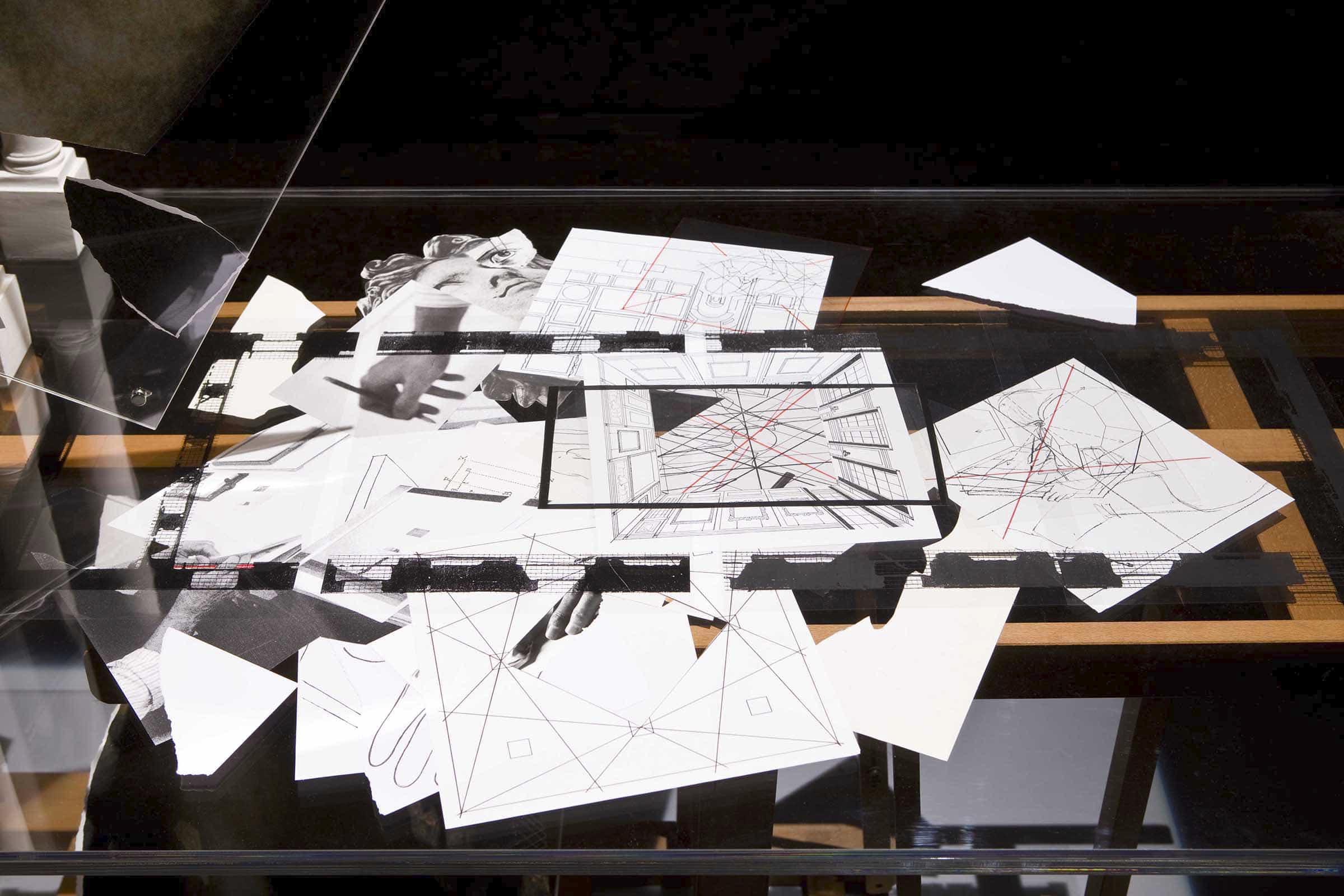
Grey-painted wooden platform, torn photographic enlargement, torn sheets of drawing paper, plexiglas sheets and display frames, steel cables, easels, plaster casts, xerox reproductions on paper and on acetate
Grey platform 8 × 160 × 240 cm, two plexiglas display frames 58.5 × 80 cm each, two plexiglas display frames 43.5 × 58 cm each, six casts h 59 cm each, one plexiglas sheet 70 × 70 cm, two plexiglas sheets 90 × 160 cm each, overall dimensions variable
Collection of the artist
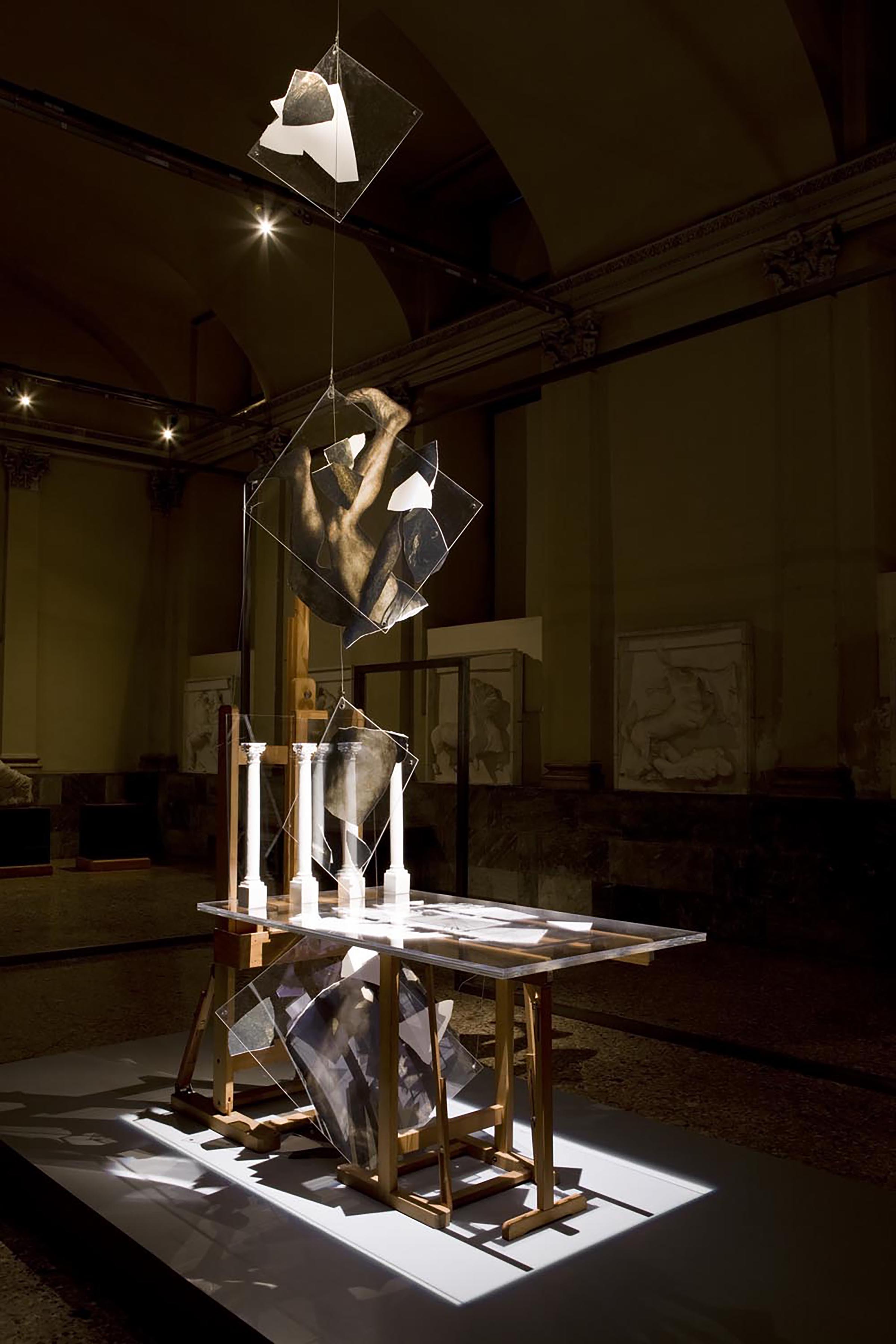
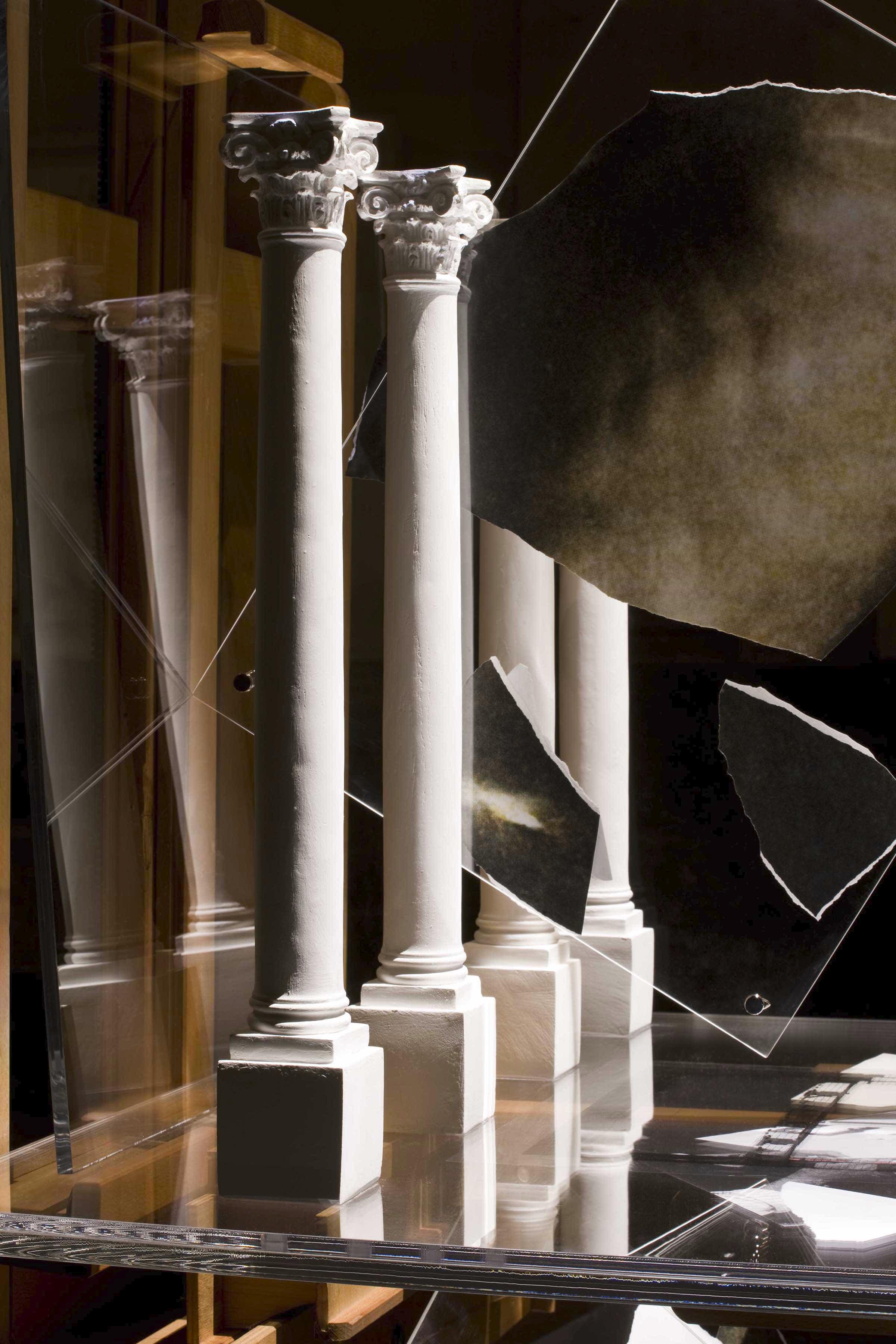
• 2010, Milan, Accademia di Belle Arti di Brera: the platform is white and measures 22.5 x 203 x 403 cm; the plexiglas sheets that act as a work surface hold a multitude of paper elements, including a site plan on acetate of the exhibition space, divided into three sheets and laid down on the assemblage; on the horizontal plane, close to the easel, are four plaster columns in a row, reflecting the ones present in the same Salone Napoleonico.
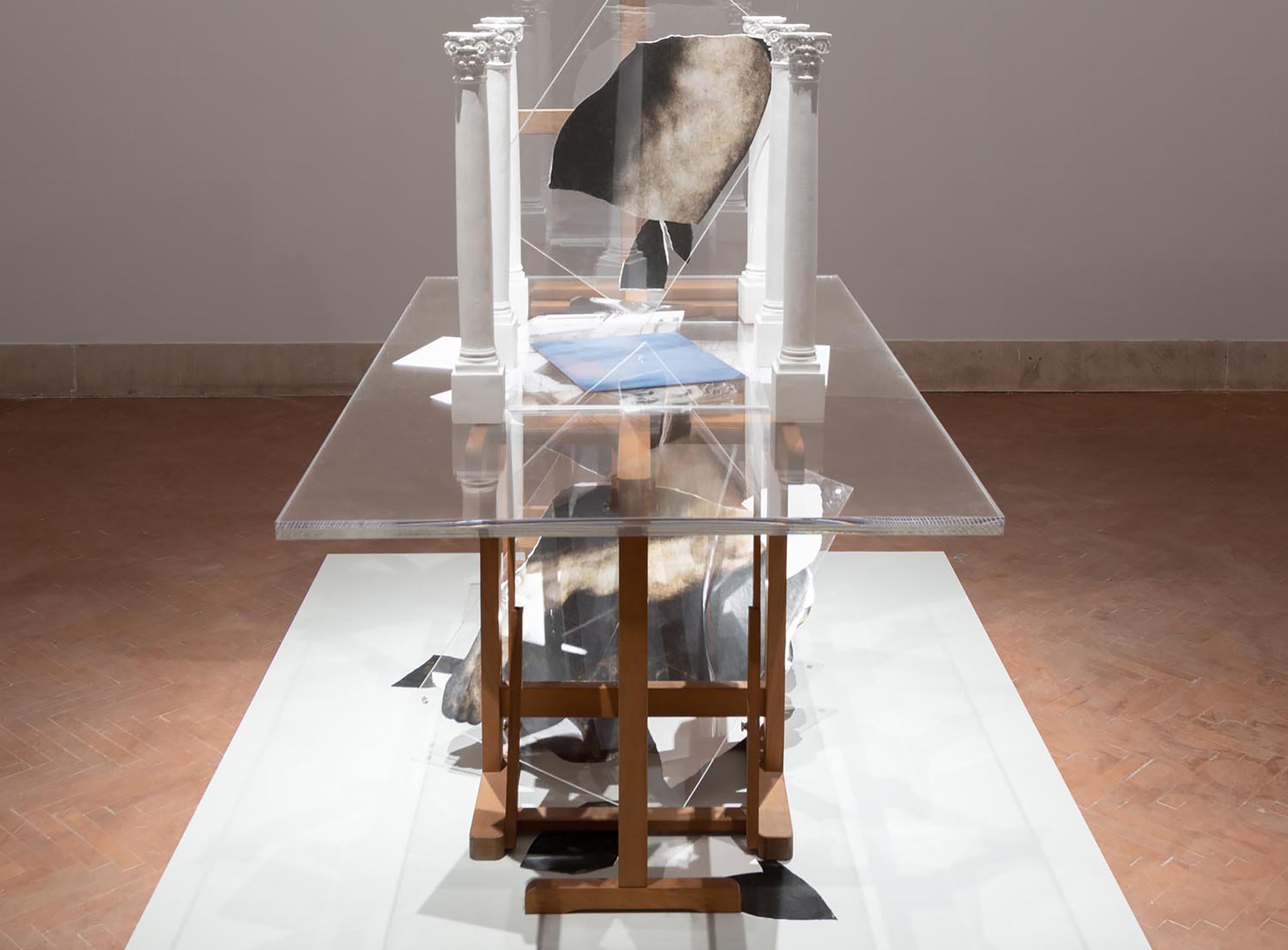
• 2023, Rome, Accademia Nazionale di San Luca: the platform is grey and measures 8 x 160 x 240 cm (like those of the other two versions of A come Accademia on display); on the horizontal plane six columns arranged in two parallel rows delimit the central area. The plexiglas sheets hold only some of the images used originally; omitted in particular is the site plan of the exhibition space, which has been replaced by a work made by the artist when he was a young man, placed in between two plexiglas sheets measuring 40 x 60 cm each, titled Detail of Atlantis, 1958 (tempera on cardboard applied to masonite, 27.8 x 36 cm, collection of the artist).
Four plexiglas supports, suspended at different heights between the ceiling and the floor, hold the torn parts of a photographic enlargement of Titian's Sisyphus (1548-49) along with several pieces of drawing paper. In their ruinous vertical trajectory, the images intercept an easel that, along with a second folding easel, holds two large plexiglas sheets that overlap to create a horizontal plane. On this work surface, six plaster columns delimit an ensemble of photographic reproductions and drawings – on paper or on acetate – arranged at random between the two transparent sheets: projects, studies, eyes, hands, and others images coming from the artist's repertoire, some of which squared with red ink along the diagonals. Also located on the first easel is a plexiglas sheet that serves as a “backdrop”, recalling, in a broad sense, a painting that is still unknown.
The figure of Sisyphus, who, through the motif of the fall recalls another mythological character, Icarus, who fell into the sea, metaphorically suggests the artist's inevitable fate: even though he is aware of the impossibility of bringing the creation to fruition, he does not forgo constantly renewing his task. The work materials scattered across the table and symbolically inscribed in the architecture of a temple – alluded to by the columns – are the clues of a work that is becoming, clues that refer to the context of the design and the reflection on art: the artist's studio, as well as the room of a fine arts academy (the work was conceived for an exhibition at the Accademia di Belle Arti in Brera, which also inspired the title of the work).
In 2023, on the occasion of the solo exhibition at the Accademia Nazionale di San Luca in Rome, Paolini made several variants to the installation of the elements on the horizontal plane with respect to the first presentation in Milan in 2010. In particular, he omitted the site plan on acetate of the Salone Napoleonico – placed on the ensemble of paper elements in Milan – in favour of a work he made as a young man, titled Detail of Atlantis (1958), inspired by the legendary sunken island of Atlantis and meant as the echo of an unattainable destination. The small tempera on cardboard is placed in between two transparent plexiglas sheets the same size as Disegno geometrico, the painting that was made two years later, in 1960, and that has since become the conceptual model of Paolini's poetics. “The choice is based on my desire to show something that preceded the future absoluteness of Disegno geometrico”,1 says the artist to this regard, emphasizing the condition of anteriority, expectation, and research, with respect to the finished dimension of a defined work.
The same title was used for two other works, made in 2023 on the occasion of the artist's solo exhibition at the Accademia Nazionale di San Luca in Rome, also titled A come Accademia (cf. GPO-1053, GPO-1054).
1 G. Paolini interviewed by A. Soldaini, “In dialogo”, in Giulio Paolini. A come Accademia, exhibition catalogue, Rome, Accademia Nazionale di San Luca (Rome: Gangemi Editore, 2023), pp. 98-99.
Tiziano Vecellio, Sisifo, 1548-49, oil on canvas, 237 x 216 cm, Museo del Prado, Madrid.
| 2010-11 | Milan, Accademia di Belle Arti di Brera, Sala Napoleonica, A come Accademia, 14 December 2010 - 14 March 2011, not. repr. |
| 2023 | Rome, Accademia Nazionale di San Luca, Giulio Paolini. A come Accademia, 20 April - 15 July, cited in the checklist of exhibited works p. 304, col. repr. pp. 30 (exhibition view Milan 2010), 46-49 (exhibition view), 99 (exhibition view Milan 2010), referred to in texts by A. Soldaini pp. 30-34, F. Guzzetti pp. 71-72. |
| • | G. Paolini, “A come Accademia”, in Giulio Paolini. A come Accademia, exhibition catalogue, Rome, Accademia Nazionale di San Luca (Rome: Gangemi Editore, 2023), pp. 20-21. |
| • | G. Paolini in the interview with A. Soldaini, “In dialogo”, ibid., pp. 97, 98-99. |
| • | Artisti nello spazio da Lucio Fontana a oggi: gli ambienti nell'arte italiana, exhibition catalogue, Catanzaro, Complesso Monumentale del San Giovanni (Cinisello Balsamo: Silvana Editoriale, 2013), col. repr. p. 175 (exhibition view Milan 2010). |
| • | L. Canova, “Negli abissi del tempo. Giulio Paolini e Giorgio de Chirico”, in Metafisica. Quaderni della Fondazione Giorgio e Isa de Chirico 22-23 (Imola: Maretti Editore, 2023), p. 127, not repr. |
| • | F. Miglietta, ”Trascrizione e memorie. Dialogo con Giulio Paolini”, in Abitacolo. Forme e linguaggi del contemporaneo 24-25, no. 1 (Cosenza), 2023-24, col. repr. p. 48 (exhibition view Rome 2023). |
| • | G. Paolini, Eccomi. Qui dove sono (Turin: Fondazione Giulio e Anna Paolini, 2025), col. repr. p. 80 (exhibition view Rome 2023). |

