In volo (Icaro e Ganimede), 2019
GPO-1075
In Flight (Icarus and Ganymede)
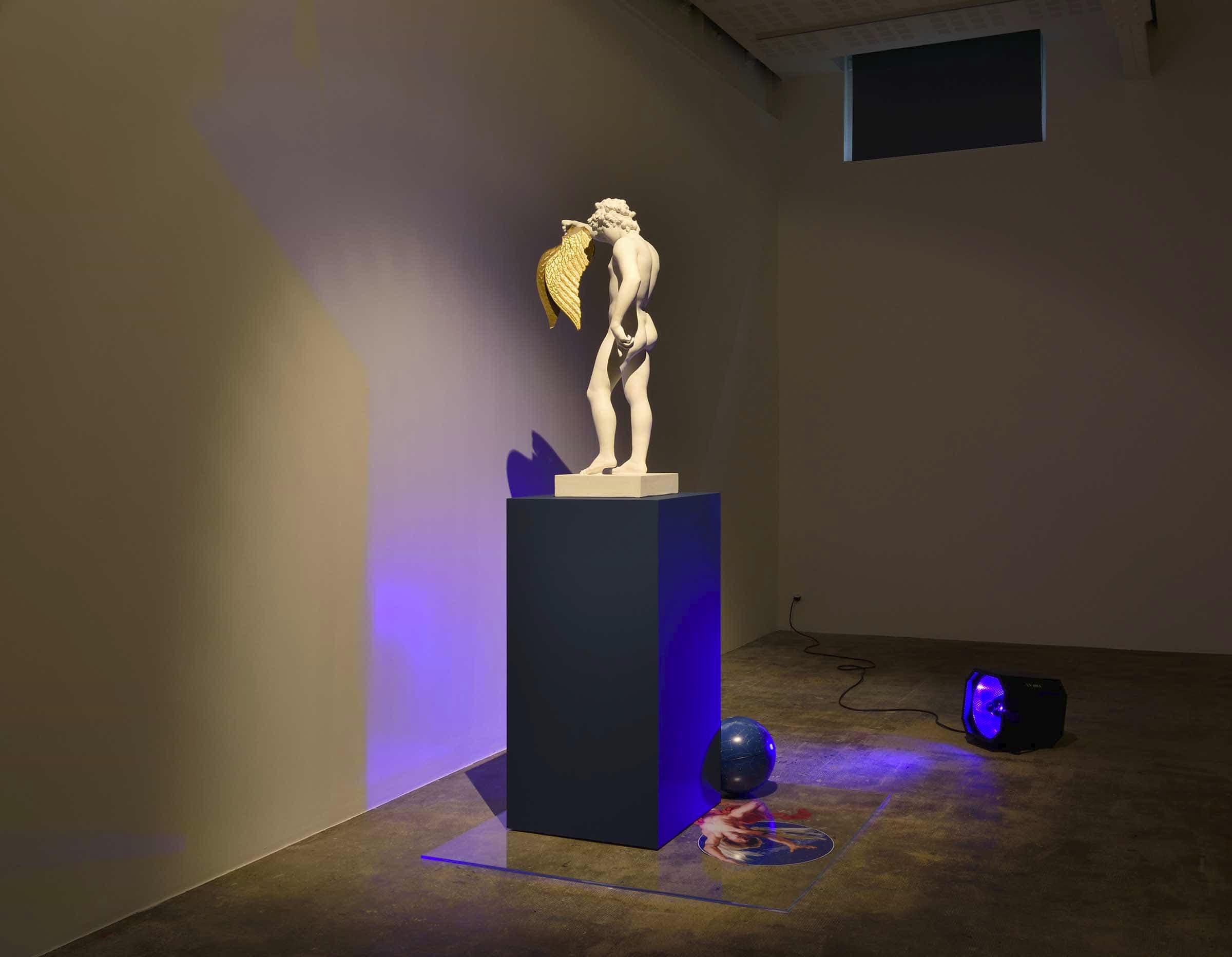
Plaster cast, golden card-stock wings, dark blue-painted plinth, plexiglas sheet, stellar globe, xerox reproduction, Wood’s light
241 x 245 x 190 cm
Private collection
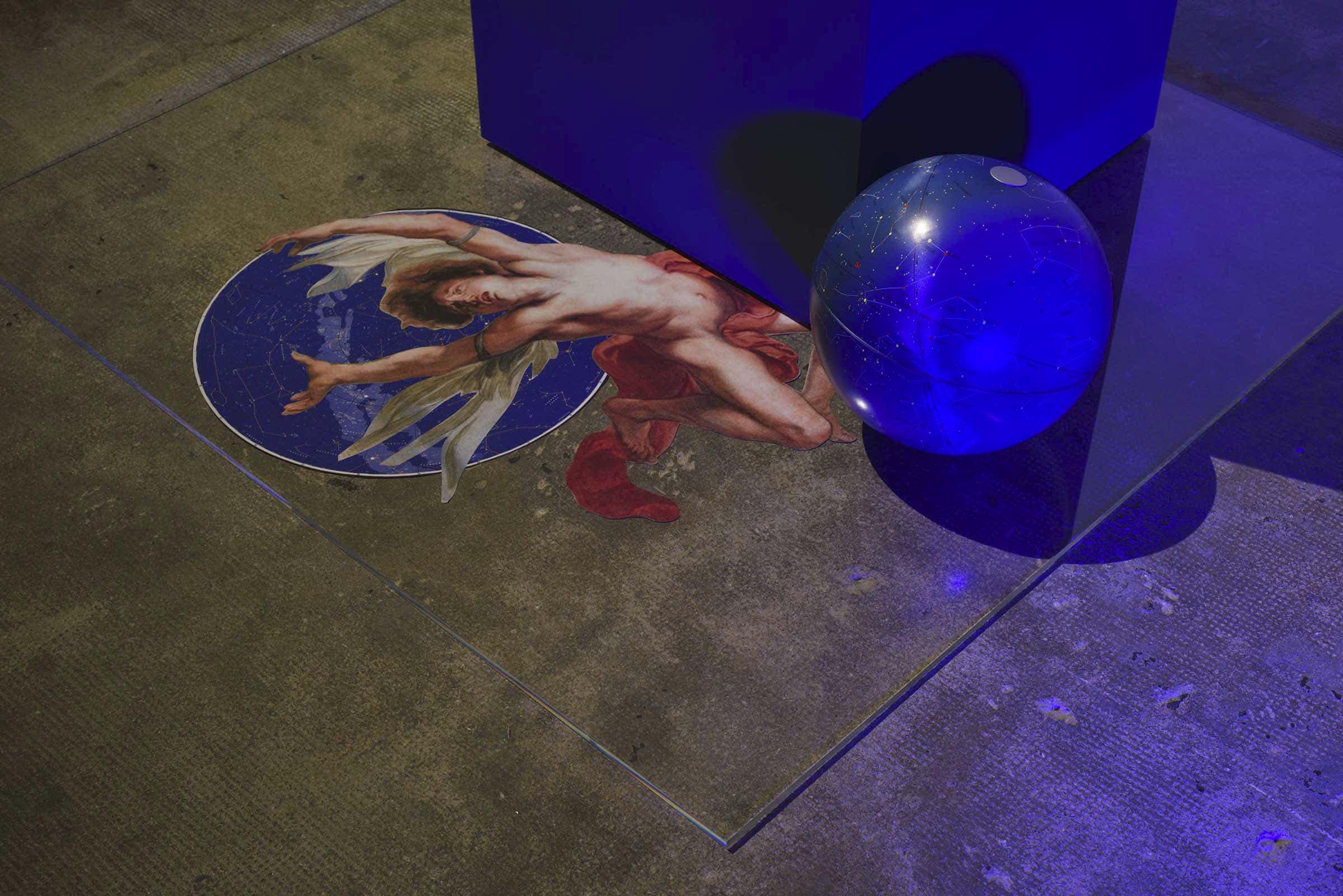
The plaster cast of Ganymede, set on a blue-coloured plinth and turned to face the wall, is holding a pair of gilt wings in its right hand. On the floor, a plexiglas sheet holds down the partial reproduction of the painting The Fall of Icarus (1636-37) by the Flemish artist Jacob Peter Gowy; up against the plinth is a stellar globe, lit by a Wood’s light.
The key to interpretation lies in the gilt wings that call into play the destinies of both Ganymede and Icarus, both of whom belong to ancient Greek mythology. A young man of supreme beauty, Ganymede flew into the sky, abducted by Zeus who took him to the Olympus to be his lover. Icarus, on the contrary, fell to the sea because the wax used to make his wings melted when he flew too close to the sun. In the artist’s own words: “Two naked bodies, one falling to the ground, the other soaring upwards, are both suspended in the vertigo of the flight (of the void). These are actors aimed at impersonating the parallel fates of two figures: Icarus and Ganymede, the end and the beginning of an idea of Beauty, of a single nameless figure”.1 A sort of allegorical “self-portrait”, In volo (Icaro e Ganimede) joins the desire for the absolute and the passion for beauty, albeit aware of the impossibility of their conquest and the fatal destiny of a flight that is too audacious.
The ineffable dimension from which the artist cannot turn away his gaze is also recalled by the cosmic elements. The stellar globe and the fragments of star charts refer to an astronomical context, in which Ganymede is the main satellite of the planet Zeus, as well as being the largest in the solar system.
The same theme was formulated in a second version as well, made in 2020 (GPO-1098), which is mainly distinguished by the absence of the Wood’s light and the different source of the elements arranged on the ground.
1 G. Paolini in conversation with B. Della Casa, January 2019.
• Benvenuto Cellini, Ganimede, 1548-50, marble, h 109 cm, Museo del Bargello, Florence.
• Jacob Peter Gowy, De val van Icarus, 1636-38, oil on canvas, 195 x 180 cm, Museo del Prado, Madrid.
| 2019 | Paris, Galerie Marian Goodman, Giulio Paolini, 15 March - 11 May. |

