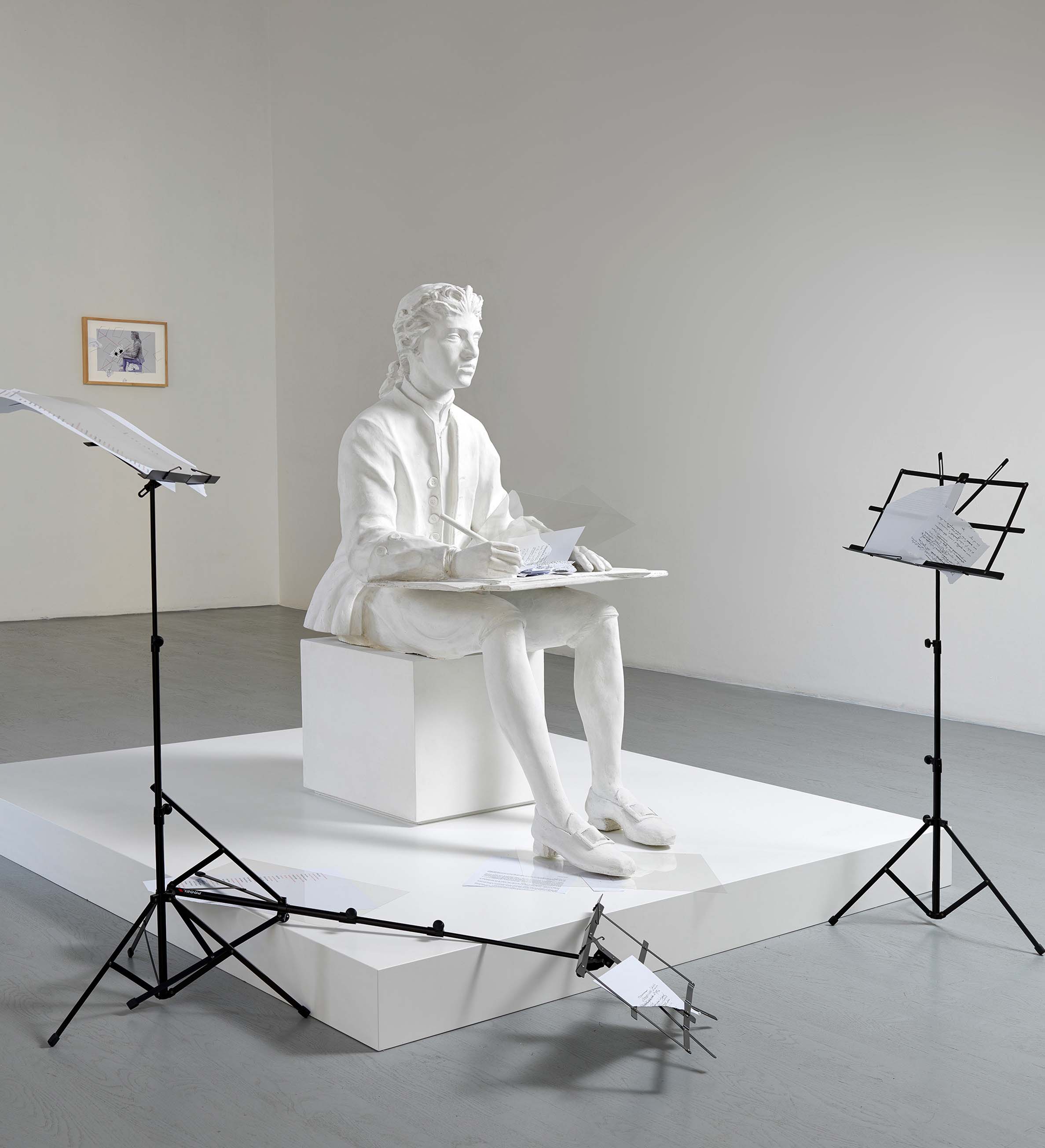
Firmamento, 2024
GPO-1169
Firmament
Plaster sculpture, white-painted wooden platform, acetate sheets, xerox reproductions, music stands
Sculpture h 130 cm, platform 20 x 190 x 190 cm, acetate sheets 29.7 x 42 cm each, overall dimensions 153 x 235 x 224 cm
Collection of the artist
The plaster scultpure, placed on a white platform, portrays a male figure in period costume, seated and intent on writing. Three music stands set up on either side of the platform – one of them is lying on the ground – respectively hold a list of names of artists of the past, evoked or quoted by Paolini in his works, some torn fragments of a manuscript by the author, with a description of the work itself, as well as sheets of transparent acetate. Other similar sheets are retained by the figure, while yet others are scattered on the platform; near the hand holding the pencil is the crumpled reproduction of an ink stain.
The title of the work, Firmamento, implies a play on words:1 it alludes to the gesture of the figure who is “signing” the sheets in front of him, not with his own signature, but with the names of the artists who make up his own historical-artistic “firmament”. In the author's intentions, the character – the artist's stand-in – is intent on transcribing, one after the other, the names listed in the typescript arranged on one of the music stands, paying homage to the empyrean of his own personal references, as in a sort of artistic testament. Similarly, “the ink stain, a lump of writing, next to the draughtsman's hand thickens on the sheet and corresponds to the sum of the names of the artists evoked and frequented by the author over the course of his long career”,2 Paolini explains.
The “disheveled” aspect of the scene – the scattered sheets of paper that seem to slip out of the figure's hand, the fallen music stand, the tearing of the paper elements – refers to the impossibility of transcribing in its entirety that sublime and ineffable “firmament”, a metaphor for Art and its absolute dimension.
1 Translator's note: the play on words refers to the Italian noun “firma” (“signature”) and the verb “firmare” (“to sign”). The addition to the stem (“firm–”) of the suffix “–mento” – to make the noun indicating the result of the action of the verb – creates the word “firmamento”, which refers to the action of signing and plays with “firmamento” as “firmament”.
2 G. Paolini in the text on the solo exhibition at Alfonso Artiaco, Naples, February 2024.
• Jacques-Philippe Le Bas, Étude du dessin, 1757, engraving, National Gallery of Art, Washington, from Jean-Baptiste-Siméon Chardin, L’Étude du dessin, 1748, oil on canvas, 41 x 47 cm, Wanas Collection, Switzerland.
• Ink blotch: Francis Picabia, La Sainte Vierge II, 1920, Indian ink on paper, Bibliothèque Doucet, Paris.
| 2024 | Naples, Alfonso Artiaco, Giulio Paolini. Dall’Italia, 2 March - 20 April. |
| • | G. Paolini, Eccomi. Qui dove sono (Turin: Fondazione Giulio e Anna Paolini, 2025), p. 90 (unpublished statement written in 2024). |
| • | G. Paolini, Eccomi. Qui dove sono (Turin: Fondazione Giulio e Anna Paolini, 2025), col. repr. p. 90 (exhibition view Naples 2024) and on cover (graphic processing). |

