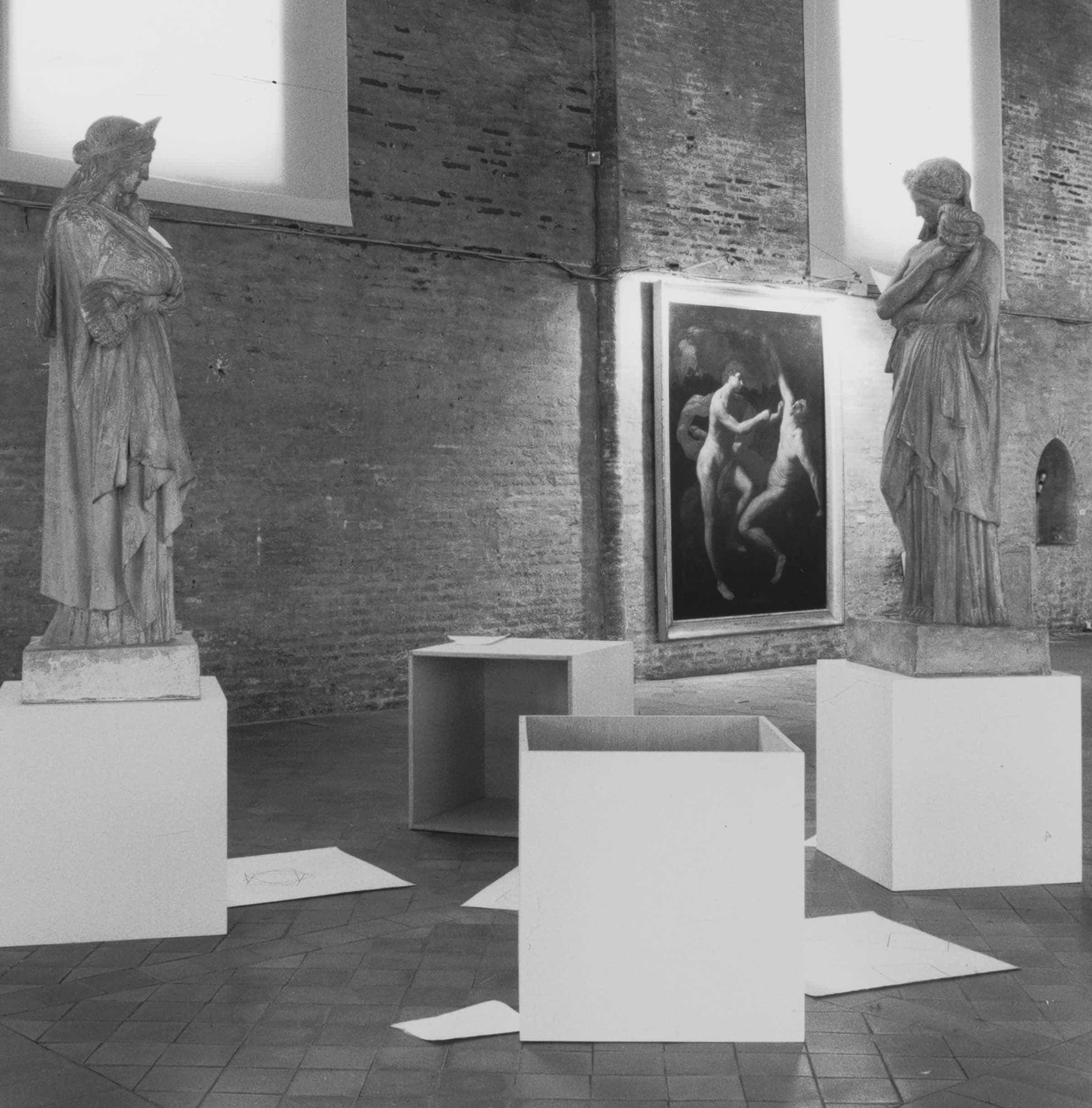
Quattro per due, 1995
GPO-0746
Four for two
Plaster casts, pencil on paper, white plinths
Dismantled work
The work is made up of four white-painted cubes open on one side, and four square sheets of drawing paper of the same size as the side of the cubes. Two cubes are upside down and placed opposite each other, serving as a base for the two sculptures (pre-existing in the display space for which the work was made1), a third cube is turned so that the opening is at the top, and the fourth one is lying on its side. Three of the sheets scattered on the ground between the cubes bear the drawing of four square units organized in various ways (in random order, wedged one inside the other, etc.), while the fourth sheet is torn into fragments, arranged in part on the ground, in part on the sculptures and cubes.
Four bases for two sculptures: Quattro per due stages the countless ways of organizing a unit in space, that is, by arranging different parts of a whole so that they form a unit.
1 The two nineteenth-century sculptures chosen by Paolini among the works in the collection of the Musée des Augustins in Toulouse are the plaster casts of two bronzes by Francisque Michel Duret, Allégorie de la Tragédie and Allégorie de la Comédie. The involvement of the works held in the various spaces of the exhibition was an integral part of the exhibition project, devoted to the theme of memory, and to the comparison between past artists and contemporary ones.
| 1995 | Tolosa, Réfectoire des Jacobins, Corps de la mémoire, 27 March - 3 June, vol. 1: cited in the checklist of exhibited works p. 40, vol. 6-7: repr. p. 12 (exhibition view). |
| • | M. Disch, Giulio Paolini. Catalogo ragionato 1960-1999, vol. 2 (Milan: Skira editore, 2008), cat. no. 746 p. 759, repr. |

