Opera omnia, 1996-97
GPO-0796
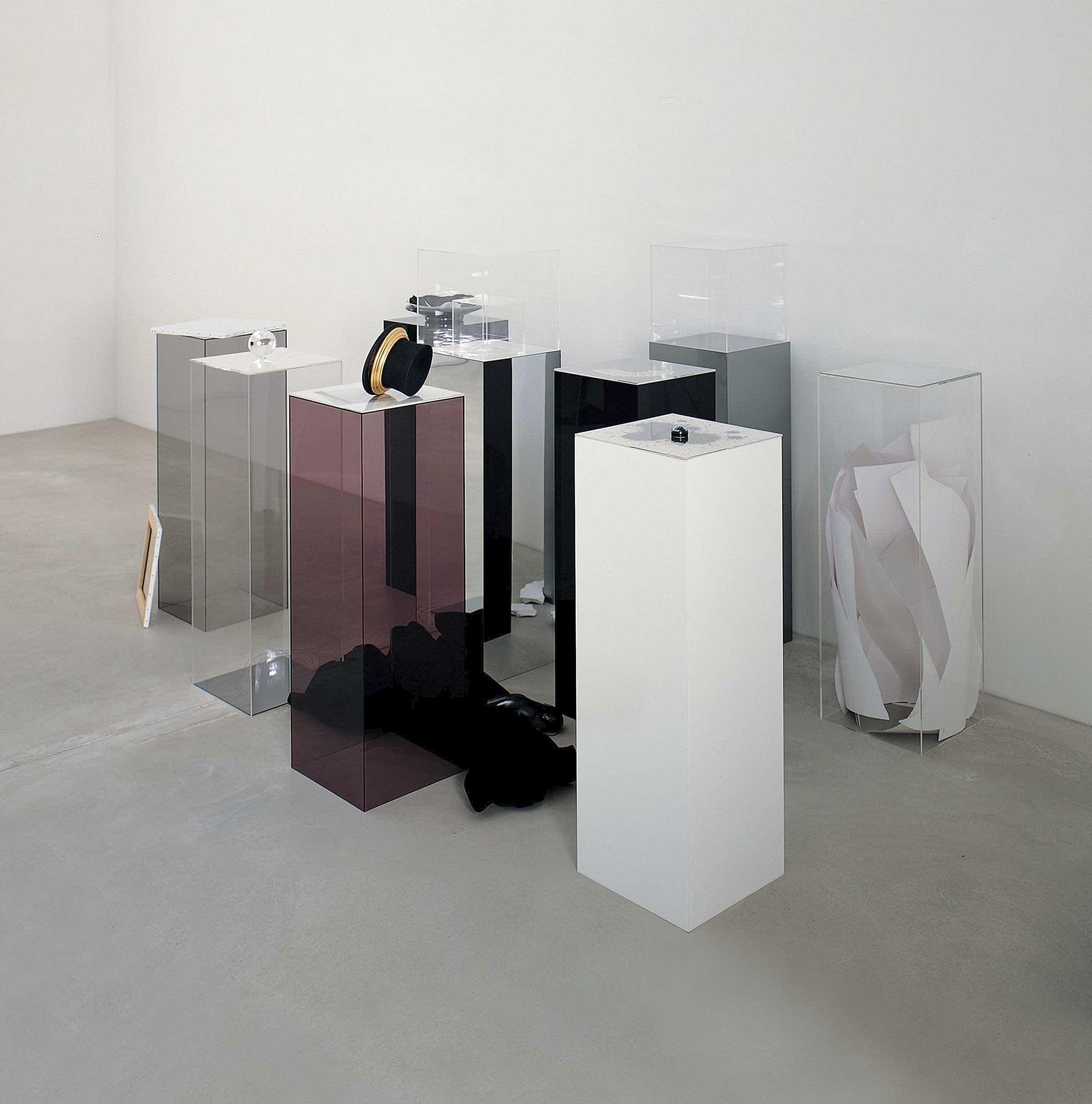
Plexiglas plinths of different colours, transparent plexiglas sheets and cases, primed canvases, various objects
Nine plinths 120 x 40 x 40 cm each, overall dimensions 160 x 335 x 210 cm
The Rose Collection and The Rachofsky Collection
The nine plinths must be arranged in a rectangular area inside the proportional parameter of 40 x 60 cm (for instance, 160 x 240 or 320 x 480 cm). How close together they are is not pre-established, but the spaces between them must in any case be equidistant, as must the alternation between dark and light.
• 1997, Milan, Galleria Christian Stein: the work originated with seven plinths (cf. the first seven elements in the description of the work in this entry).
• 1998, Graz, Neue Galerie: the artist added an eighth reflecting plinth topped by a transparent case that in turn contains an empty transparent cube.
• 2005, Winterthur, Kunstmuseum: the artist added to the eight previous episodes a transparent plinth with the torn sheets of drawing paper.
Nine plexiglas plinths ranging in colour from white to black and distinguished by different degrees of transparency and reflection are arranged in a rectangular area determined by the proportions of Paolini’s first painting, Disegno geometrico, 1960 (GPO-0001). Each plinth contains – either placed on top or at the foot – one or more elements characteristic of the artist's formal and conceptual repertoire.
• opaque white plinth: a black stamp collector’s magnifying lens is placed on a photographic reproduction of Francis Picabia’s Sainte Vierge II, held down by a plexiglas sheet;
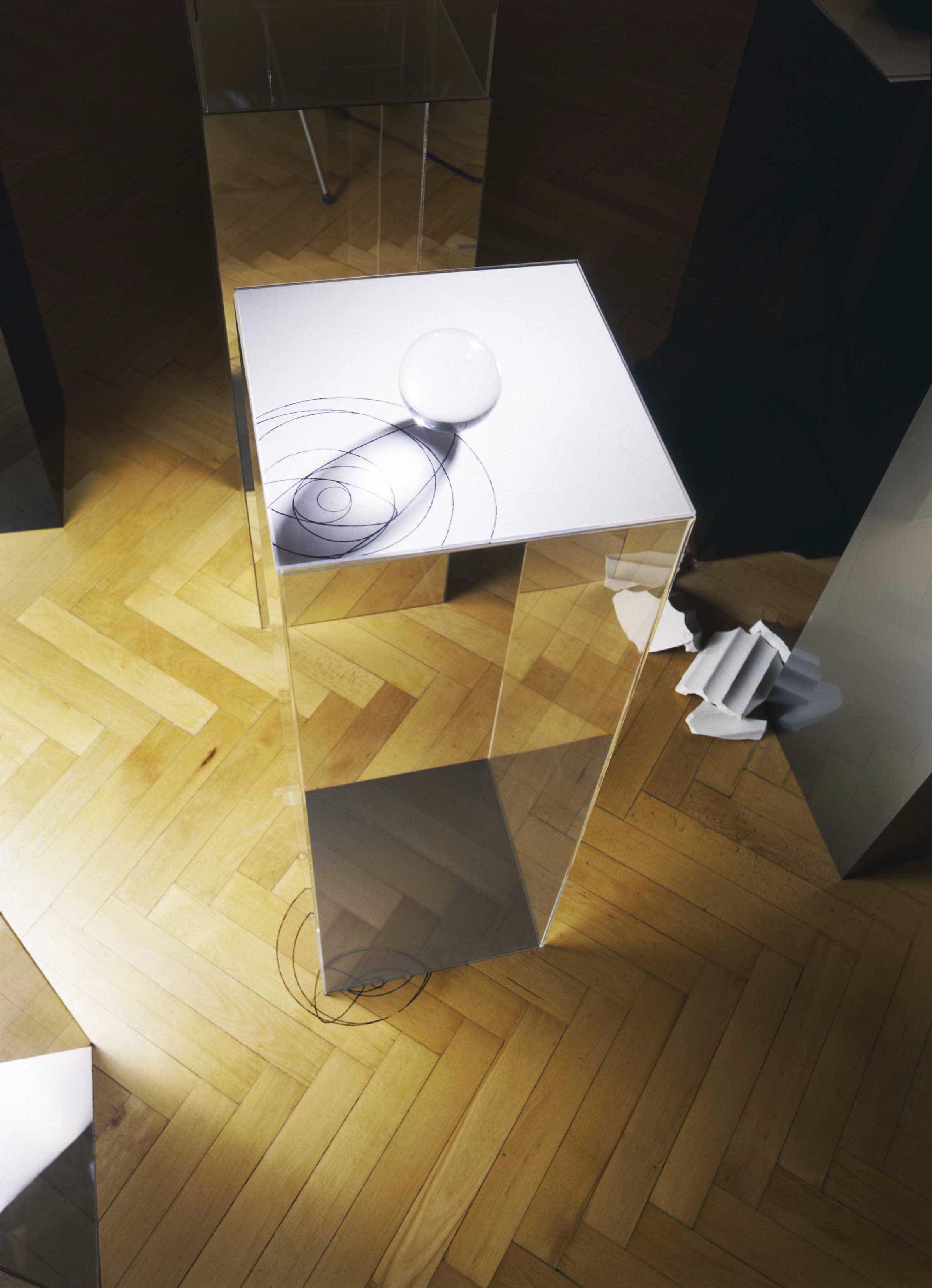
• transparent plinth with a grey bottom: a crystal sphere is placed so that it is at the centre of a drawing of planetary orbits held down by a plexiglas sheet; cut off by the edge of the plinth’s top surface the drawing is extended, in the missing part, to the floor onto a circle of transparent acetate;
• light grey plinth: a white canvas, placed so that it is askew on the plinth, bears a pencil sketch that traces the square shape of the support surface; a second canvas is turned so that we see it from the verso, and set on the floor against the bottom of the plinth;
• reflecting grey plinth: on top of the plinth is an empty case, while scattered about on the floor are the fragments of the plaster cast of an ancient column;
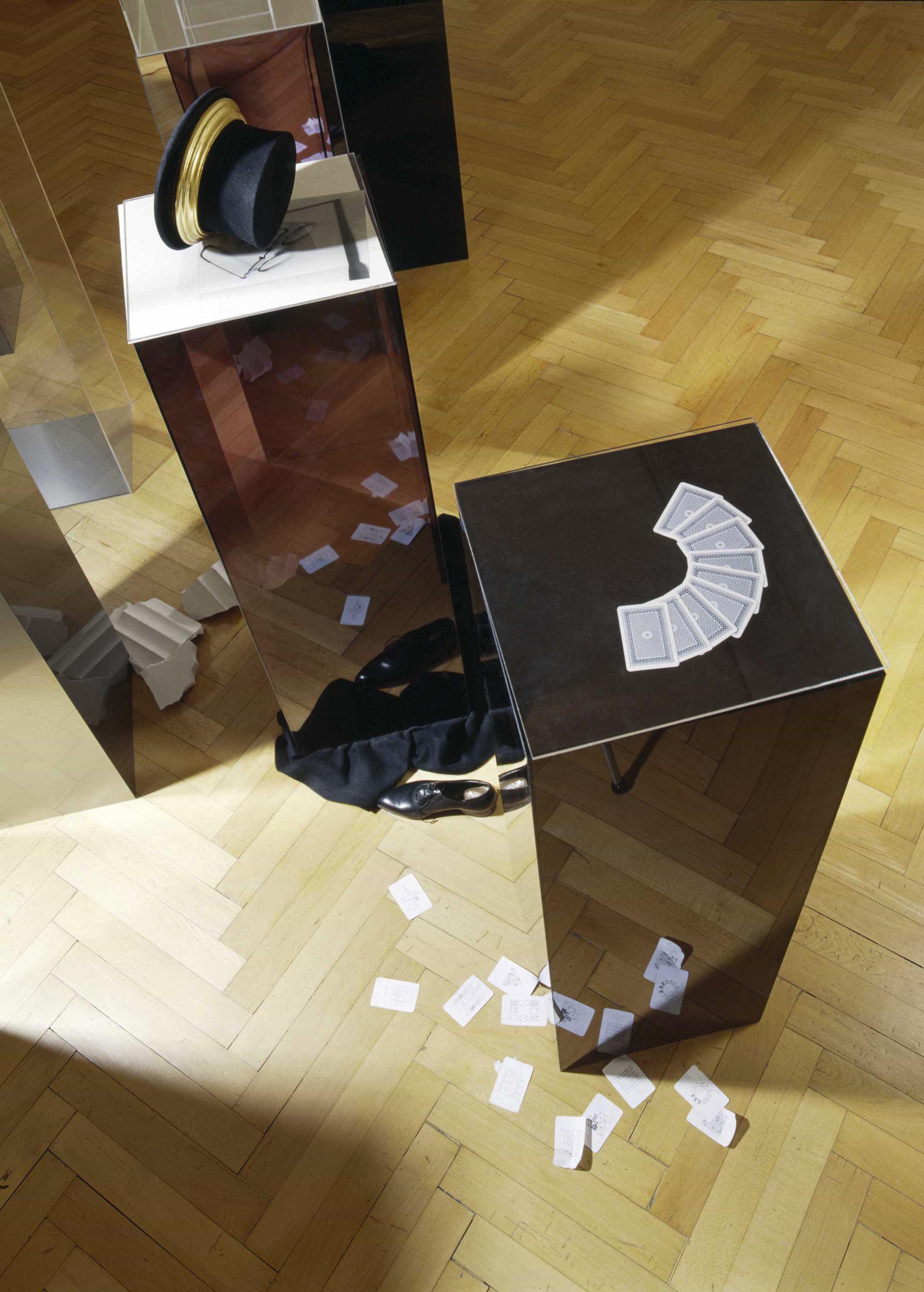
• smoky plinth: on top of the plinth a top hat, with a golden oval frame instead of the ribbon, stands out on the photograph of a pair of glasses set upon an open book (the image is held down by a plexiglas sheet); arranged on the ground is a men's cloak;
• anthracite grey base: a deck of reversed playing cards is arranged fan-like on top of the plinth, held down by a plexiglas sheet; other cards reproducing the game of solitaire are strewn about on the floor;
• transparent black plinth: the torn fragment of a photographic reproduction of the phases of Venus is placed inside a roulette;
• reflecting plinth: a plexiglas case encloses a smaller transparent empty cube;
• transparent plinth: contained inside the plinth are torn sheets of drawing paper; on top of the plinth is a reflecting plexiglas sheet.
In the author's intentions, the title refers to an "all-encompassing" register of objects and materials that are constantly being called into play as if they were the game pieces on a chequerboard. Similarly, the plinths from white to black represent a complete range of colours. The explicit game references – the magician's top hat, the playing cards, the roulette – allude to the artist's “game table”, where each configuration is susceptible to transformations. Broadly speaking, the ”opera omnia” constitutes a sort of hortus conclusus, brought to life by figures, materials, and objects meant to trigger precarious appearances and disappearances, images and visions, potential works.
Francis Picabia, La Sainte Vierge II, 1920, Indian ink on paper, Bibliothèque Doucet, Paris.
| 1997 | Milan, Galleria Christian Stein, Giulio Paolini, from 27 October. |
| 1998 | Graz, Neue Galerie im Landesmuseum Joanneum, Giulio Paolini. Von heute bis gestern / Da oggi a ieri, 4 April - 31 May, cited in the checklist of exhibited works no. 7 p. 180, not repr. |
| 1999 | Turin, GAM Galleria Civica d’Arte Moderna e Contemporanea, Giulio Paolini. Da oggi a ieri, 8 May - 25 July, cited in the checklist of exhibited works no. 5 p. 37, col. repr. pp. 90-91 (exhibition views Graz 1998, reproduction on p. 91 upside down). |
| 2005 | Winterthur, Kunstmuseum Winterthur, Giulio Paolini. Esposizione universale, 23 April - 24 June, cited in the checklist of exhibited works no. 17 p. 87, col. repr. n. pag. (exhibition view), referred to in the text by D. Schwarz p. 23. |
| 2024 | Dallas, The Warehouse, For What It’s Worth: Value Systems in Art since 1960, 2 February - 29 June, cited in the checklist of exhibited works p. 308, col. repr. p. 61 (with incorrect date “1996-2005”), referred to in the conversation between T. Feulmer and L. Le Feuvre p. 25 and in the [anonymous] introduction p. 55. |
| • | D. Paparoni, “Giulio Paolini”, in Tema Celeste, no. 62 (Syracuse), May-June 1997, col. repr. p. 74 (exhibition view Milan 1997). |
| • | G. Paolini, Andata e ritorno (Milan-Ravenna: Galleria Christian Stein and Danilo Montanari Editore, 2003), col. repr. pp. 37, 39 (exhibition views Milan 1997). |
| • | M. Disch, Giulio Paolini. Catalogo ragionato 1960-1999, vol. 2 (Milan: Skira editore, 2008), cat. no. 796 pp. 814-815, repr. and col. repr. (exhibition view Graz 1998 and exhibition view Winterthur 2005, details). |
| • | G. Celant, Arte Povera. Storia e storie (Milan: Mondadori Electa, 2011), col. repr. p. 222 (exhibition view Winterthur 2005). |
| • | Paolini. I Grandi illustrati del Corriere della Sera. Arte contemporanea – I protagonisti 8, edited by F. Gualdoni (Milan: RCS MediaGroup S.p.a., 2022), p. 72, col. repr. p. 73 (exhibition view Winterthur 2005). |

