Teogonia, 1982-24
GPO-1172
Theogony
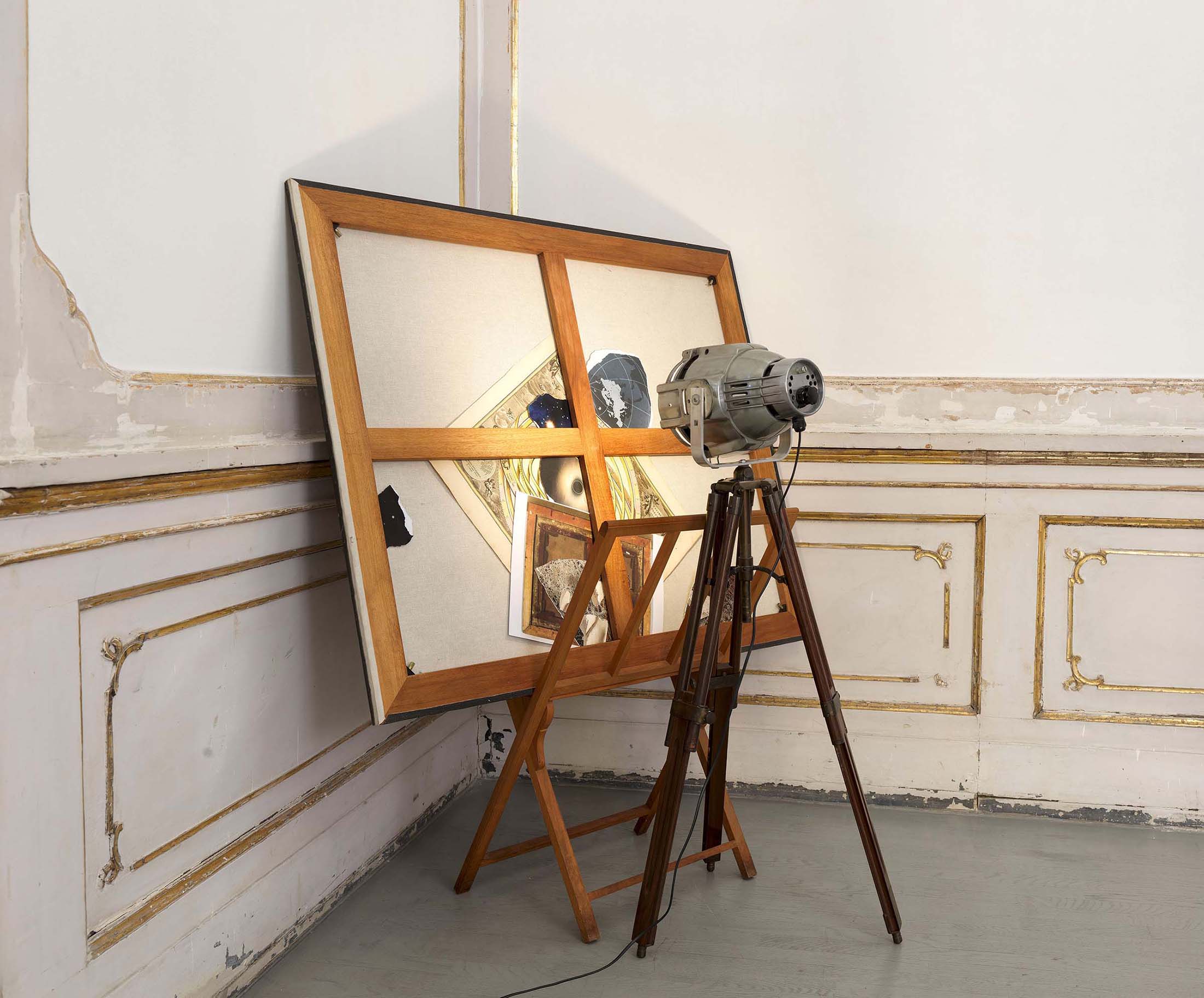
Collage on reversed canvas, print rack, floodlight
Canvas 100 x 125 cm, overall dimensions 144 x 125 x 84 cm
Collection of the artist
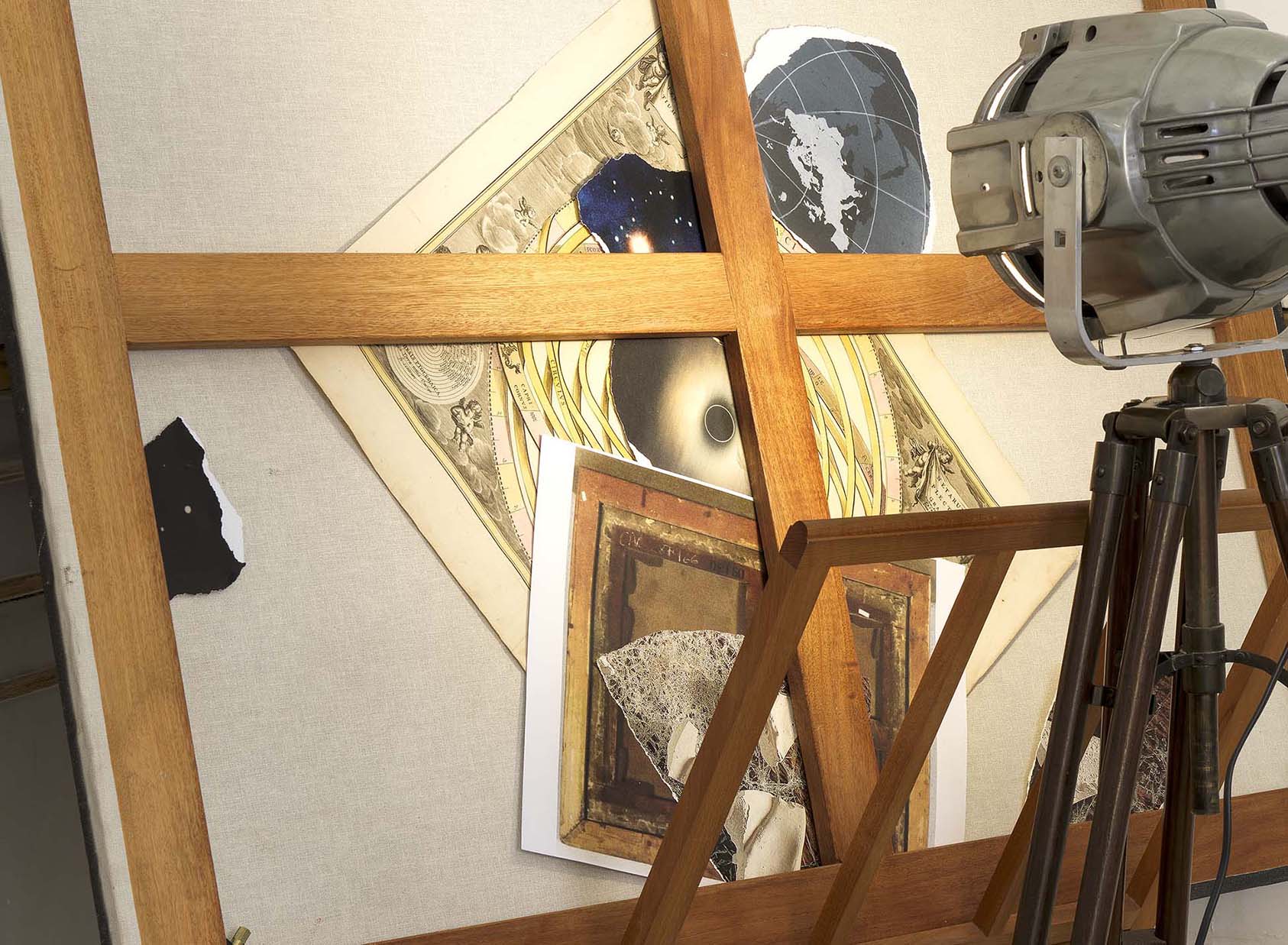
A print rack serves as a support for a reversed canvas which holds, at the cross brace of the stretcher, a few fragments of images with a cosmic subject,1 illuminated by the spotlight placed close to the print rack.
The title – “theogony” designates the narration of the birth of the gods – alludes symbolically to the mystery of a work yet to come, which the spotlight seems to want to closely explore. A primordial core, almost a sort of Big Bang, that invites us to imagine what the front of the canvas – the face of the painting – could be, still unknown and kept out of our view. Through the emblematic reference to theogony and the supernatural dimension of the universe, the becoming of a work is understood as something unfathomable, which transcends the limits of perception and representation.
1 The main image, an eighteenth-century engraving reproducing Andreas Cellarius' model of planetary orbits, contains three torn details of celestial subjects and one of the globe. Further down are a reproduction of the verso of a painting, echoing the reversed canvas, and two photographic fragments of plaster shards against the backdrop of a shattered sheet of glass (taken from the poster of the solo exhibition at Studio Marconi, Milan, 1984, linked to the iconography of the cycle of works entitled Cythère).
Andreas Cellarius, Harmonia Macrocosmica seu atlas universalis et novus, totius universi creati cosmographiam, et novam exhibens, engraving, Johannes Janssonius, Amsterdam 1661, plate 3.
| 2024 | Naples, Alfonso Artiaco, Giulio Paolini. Dall’Italia, 2 March - 20 April. |
| • | G. Paolini, Eccomi. Qui dove sono (Turin: Fondazione Giulio e Anna Paolini, 2025), col. repr. p. 103 (detail). |
| • | A. Fiz, “Arte fiera”, in Arte 630 (Milan), February, 2026, col. repr. p. 64. |

