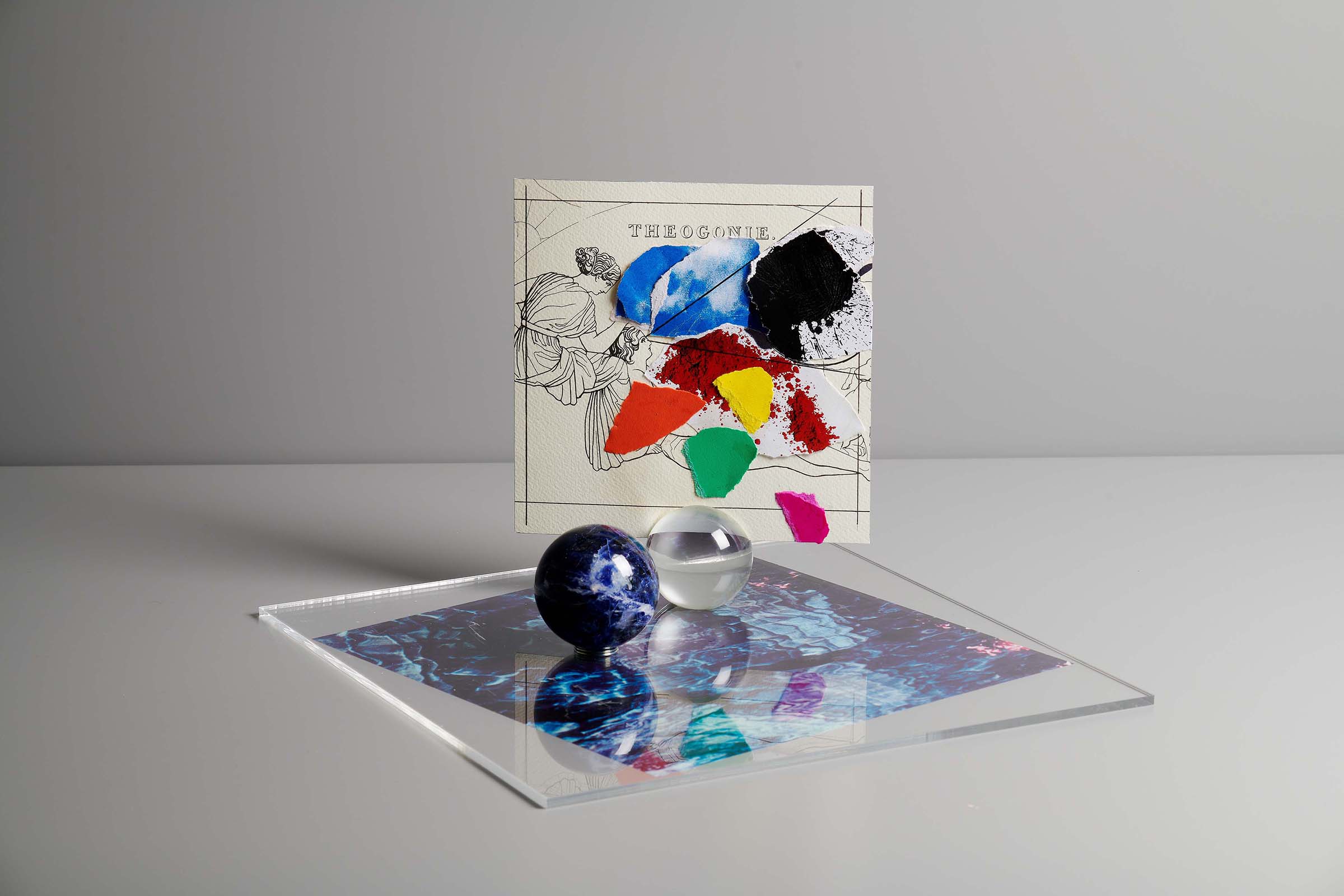
Théogonie, 2025
GPO-1185
Black ink and collage on xerox reproduction, Murano glass sphere, sodalite sphere, silkscreen printer's proof, plexiglas sheet
Collage 20 x 20 cm, glass sphere Ø 6 cm, sodalite sphere Ø 7 cm, plexiglas sheet 35 x 35 cm, overall dimensions 24 x 35 x 35 cm
Titled, signed, and dated on the verso of the collage, centre: " "Thégonie" / Giulio Paolini / (2025)"
Collection of the artist
Two spheres, one made of Murano glass the other sodalite, are set down on a plexiglas sheet that holds down a photographic image, arranged so that it is askew, of a body of water vibrating with reflections. The iridescent blue sphere echoes the iridescent surface of the water, while the slit in the glass sphere holds a collage that reproduces an etching by William Blake representing a scene inspired by Hesiod’s Theogony. Applied to the nineteenth-century drawing are several torn fragments that reproduce, from top to bottom, a patch of blue sky, the detail of a black ink stain, red pigment, and some fragments of coloured paper. Proceeding from the male figure’s gaze is a drawing that designs its visual angle.
The title, impressed in Blake’s plate, refers to the story of the birth of the gods, which for Paolini becomes metaphorically an allusion to the unfathomable mystery of the realization of a work of art. The colour fragments and the ink stain are in fact the first clues, albeit still shapeless, of an unknown work; similarly, the indistinct image of the body of water suggests a primordial context, preceding any formal definition. The two spheres and the patch of sky instead represent an ideal dimension, that is, the ineffable All that the protagonist waits to see on his own horizon line.
• Printed image in the collage: John Flaxman, Compositions from the Works and Days and Theogony of Hesiod, engraved by William Blake (London: Longman, Hurst, Rees, Orme and Brown, 1817).
• Image of the body of water: Cleopatra Pool, Hierapolis-Pamukkale; reproduction from Roloff Beny Interprets in Photographs Pleasure of Ruins by Rose Macaulay (New York: Holt, Rinehart and Winston, 1977), p. 9, “Columns under water at Hierapolis, Turkey”.
• Black ink blotch: Francis Picabia, La Sainte Vierge II, 1920, Indian ink on paper, Bibliothèque Doucet, Paris.
| • | G. Paolini, Eccomi. Qui dove sono (Turin: Fondazione Giulio e Anna Paolini, 2025), col. repr. p. 102. |

