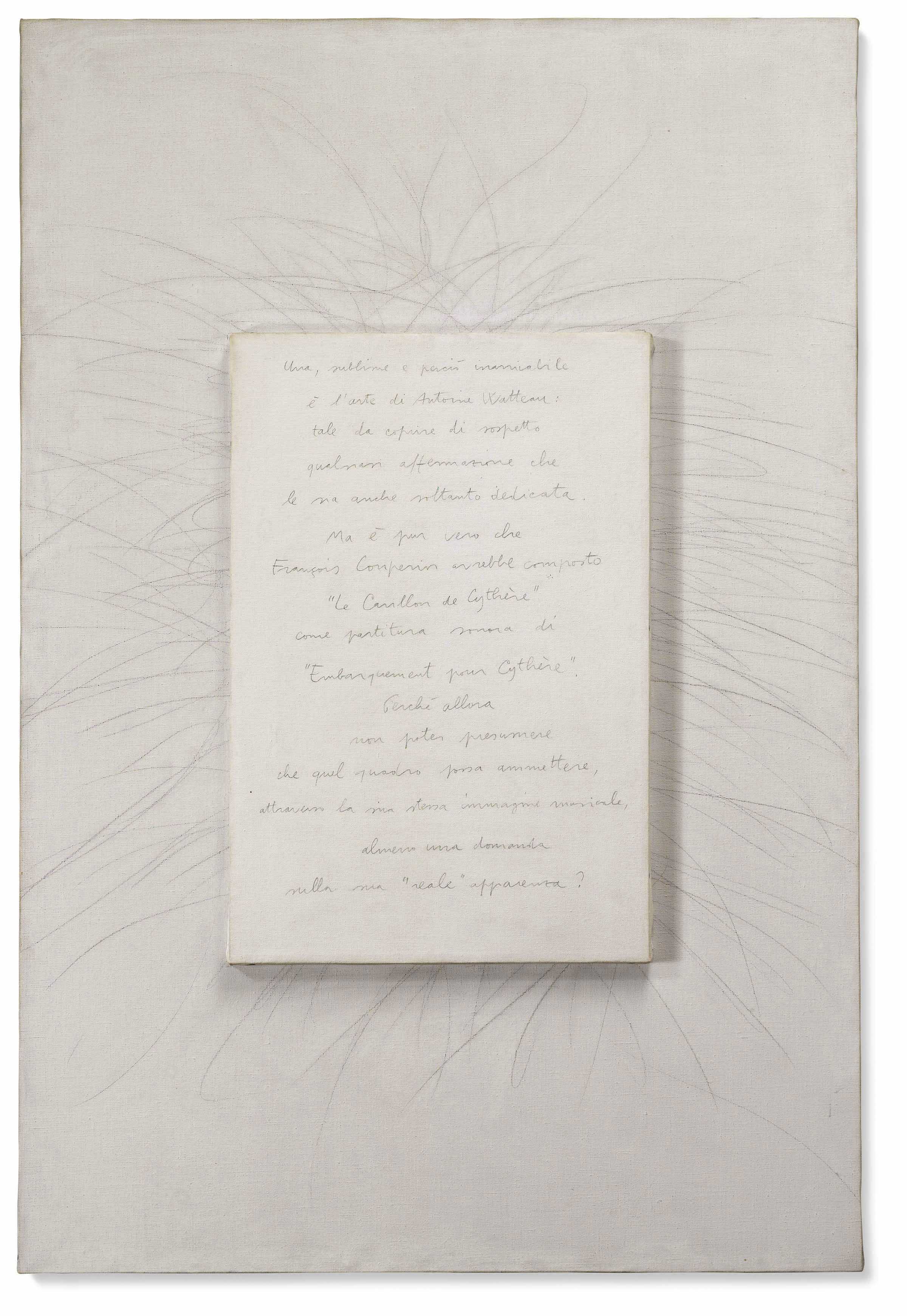
Una visione, 1973
GPO-0254
A Vision
Pencil on primed canvases mounted one on top of the other
120 x 80 cm
Signed, titled, and dated on the verso, upper stretcher bar, left: “Giulio Paolini / Una visione 1973”
Private collection
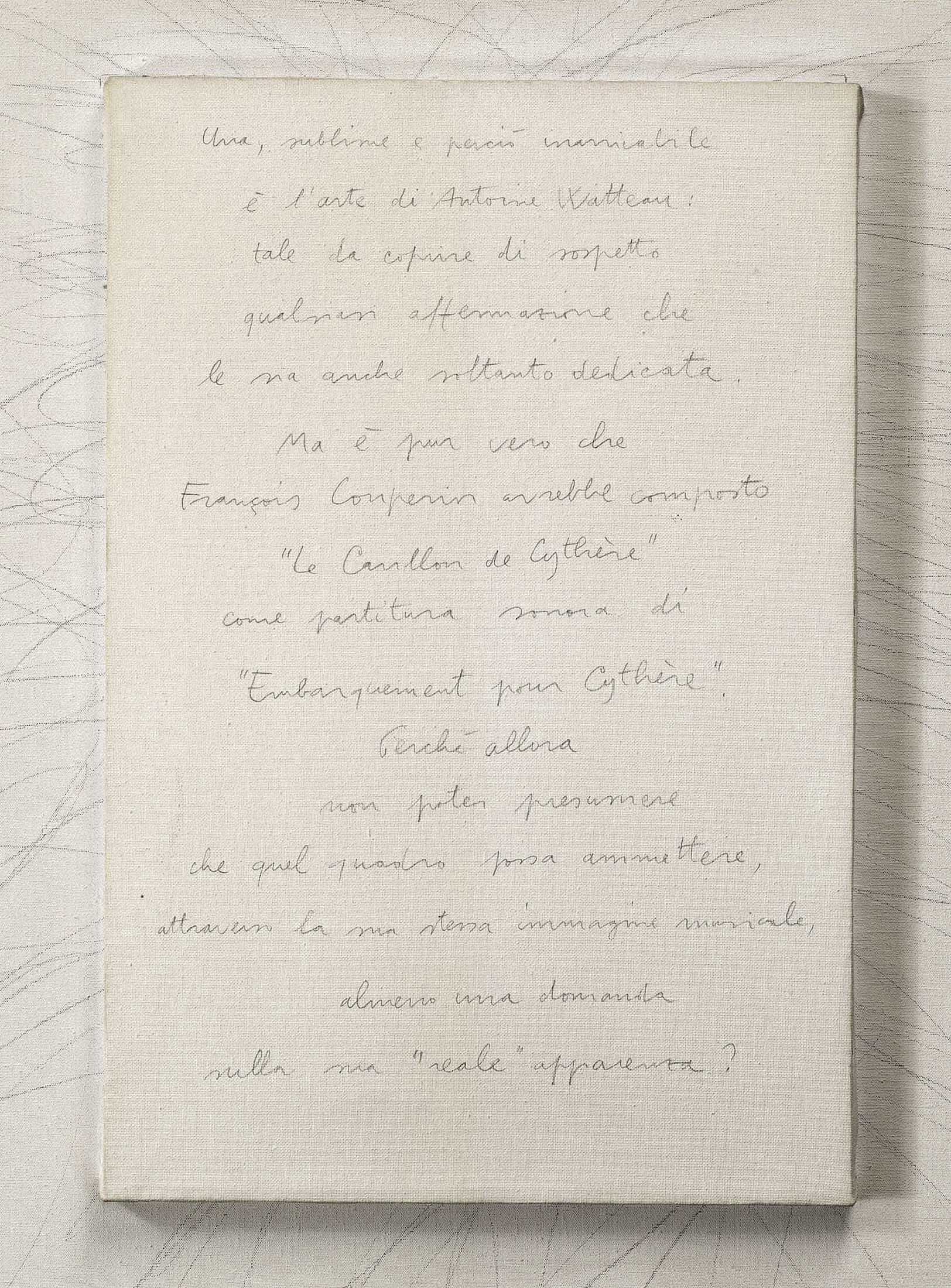
A primed canvas bearing a text written in pencil by the artist is mounted at the centre of a larger canvas, so that the presumed drawing, of which all we can see are the marks around it made free-hand, remains hidden. The words, which call into question the existence of an image, are as follows: “Unique, sublime and therefore unattainable is the art of Antoine Watteau: enough to cover with suspicion any affirmation that is even just dedicated to it. However, it is also true that François Couperin composed Le Carillon de Cythère as a musical score for Embarquement pour Cythère. Why then not presume that that painting can admit, through its own musical image, at least one question on its 'real' appearance?".
The same theme was formulated in a more complex variant as well, made during the same year (GPO-0256).
• Jean-Antoine Watteau, Embarquement pour Cythère, 1718, oil on canvas, 129 x 194 cm, Schloss Charlottenburg, Berlin.
• Jean François Couperin, Le Carillon de Cythère, 1722, piece for harpsichord.
| • | G. Paolini, Idem (Turin: Giulio Einaudi editore, 1975), repr. p. 81; new edition (Milan: Electa, 2023), repr. p. 107. |
| • | M. Disch, Giulio Paolini. Catalogo ragionato 1960-1999, vol. 1 (Milan: Skira editore, 2008), cat. no. 254 p. 266, repr. |
| • | E. Volpato, “L’Ile enchantée. La visione è cieca”, in E. Franz et al., Giulio Paolini. Vedo e non vedo. In tema 1 (Turin-Mantua: Fondazione Giulio e Anna Paolini and Corraini Edizioni, 2014), pp. 60, 72, repr. p. 67. |
| • | B. Cinelli, “Il grande gioco dell’arte, in Teatro di Mnemosine. Giulio Paolini d’après Watteau”, exhibition catalogue, Lugano, Spazio -1 Collezione Giancarlo e Danna Olgiati (Bellinzona: Edizioni Casagrande, 2015), pp. 69, 73, repr. p. 71. |

