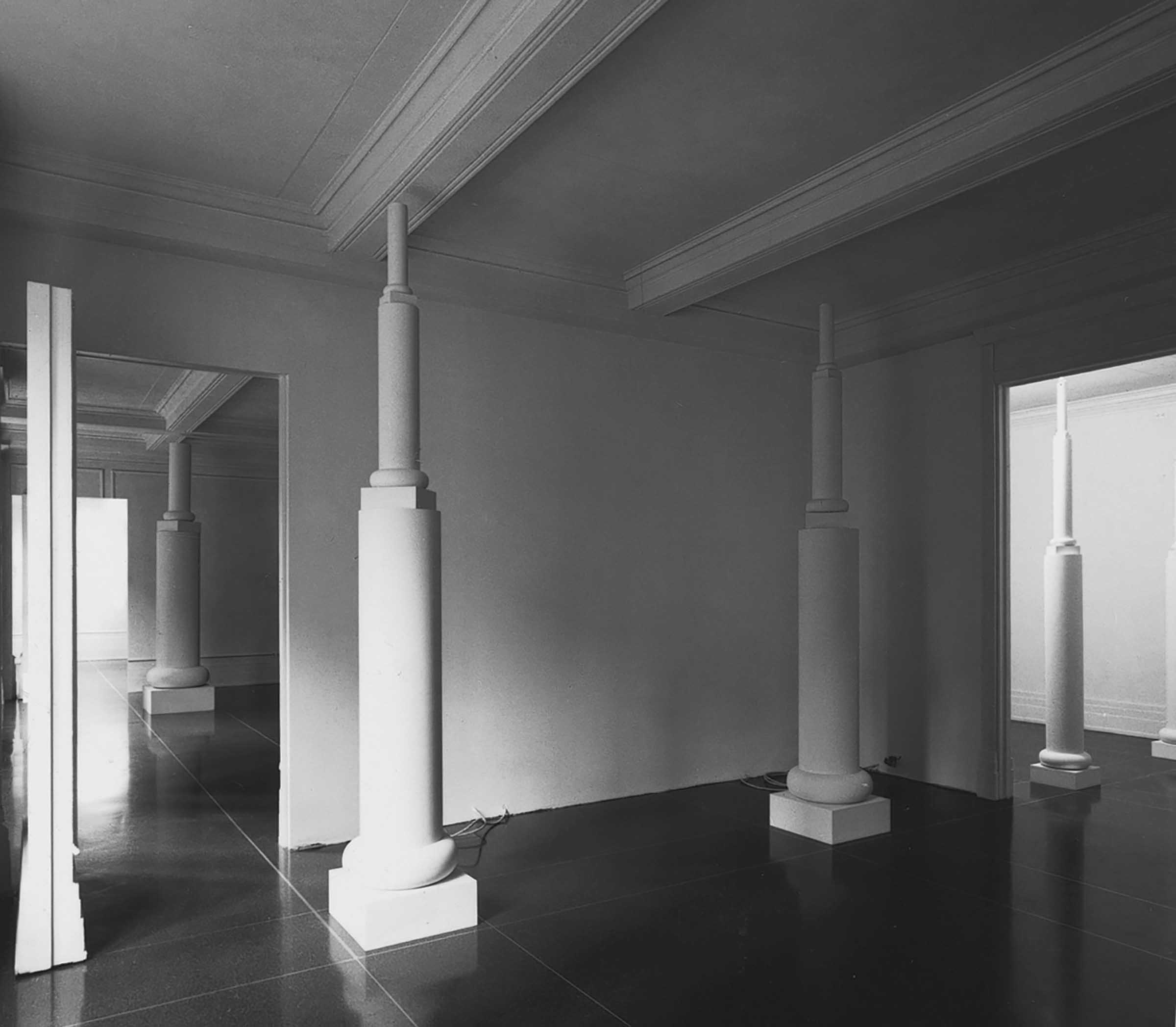
Early Dynastic (IV), 1978
GPO-0399
Enamelled wood, printed PVC digital floor, videoprojection
Seven parts h 292 cm each and each with a different number of columns placed one on top of the other, floor 650 x 362 cm, videoprojection on wall 465.6 x 650 cm, overall dimensions site-specific
Walker Art Center, Minneapolis, Gift of Nicola and Beatrice Bulgari, 2018
Gift of Nicola and Beatrice Bulgari, 2018, inventory no. 2018.19.1-.9
The projection requires that the installation be made in a semi-dark environment. The arrangement of the columns was pre-established by the artist. The width of the projection corresponds to that of the PVC floor surface.
The fourth version of Early Dynastic – a cycle of five works begun in 1971 (cf. GPO-0228, GPO-0257, GPO-0324 [reproduced in travertine, GPO-0354], GPO-0713) – dates back to a commission for a work in situ in the New York apartment of Nicola Bulgari, remodeled by the architect Piero Sartogo in 1978. After a series of events, on the occasion of the donation of the work to the Walker Art Center in Minneapolis in 2018, the artist decided to reformulate the work in its entirety for the new context.
Originally, the work developed across four adjacent rooms and was strictly correlated with a floor design in stainless steel sections, based on an increase in orthogonal modules. In analogy with the mesh of the geometric pattern, the seven elements gradually grew in diameter, while in compliance with the basic criterion for the Early Dynastic cycle, they varied with regards to the number of overlapping components that were gradually halved in size. The first room hosted the four thinnest elements, consisting of four overlapping columns; made up of three columns; the third of one element made up of two columns; while the last one was characterized by a drawing on the floor that was limited to indicating the position of the hypothetical fourth element, made up of just one oversized column.
In the new version the seven columns are arranged on a PVC floor surface that is characterized by an orthogonal pattern of 9 x 5 units. On the rear wall is a projection in a loop of a series of images (in positive or in negative) of the original installation of the work. This new version joins past, present, and future seamlessly. The archival images fading in and out bear witness to the original configuration, just as the pattern on the floor recalls the original floor design, changed, however, into the register of a uniform chequerboard. The columns scattered about in the manner of an archaeological site have thus become pieces in a game arranged on square modules, according to a potentially limitless design. Among the clues of an irreversible past and the unpredictable variables of the future, the game is open: the columns that preserve the memory of their original context became the tiles in a constantly evolving mosaic.
| 2001-02 | Rome, Studio d’Arte Contemporanea Pino Casagrande, Giulio Paolini. Early Dynastic, 6 December 2001 - 20 February 2002, repr. pp. 10-13, 22-26 (views of the original installation), commentary by A. Bonito Oliva pp. 10-12, general entry to the cycle of works titled Early Dynastic and catalogue entry by M. Disch pp. 15, 21, note on the architectural design of the original environment by P. Sartogo p. 22. |
| 2014 | Rome, MAXXI Museo nazionale delle arti del XXI secolo, TRA/BETWEEN. Arte e architettura. Piero Sartogo e gli artisti, 16 April - 3 September, pp. 214-229 (statements by P. Sartogo and A. Bonito Oliva, col. repr. of the work exhitibed and of the original installation in New York). |
| • | P. Goldenberg, “Spatial Imagery. The Redesign of a Traditional Park Avenue Apartment”, in Architectural Digest 4 (New York), April, 1979, pp. 64-69, repr. |
| • | M. Filler, “Park Avenue palazzo”, in Progressive Architecture 5 (Stamford), May, 1979, pp. 114-116, col. repr. and on cover. |
| • | “Il sublime e l’insignificante. Il mito dei due amanti o l’idea del sublime di Giulio Paolini”, in Gran Bazaar 4 (Milan), September-October, 1979, p. 156, repr. |
| • | G. Odoni, “La metafora di un colonnato”, in Casa Vogue 125 (Milan), December, 1981, pp. 202-205, col. repr. |
| • | Giulio Paolini, vol. Images/Index (Villeurbanne: Le Nouveau Musée, 1984), repr. p. 115 (erroneously titled “Early Dynastic (III)” and erroneously dated “1979”). |
| • | Piero Sartogo / Nathalie Grenon. Architecture in Perspective, edited by R.L. Wentworth (New York: The Monacelli Press, 1998), pp. 138-141, repr. |
| • | A. Vettese, “L’enigma e il teorema”, in Vernissage 3, no. 24 (Turin), February, 2002, supplement to the periodical Il Giornale dell’arte, p. 22, col. repr. (with incorrect caption). |
| • | M. Disch, Giulio Paolini. Catalogo ragionato 1960-1999, vol. 1 (Milan: Skira editore, 2008), cat. no. 399 pp. 404-405, repr. |
| • | Claudio Abate. Un progetto di Germano Celant (Cinisello Balsamo: Silvana Editoriale, 2023), p. 381 (referred to in the text by I. Bernardi), not repr. |

