Esposizione universale, 1992
GPO-0705
Universal Exposition
Plexiglas cubes and sheets, reflecting plexiglas sheet, steel profiles, spotlights, various objects
405 x 135 x 135 cm
Dismantled work
• 1992, Paris, Grand Palais: the empty structure, without any objects in it, was exhibited on a wooden platform painted dark grey outside the Grand Palais opposite the main entrance.
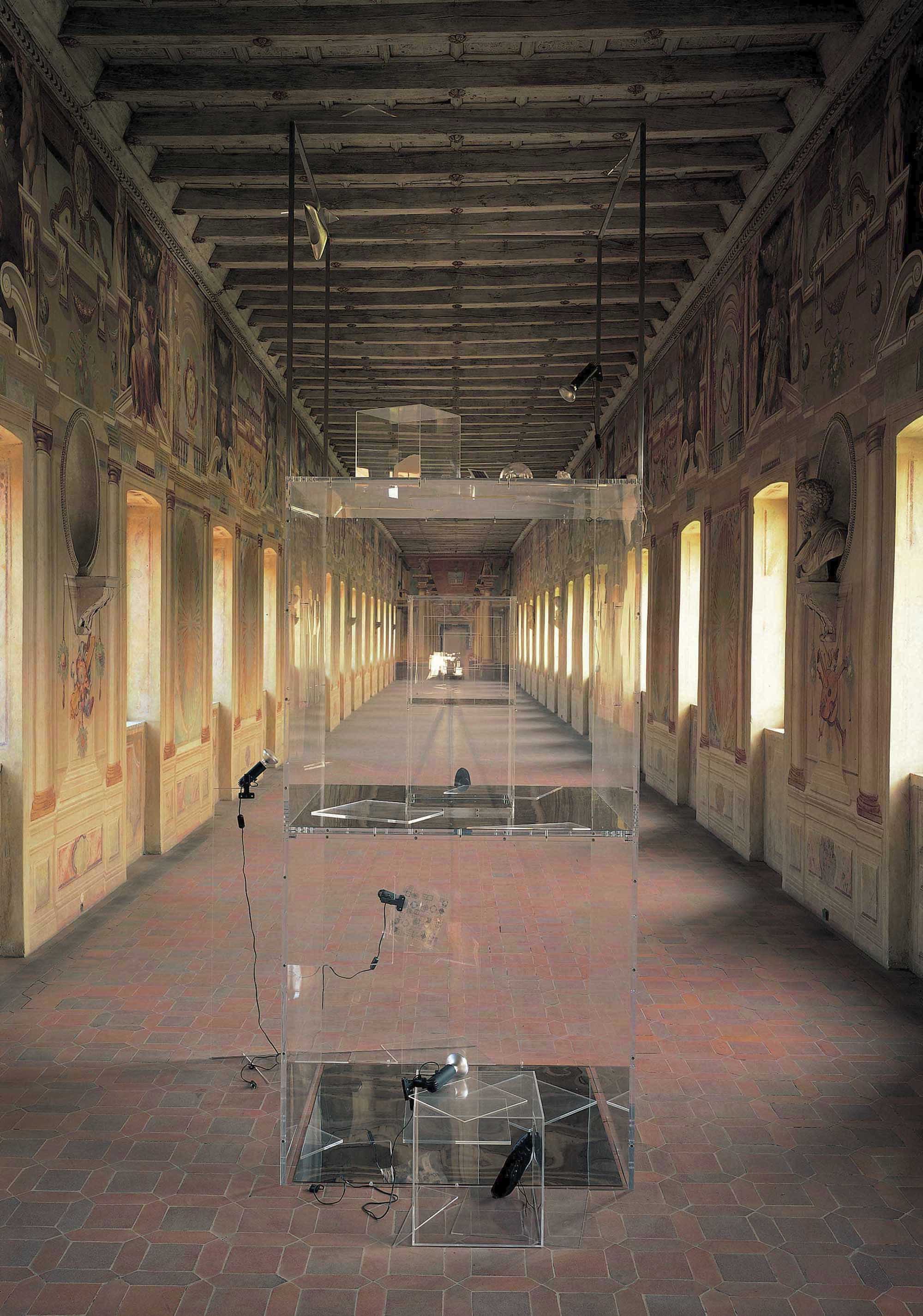
• 1997, Sabbioneta, Galleria degli Antichi: on top of the middle cube the artist placed numerous objects distinguished by their transparency: an eye-piece, a small plexiglas display case with a photographic negative, a CD-ROM, a compass, a brass display stand with a crumpled sheet of letter paper, two plexiglas prisms with total reflection, a compass, an hourglass with white sand, a goblet lying on its side with a colourless fragment of Murano glass, a small plexiglas case containing a crystal ball with a slit in it, in which a torn fragment of drawing paper was inserted; several shaped plexiglas sheets, as if they were broken, were arranged on the middle support surface. Between the base and the top of the structure the artist arranged four clip-on spotlights turned towards the inside of the two cubes: one spotlight was placed at the top, on the steel profile; another one was clamped to a plexiglas sheet (135 x 135 cm) up against a lower cube and bearing a square cut out at the centre; a third spotlight was applied to this empty square and held down several transparent films with drawings of squares in various combinations, while the fourth spotlight was propped up against a plexiglas cube. On the top of the structure were also four unmatched men's and women's shoes of different types and from different eras: two of them are held down in an upper corner of the steel structure, while the other two are just above the plexiglas structure.
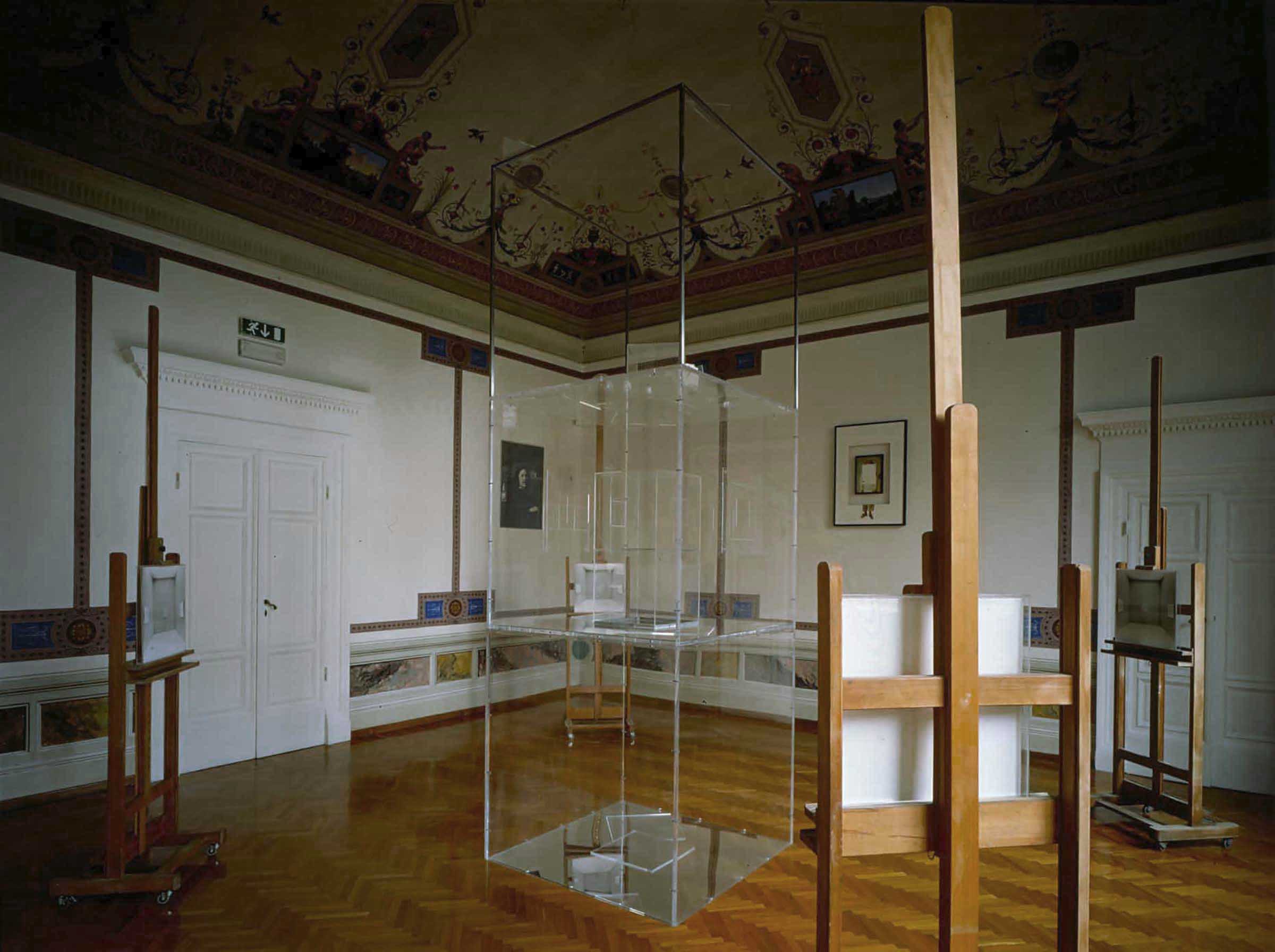
• 1998, Siena, Palazzo delle Papesse: the work featured only some accessory elements borrowed from the installation in Sabbioneta, and was the centre of an exhibition installation that combined various works.
Esposizione universale is made up of two plexiglas cubes placed one on top of the other, topped by the steel profile of a third, identical cube. Inside the central cube two smaller cubes duplicate the outer ones. At the viewer's eye level four small sheets screwed to the centre of the four sides of the middle cube feature a carved drawing with a square in the middle;1 this corresponds exactly to the four small squares at the centre of the four sides of the interior cube at the top. Scattered across the reflecting bottom of the cube set down on the ground are a plexiglas fragment and two whole sheets – the one in the middle corresponds to the carved square at the centre of the upper face of the middle cube – while two other plexiglas fragments are placed at the top on the steel profile.
The combination of a "sculpture" displayed in a case, on a base, and hypothetical "paintings" exhibited at the viewer's eye level, Esposizione universale offers, thanks to a kaleidoscopic game of transparencies, reflections, and doubles, the very idea of the exhibition as a place for the manifestation of possible visions. In this sense, it is a work of great importance as concerns the artist's 1991-93 output, which focused on a particular insistence on this theme (cf. in particular Contemplator enim, 1991, GPO-0681, and Teatro dell’opera, 1992-93, GPO-0709).
Esposizione universale was first shown at FIAC 92, the annual international contemporary art fair in Paris, which in 1992 chose Italy as its guest country. Invited by the Italian galleries to produce a new work, Paolini conceived Esposizione universale with reference to the fair as an "exhibition of exhibitions".2 In Paris the work was presented outside the Grand Palais – the fair headquarters – opposite the main entrance, on a wooden platform painted grey. Later, on the occasion of the exhibitions in Sabbioneta and Siena, Paolini installed the work inside instead, enriching it to varying degrees with complementary elements. In 1997 in Sabbioneta the artist placed numerous objects distinguished by their transparency on top of the middle cube, and between the base and the top of the structure he arranged four clip-on spotlights turned towards the inside of the two cubes, as well as four unmatched men's and women's shoes of different types and from different eras. In 1998 in Siena the work featured some accessory elements borrowed from the installation in Sabbioneta, and was the centre of an exhibition installation that combined various works.
1 The four different drawings respectively illustrate four squares placed close together to form a square made up of 3 x 3 units, several squares arranged concentrically, a room seen in perspective, and the pattern of a case on a base at the centre of a display space; cf. in Giulio Paolini. Esposizione universale, exhibition catalogue, Sabbioneta, Galleria degli Antichi (Ravenna: Danilo Montanari Editore, 1997), p. 19, bottom left.
2 Cf. G. Paolini interviewed by H.F. Débailleux, in Libération (Paris), 23 October 1992, p. 30.
| 1992 | Paris, Grand Palais, FIAC 92, 24 October - 1 November, not repr. (side event at the fair). |
| 1997 | Sabbioneta, Galleria degli Antichi, Giulio Paolini. Esposizione Universale, 25 May - 29 June, not repr. (reproduction of a photomontage of the Paris installation in 1992 p. 7, illustrations of the making of the work at the Alpeat laboratory in Turin pp. 21-23), referred to in the texts by S. Risaliti pp. 27-31, L. Cherubini p. 37. |
| 1998-99 | Siena, Palazzo delle Papesse, Centro Arte Contemporanea, Itinere. 1, 21 November 1998 - 30 January 1999, repr. in the exhibition booklet n. pag. (exhibition view). |
| • | G. Paolini in the interview with H.F. Débailleux, “FIAC 92 L’antipasto Paolini”, in Libération, 23 October 1992, p. 30. |
| • | G. Paolini in Giulio Paolini. Esposizione universale, exhibition catalogue, Sabbioneta, Galleria degli Antichi (Ravenna: Danilo Montanari Editore, 1997), pp. 5-6. |
| • | Giulio Paolini. Von heute bis gestern / Da oggi a ieri, exhibition catalogue, Graz, Neue Galerie im Landesmuseum Joanneum (Ostfildern-Ruit: Cantz Verlag, 1998), repr. pp. 137 (exhibition view Sabbioneta 1997), 330 (detail). |
| • | Arte italiana. Ultimi quarant’anni. Pittura aniconica, exhibition catalogue, Bologna, Galleria d’Arte Moderna (Milan: Skira editore, 1998), col. repr. no. 81 pp. 114-115 (exhibition view Sabbioneta 1997). |
| • | Giulio Paolini. Da oggi a ieri, exhibition catalogue, Turin, GAM Galleria Civica d’Arte Moderna e Contemporanea (Turin: Hopefulmonster, 1999), col. repr. pp. 56-57 (exhibition view Siena 1998). |
| • | Giulio Paolini. Premio Internazionale Koinè 2000 alla carriera, exhibition catalogue, Verona, Galleria d’Arte Moderna e Contemporanea Palazzo Forti (Milan: Electa, 2001), col. repr. pp. 31-32 (exhibition view Siena 1998). |
| • | M. Disch, Giulio Paolini. Catalogo ragionato 1960-1999, vol. 2 (Milan: Skira editore, 2008), cat. no. 705 pp. 718-719, col. repr. (exhibition view Sabbioneta 1997). |

