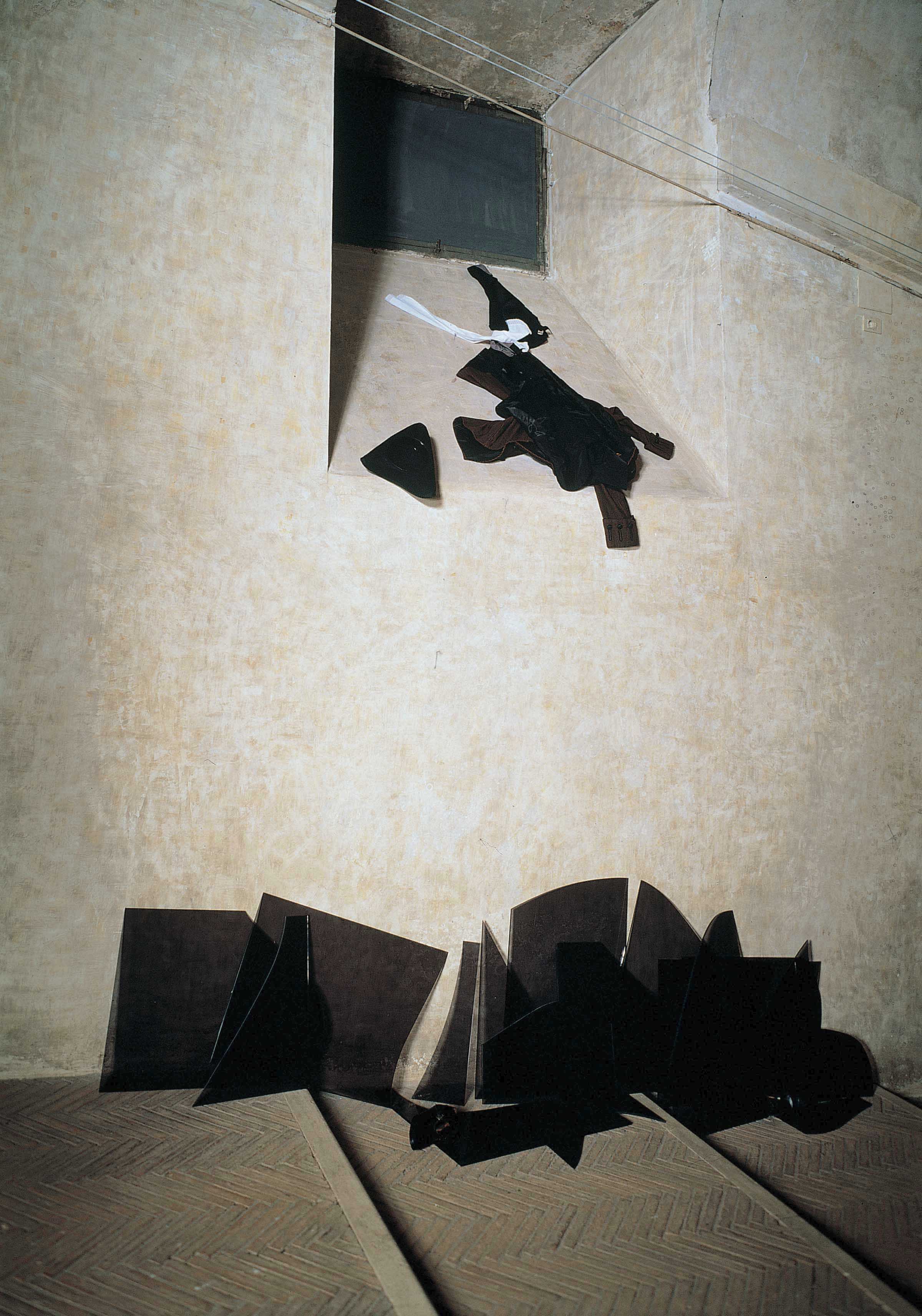
Surtout Valadier, 1995-96
GPO-0774
Coloured and shaped plexiglas, stage costume
Eighteen plexiglas parts, overall dimensions variable
Dismantled work
• 1996, Rome, Villa Medici: Paolini installed the work on the ramp leading from the ground floor to the first floor, placing the clothing items up above in the inclined space of the window, as if they were slipping on the plexiglas sheets propped up on the ground against the wall.
Inspired by the most famous work of the Roman goldsmith and sculptor Luigi Valadier (1726-1785) – the Surtout (1783), preserved at the Louvre – and at the same time by the tragic death of the latter, who drowned in the Tiber, Surtout Valadier is made up of an eighteenth-century theatrical costume, arranged high up above, in the area corresponding to the eighteen shaped plexiglas sheets, propped up against the bottom of the wall on the ground. As a whole the sheets make up both the dimensions of the surface of Valadier's centerpiece, and the path of the Tiber in Rome. Their dark grey colour recalls the murky waters the night when Valadier committed suicide. “The fall of the fragments thus represents the end of the masterpiece and that of the artist at the same time", Paolini explains.1
1 G. Paolini interviewed by A. Di Genova, in Il manifesto (Rome), 10 March 1996.
Title and dimensions from Luigi Valadier, Plateau de surtout, 1783, gilded bronze, marble, alabaster, granite, porphyry, 12 x 506.5 x 87.5 cm, Musée du Louvre, Paris.
| 1996 | Rome, French Academy, Villa Medici, Giulio Paolini. Correspondances, 13 March - 28 April, cat. no. 19, not repr., with a note by the artist. |
| • | G. Paolini in Giulio Paolini. Correspondances, exhibition catalogue, Rome, French Academy, Villa Medici (Turin: Umberto Allemandi & C., 1996), n. pag. |
| • | G. Paolini in the interview with A. Di Genova, in Il manifesto (Rome), 10 March 1996. |
| • | M. Disch, Giulio Paolini. Catalogo ragionato 1960-1999, vol. 2 (Milan: Skira editore, 2008), cat. no. 774 p. 788, col. repr. |
| • | Giulio Paolini. A come Accademia, exhibition catalogue, Rome, Accademia Nazionale di San Luca (Rome: Gangemi Editore, 2023), col. repr. p. 222 (exhibition view Rome 1996). |

