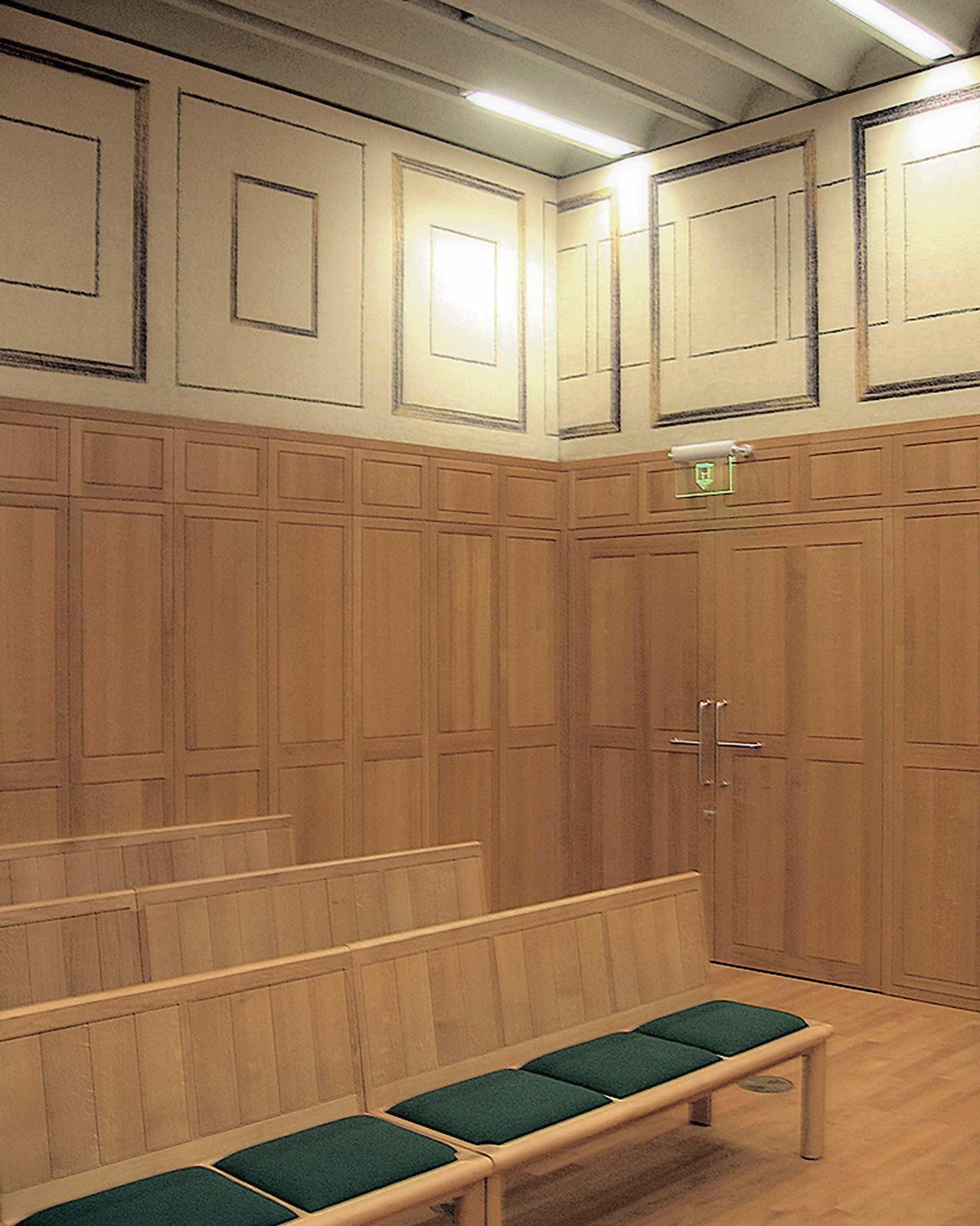
Arazzi per il tribunale del nuovo Palazzo di Giustizia di ‘s-Hertogenbosch, 1997-98
GPO-0799
Wall Hangings in the Hall of Justice, 's Hertogenbosch
Wall hanging
Courtroom A: two hangings 165 x 835 cm each, one hanging 165 x 742 cm
Courtroom B: two hangings 377 x 1368.2 cm each
Hall of Justice, 's Hertogenbosch
Acquired in 1998
The five tapestries commissioned from the artist for the new headquarters of the ‘s-Hertogenbosch Hall of Justice (Low Countries) are arranged in two adjacent courtrooms, located on the ground floor and called A and B here, respectively.1
In courtroom A three tapestries, placed close together on three sides of the room so that they form a continuous frieze along the top part of the walls with wood finishing, each present a sequence of golden frames and grey rectangles (as if they had been drawn in pencil). In the two longer tapestries, placed opposite each other, a series of golden frames is crossed by a series of smaller pencil-drawn rectangles or vice versa. In the third tapestry the golden frames and the grey rectangles, whether large or small, alternate without overlapping.
In courtroom B two long tapestries installed opposite one another each offer a central moment of "order" that offsets a peripheral situation of "disorder". In one case, the large golden frame at the centre contains a regular pattern of smaller "pencil-drawn" rectangles, while outside grey and golden rectangles alternate and overlap freely. In the other tapestry, the central grey rectangle joins smaller gilt rectangles all along its perimeter, while on the sides the same situation is broken down into individual units distributed in random order.
1 On the initiative of Charles Vandenhove, the architect who designed the new Hall of Justice (1992-98), in early 1997, nine international artists (Rob Birza, Jan Dibbets, Marlène Dumas, Ludger Gerdes, Hein Jacobs, Willem Oorebeek, Giulio Paolini, Luc Tuymans, Jeff Wall) were commissioned to conceive monumental tapestries for the sixteen courtrooms, located on the ground and first floor of the building. The selection of the artists and the coordination of the project were curated by Chris Dercon. Prior to their definitive placement in the courtrooms in the summer of 1998, the tapestries were presented to the public at the Museum Boijmans Van Beuningen in Rotterdam, in the form of exhibition copies made in agreement with the artists. These remained the property of the State of the Low Countries.
| 1998 | Rotterdam, Museum Boijmans Van Beuningen, Extenuating Circumstances. Wall Hangings in the Hall of Justice ‘s-Hertogenbosch, 28 March - 17 May, repr. pp. 3, 76-83, 106-107 (projects), anonymous entry p. 77; exhibition copies of the wall hangings from courtroom A. |
| • | A. Coulange, Giulio Paolini. Carnets de la commande publique (Paris: Éditions du Regard, 1997), repr. p. 68 (projects for all the wall hangings). |
| • | Charles Vandenhove. Art & architecture (Tournai: La Renaissance du Livre, 1998), col. repr. p. 138 (projects for the two wall hangings in courtroom B). |
| • | E. Mézil, K. Zwarts, Charles Vandenhove. Art in Architecture (Ghent: Ludion, 2005), col. repr. p. 142. |
| • | M. Disch, Giulio Paolini. Catalogo ragionato 1960-1999, vol. 2 (Milan: Skira editore, 2008), cat. no. 799 pp. 818-819, col. repr. |

