Zeusi e Parrasio, 2003
GPO-0876
Zeuxis and Parrhasius
Pencil on primed canvas, plaster casts, white plinths, plexiglas cases
Canvas 188 x 220 cm, two plexiglas cases 50 x 50 x 50 cm each, two plinths 135 x 50 x 50 cm each, overall dimensions variable
Castello di Rivoli Museo d’Arte Contemporanea, Rivoli-Turin
Acquired in 2005, inventory no. C-PAOG-008
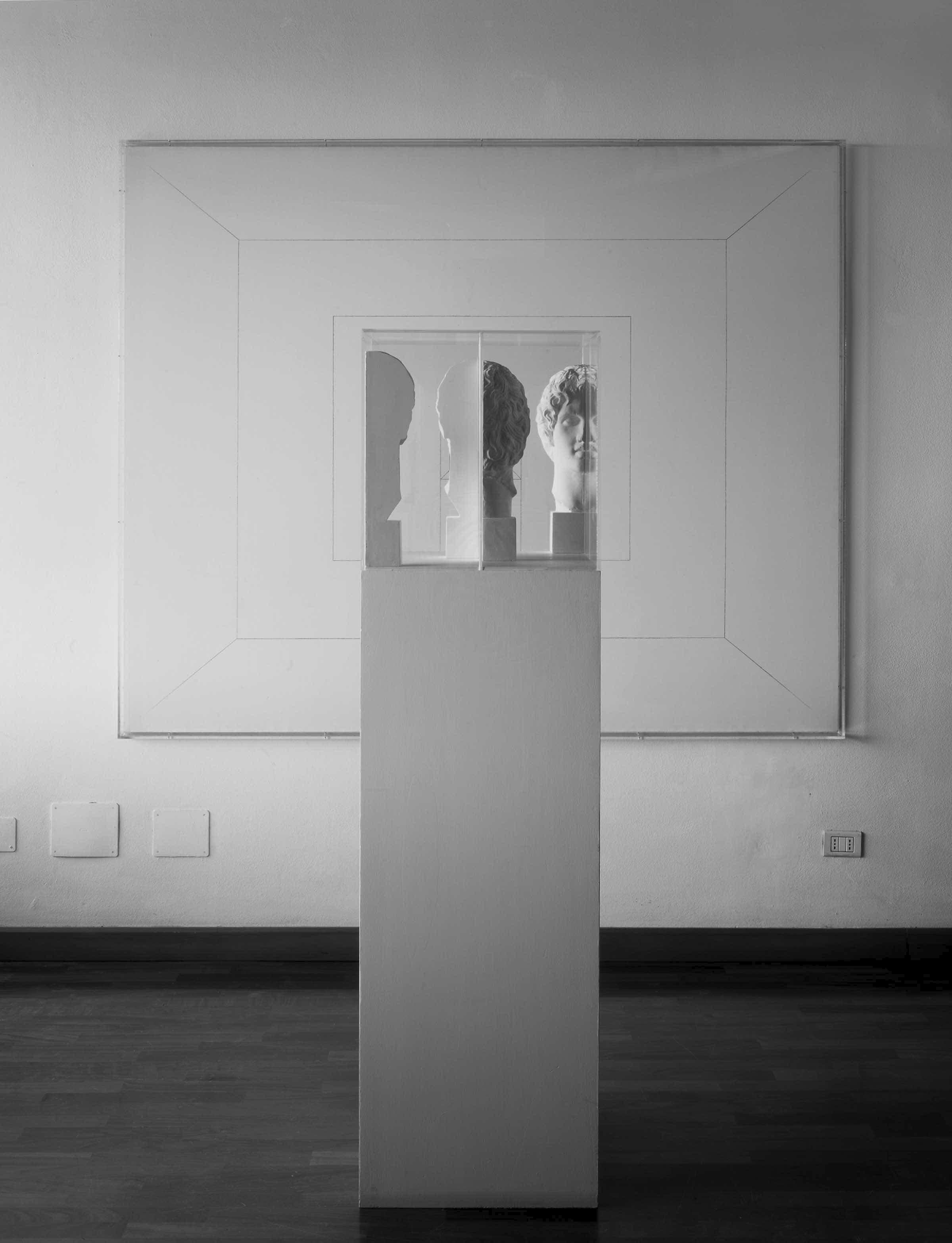
1. The two plinths must be in axis with the plinth drawn on the canvas (in other words: the drawn plinth and the two real plinths must be arranged on the same rectilinear axis, perpendicular to the surface of the canvas).
2. The distance between the canvas and the first plinth, as well as between the two plinths, must be the same and equal to 2-3 metres (to be verified in accordance with the room they are located in).
3. Between the second plinth and the edge of the room there must be at least 6 metres of free space so that the viewer has the chance to see from a certain distance the series of various elements.
4. The work must be arranged in an almost empty space (without the interference of other artworks in the area of the space occupied by the work).
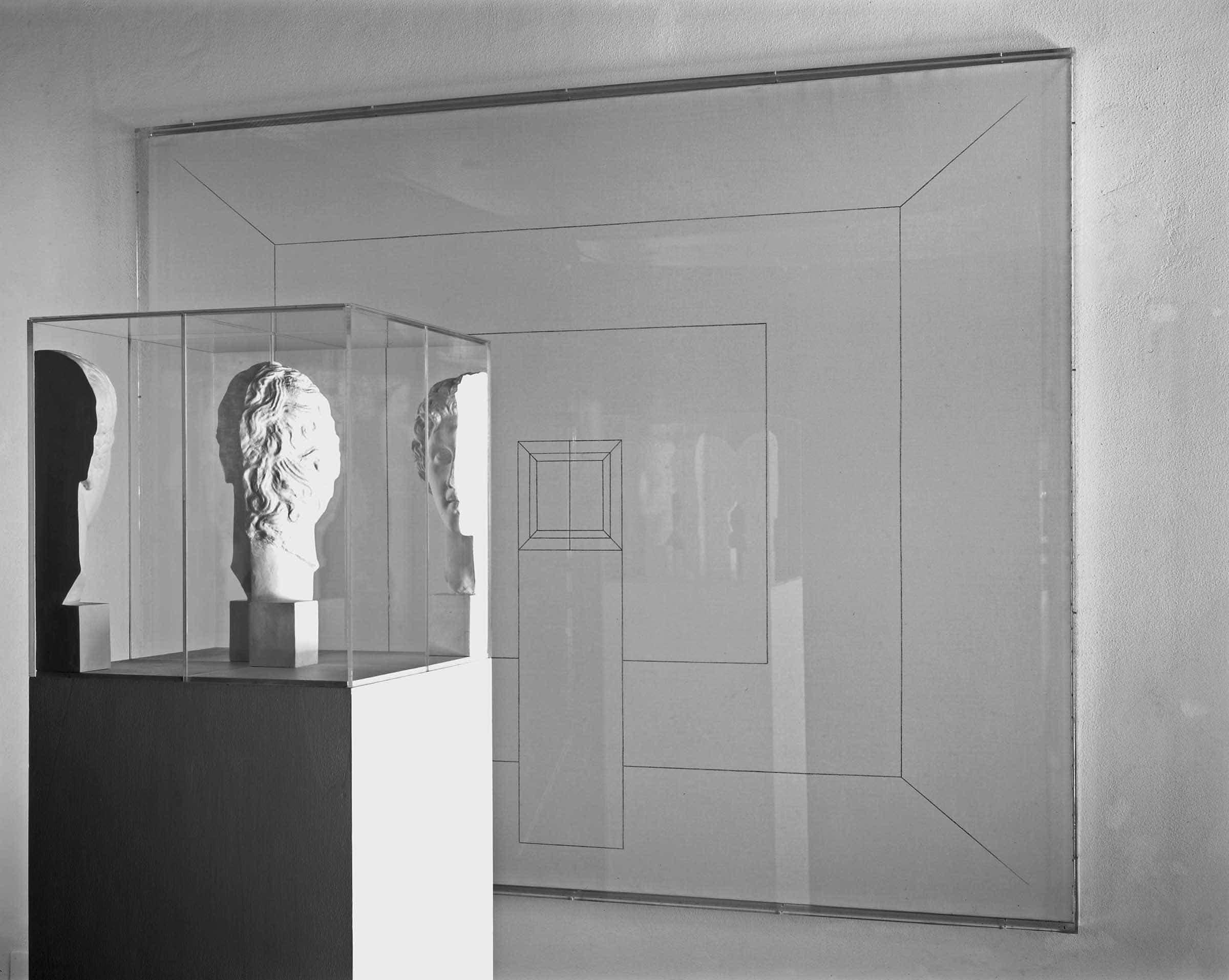
On the primed canvas the drawing outlined in pencil reproduces the work itself: a canvas hung at the centre of the wall of the room and two cases – each of which on a plinth – lined up about two metres apart along an optical axis that converges towards the centre of the canvas. The cases are divided by a cross into four compartments, each of which contains a fourth of the plaster cast of an antique male head, alternately propped up against either the outer or inner corner. The eight plaster elements derive from the orthogonal section in four parts of two different casts;1 the different parts are mixed between the various cases, so that each one hosts three elements of one figure and one of the other.
Inspired by the legend of Zeuxis and Parrhasius,2 Paolini stages the challenge that the author engages in each time from the outset with his work, that is, with himself. In the (vain) attempt to surpass himself, the author is dissolved in a composite and incongruous identity (as suggested by the fragmented casts). What’s most important is the work itself, which, on its part, is subtracted from any appropriation: the painting (outlined at the centre of the canvas) remains blank, “as it awaits an image”, in the words of the artist.3
1 One cast reproduces the Roman copy of the head of a youth, the other reproduces the head of Doryphoros by Polykleitos (Museo Archeologico, Naples).
2 In the well-known anecdote recounted by Pliny the Elder in Naturalis Historia (78-79 AD, XXX, 65-66), the two artists Zeuxis and Parrhasius compete to see who of them is the finest painter of their day. Zeuxis paints a bunch of grapes, whose perfect lifelikeness even fools the birds. Parrhasius instead paints a piece of drapery, which Zeuxis, believing it to be real, asks him to remove so that he can see the painting underneath.
3 “[...] The author, his own rival, faced with the supremacy of the work [...]. Representation of the void in the blankness of the canvas (disappearance): the author is dissolved, the work remains as it awaits an image” (Paolini in a comment about the work in May 2003).
• Polykleitos, Doryphoros, 440 BC, marble, 53 x 19 x 25 cm, Museo Archeologico, Naples.
• Greek head of a man, marble, h 44 cm, Archaeological Museum, Athens.
| 2008-09 | Rivoli, Castello di Rivoli Museo d’Arte Contemporanea, Una stanza tutta per sé, 2 April -18 January 2009, no catalogue. |
| 2011-12 | Bari, Teatro Margherita, Arte Povera in Teatro, 15 December 2011 - 11 March 2012, col. repr. no. 326 (installation view at Castello di Rivoli Museo d’Arte Contemporanea, Rivoli). |
| • | Castello di Rivoli Museo d’Arte Contemporanea. La Residenza Sabauda – La Collezione (Milan: Skira editore, 2008), commentary by G. Casagrande pp. 412, 414, col. repr. pp. 415, 416-417 (exhibition view Rivoli 2008). |
| • | Arte povera 2011, edited by G. Celant (Milan: Mondadori Electa, 2011), col. repr. no. 326 (installation view at Castello di Rivoli Museo d’Arte Contemporanea, Rivoli). |
| • | Castello di Rivoli Museo d’Arte Contemporanea. La storia e le collezioni, edited by C. Christov-Bakargiev and M. Beccaria, Rivoli, Castello di Rivoli Museo d’Arte Contemporanea (Turin: Umberto Allemandi & C., 2023), vol. II, p. 821 (referred to in the text by M. Beccaria), col. repr. p. 829. |

