Capogiro (Lo sguardo dello spettatore), 2004
GPO-0886
Dizziness (Spectator’s Gaze)
Plexiglas volume, plexiglas sheet, clothing, top hat, plexiglas sphere, xerox reproductions
Plexiglas volume 160 x 80 x 80 cm, overall dimensions 160 x 95 x 95 cm
Collection of the artist
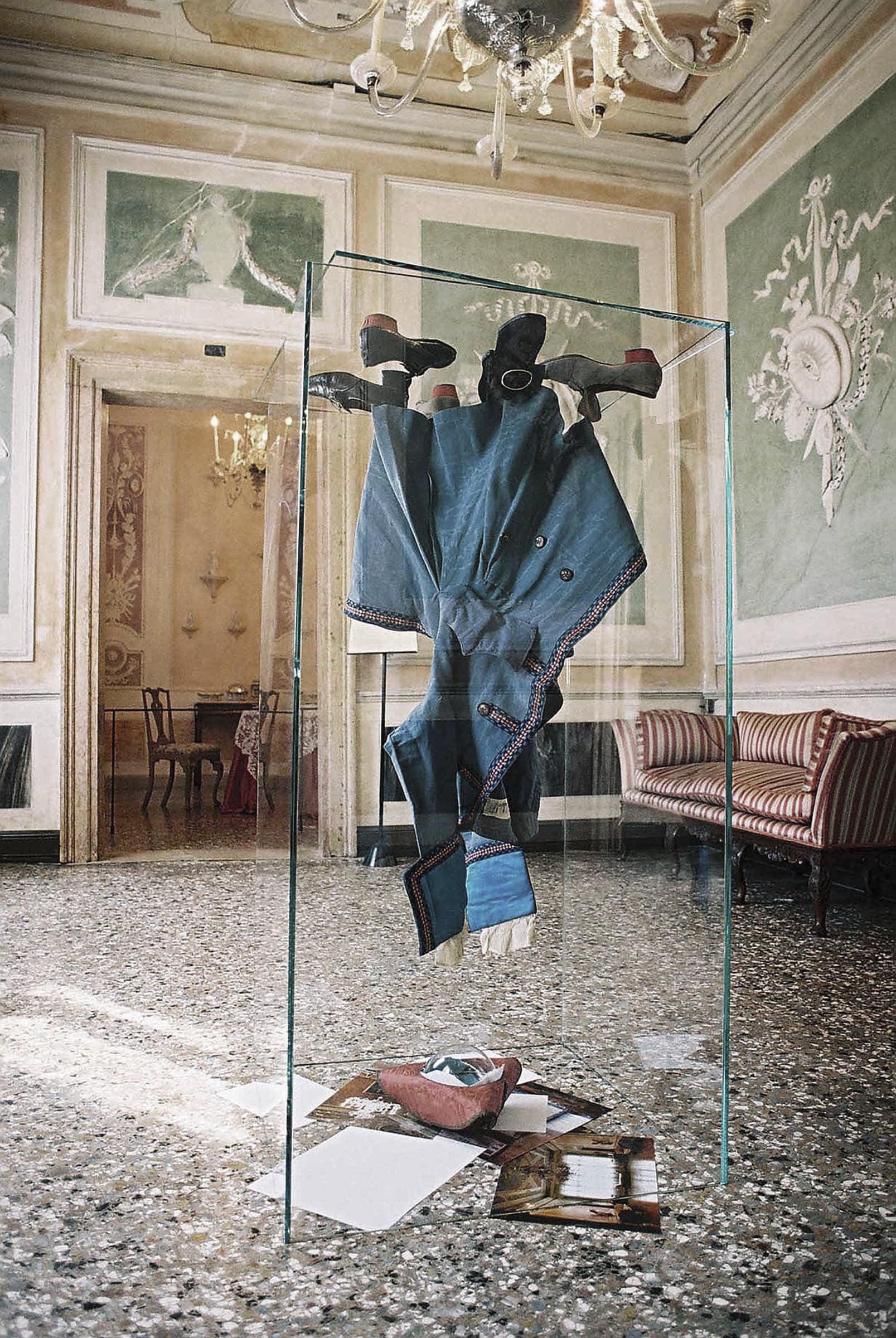
• 2004, Venice, Fondazione Querini Stampalia: the volume and the sheet are made of glass. Fastened to the lower side of the sheet, which is set so that it is askew atop the volume, are six unmatched men’s shoes, placed upside down and in opposite directions, forming a sort of quadrant that alludes to a circular movement, while remaining in place. Arranged inside the volume is a blue theatrical costume, hanging from the shoes, recalling a person hanging upside down. (The artist had originally intended to lay the costume on the ground, on top of the paper elements; after a crack unexpectedly occurred in the glass sheet, nonetheless, he decided to position the shoes in the manner of a quadrant and to hang the costume, in order to hide the crack from sight). Arranged on the ground are a tricorn hat (from Autoritratto come marionetta, 1996, GPO-0767) with a plexiglas sphere inserted in the hollow part, and the torn fragments of the photographic reproduction of an astrolabe (instrument of orientation). Scattered all around are photographic prints of the room itself where the work is exhibited and four blank sheets (all the paper elements emerge with respect to the edges of the glass volume).
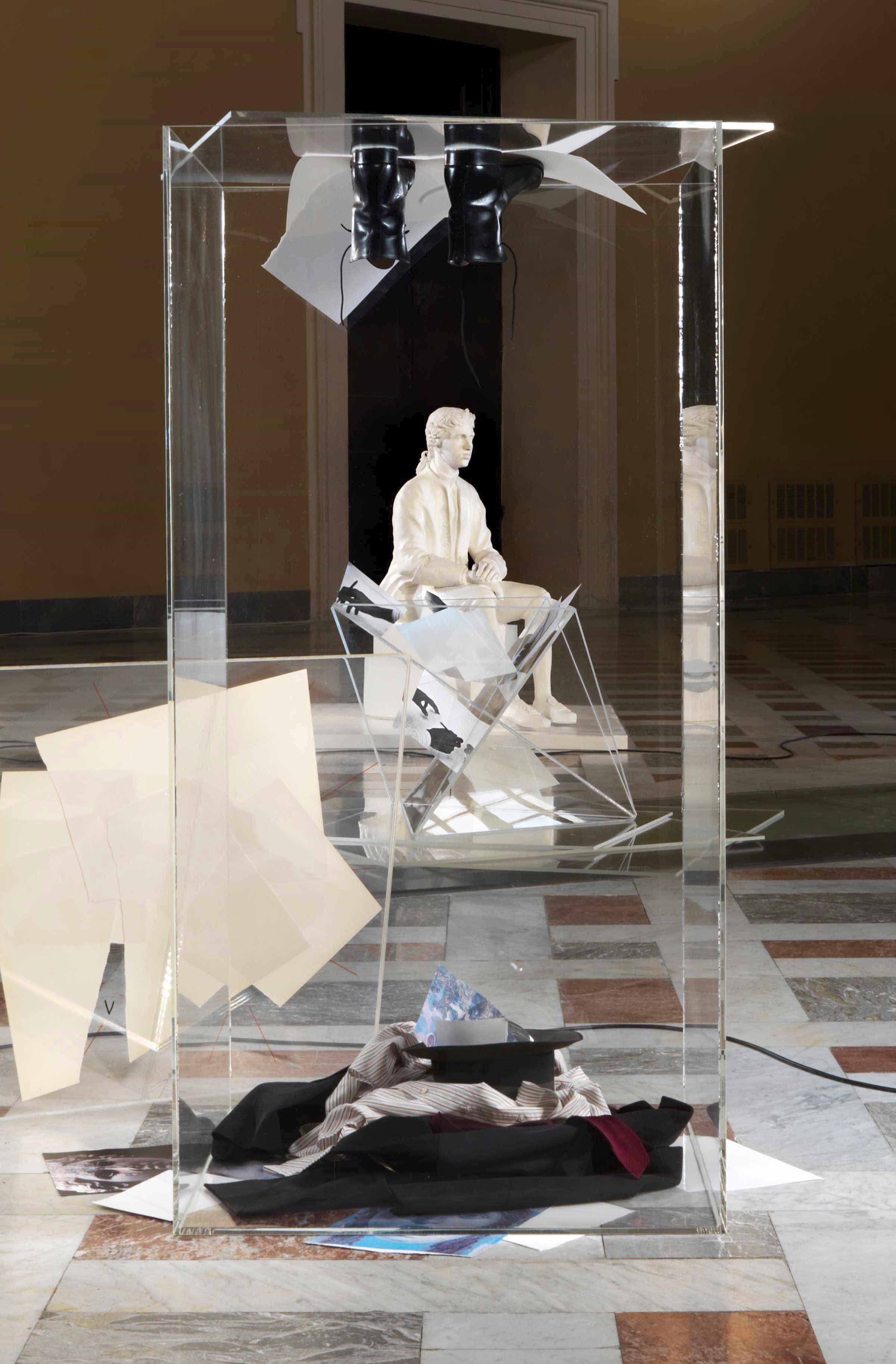
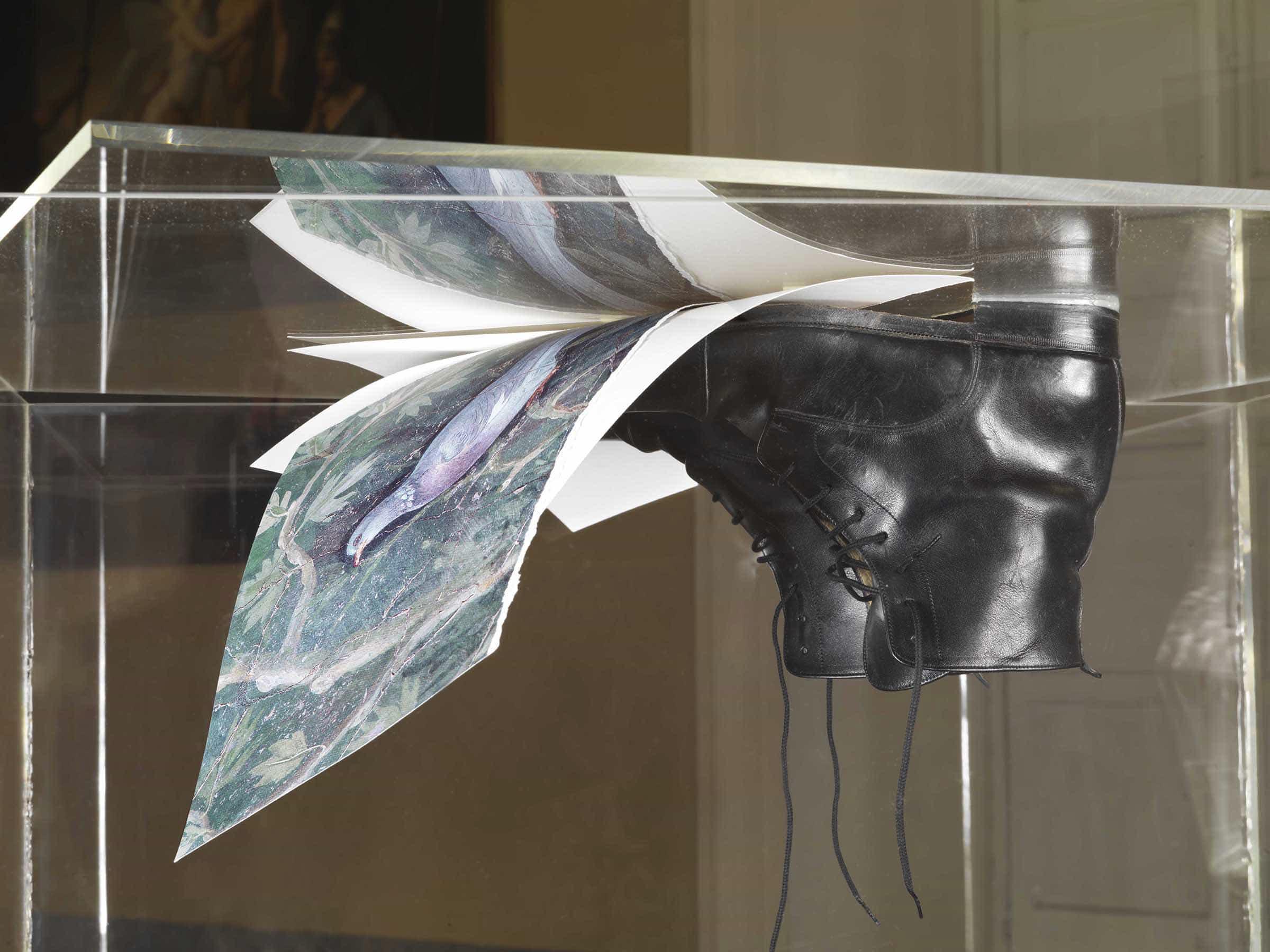
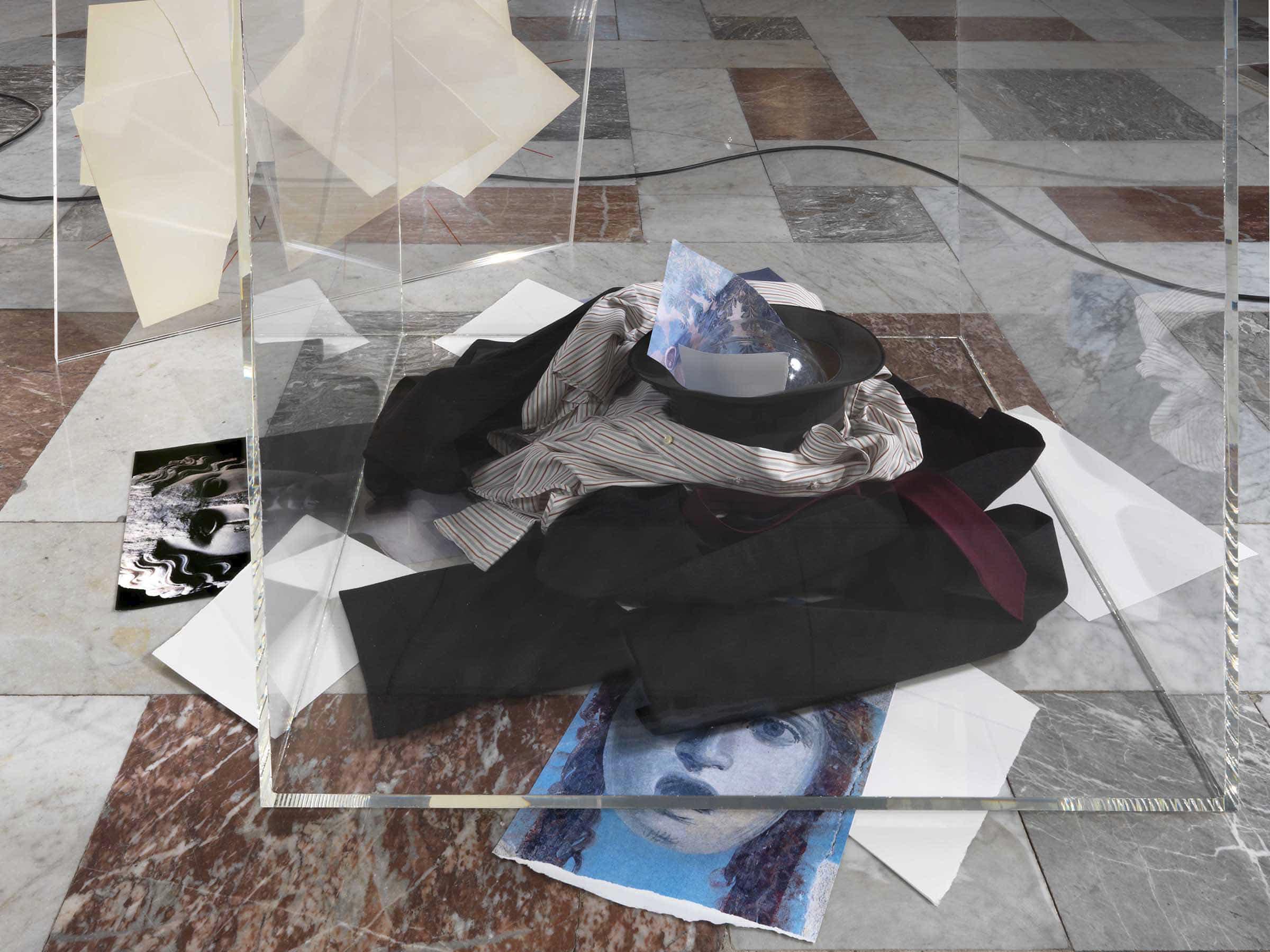
• 2009, Naples, Museo Archeologico Nazionale: the volume and the sheet are made of plexiglas. Fastened to the lower side of the sheet, this too placed so that it is staggered atop the volume, are only two men’s shoes, which at the same time hold two fragments of a sheet of drawing paper and the fragment of the photographic reproduction of a Pompeiian painting preserved in the same Museo Archeologico Nazionale. Lying on the ground a men’s jacket and shirt are arranged on top of torn blank sheets and three other photographic reproductions of works preserved at the museum (all of the paper elements emerge from the edges of the volume). On top of the clothing, in a central position, a top hat contains two other torn fragments of the reproduction of Pompeiian paintings in the museum’s permanent collection.
A plexiglas volume hosts at the top – on the lower side of the sheet placed so that it is staggered above the volume – two men’s shoes, facing different directions, suggesting movement while stationary; the shoes hold down the torn fragments of a sheet of drawing paper and of the reproduction of an ancient fresco.1 On the ground is a dishevelled men’s suit, arranged on top of several torn sheets and the reproductions of ancient works (all of the paper elements emerge with respect to the sides of the volume). On top of the clothing, a top hat contains a plexiglas sphere and two torn fragments of the reproductions of other works preserved in the place where the work was exhibited.
In the artist’s intentions, the dizziness evoked in the title is the viewer’s. Overwhelmed by the suggestions offered by the exhibition space – from the echoes that resound through the furniture, the decorations, or the works present there – they become disoriented (hence, the upside-down position of the shoes and the clothing lying on the ground).2 In a broader sense, it is also the author’s dizziness, who as he seeks an absolute dimension (represented by the sphere), with his gaze filled with the vast assortment of images, loses his balance and falls to the ground.
1 All the photographic fragments present in Capogiro (Lo sguardo dello spettatore) reproduce details of works preserved in the venue hosting the work, or of the exhibition space itself. In Venice in 2004 they were images of the large room where the work was exhibited; in Naples in 2009 they were details of paintings or sculptures from Pompeii, Herculaneum, and Stabia preserved at the Museo Archeologico Nazionale.
2 In the context of the first presentation of the work in Venice in 2004, Capogiro (Lo sguardo dello spettatore) was exhibited on the piano nobile of the Fondazione Querini Stampalia – characterized by the period decoration and the ancient works in the collection – and it represented the Viewer, that is, one of the three “actors” (alongside the Author and the Work) around which the conceptual design of the exhibition revolved.
| 2004 | Venice, Fondazione Querini Stampalia, Giulio Paolini. L'ora X, 28 March - 30 May, col. repr. pp. 52-54 (exhibition view), references in the artist’s writing pp. 27-31 and in the text by C. Bertola pp. 64-67. |
| 2009-10 | Naples, Museo Archeologico Nazionale, Sala della Meridiana, Giulio Paolini. L'Ora X. Né prima né dopo, 29 November 2009 - 18 January 2010, cited in the checklist of exhibited works p. 84, col. repr. pp. 63-65, 69, 75, 79, 81 (exhibition views), references in the artist’s writing p. 47 and in the text by R.S. Pecorara pp. 25-27. |
| • | G. Paolini in Giulio Paolini. L'ora X, exhibition catalogue, Venice, Fondazione Querini Stampalia (Prato: Gli Ori, 2004), p. 31 (in reference to the installation of the work in Venice); republished with minor adjustments in G. Paolini, “Sala della Meridiana”, in L'Ora X. Né prima né dopo, exhibition catalogue, Naples, Museo Archeologico Nazionale, Sala della Meridiana (Naples: Mondadori Electa, 2009), p. 47. |
| • | C. Bertola, Curare l’arte (Milan: Mondadori Electa, 2008), repr. p. 20 (exhibition view Venice 2004). |
| • | Arte povera 2011, edited by G. Celant (Milan: Mondadori Electa, 2011), col. repr. no. 327 (exhibition view Naples 2009). |
| • | Conservare il futuro. L’arte contemporanea alla Fondazione Querini Stampalia / Conserving the Future. Contemporary art at the Querini Stampalia Foundation, edited by C. Bertola and M. Savaris (Venice: Grafiche Veneziane, 2015), col. repr. (exhibition view Venice 2004). |
| • | C. Bertola, “Giulio Paolini”, in Id., Conservare il futuro (Venice: Fondazione Querini Stampalia, 2023), pp. 53, 257, col. repr. p. 160 (exhibition view Venice 2004). |
| • | Giulio Paolini. A come Accademia, exhibition catalogue, Rome, Accademia Nazionale di San Luca (Rome: Gangemi Editore, 2023), col. repr. pp. 262-263 (exhibition views Naples 2009). |

