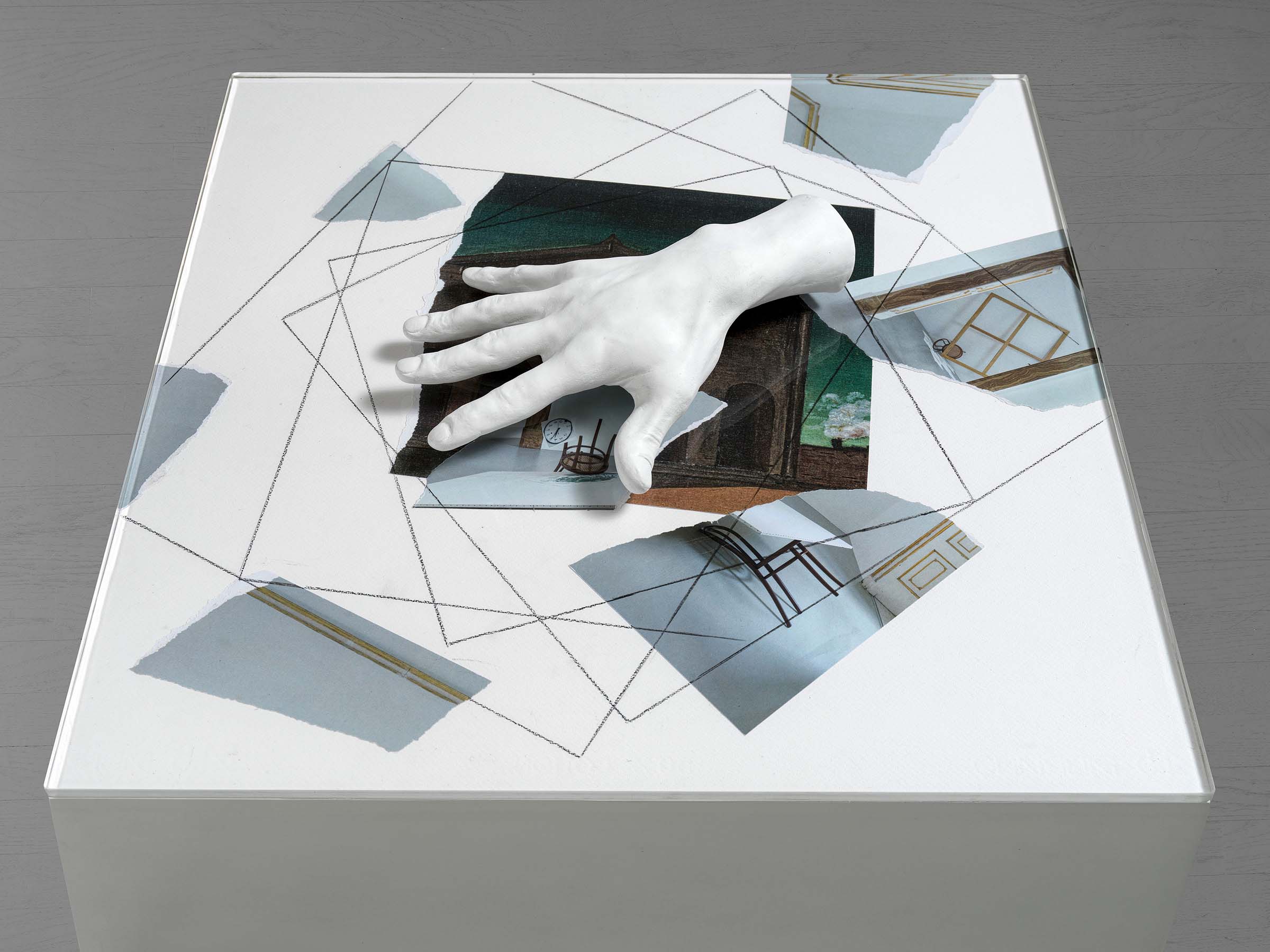
L’enigma dell’ora, 2024
GPO-1171
The Enigma of the Hour
Pencil and collage on paper, plaster cast, plexiglas sheet, white plinth
Plexiglas sheet 60 x 60 cm, plinth 70 x 60 x 60 cm, overall dimensions 78 x 60 x 60 cm
Luisa Laureati Briganti Collection, Rome
On the top surface of the plinth, a plexiglas sheet holds down a collage with a pencil drawing: in the centre, half-hidden, the torn image of a detail from Giorgio de Chirico's painting Plaisirs du poète (1912) acts as the germinal nucleus of a set of pencil squares, in rapid succession and staggered amongst themselves, while all around are scattered photographic fragments of two works by Paolini bearing the title Piazza d’Italia,1 taken from a well-known series of Dechirichian paintings. On the plexiglas sheet is placed the plaster cast of an open hand, caught in the act of stopping the dispersion of the image elements and arranged in such a way as to reveal the two clocks in the collage.
The pinwheel of drawn squares amplifies the echo of the half-hidden Dechirichian painting, just as the fragments of the Paolinian Piazze recall memories of metaphysical places. The gesture of the hand figuratively refers to the title of the work, L'enigma dell'ora (also taken from a painting by de Chirico and alluded to through the clocks in the collage), or to the suspended and enigmatic instant in which the fragments unfold into a new, as yet unknown image.
1 The torn fragments reproduce Piazza d'Italia (II), 2001 (GPO-0866) and Piazza d'Italia (III), 2002 (GPO-867) displayed at Alfonso Artiaco, Naples in 2021, that is to say, in the same rooms where L'enigma dell'ora is first exhibited in March 2024.
• Giorgio de Chirico, Les plaisirs du poète, 1912, oil on canvas, 69.5 x 86.4 cm, Esther Grether Family Collection, Basel.
• Title from Giorgio de Chirico, L’enigma dell’ora, 1911, oil on canvas, 55 x 71 cm, Mattioli Collection.
| 2024 | Naples, Alfonso Artiaco, Giulio Paolini. Dall’Italia, 2 March - 20 April. |

