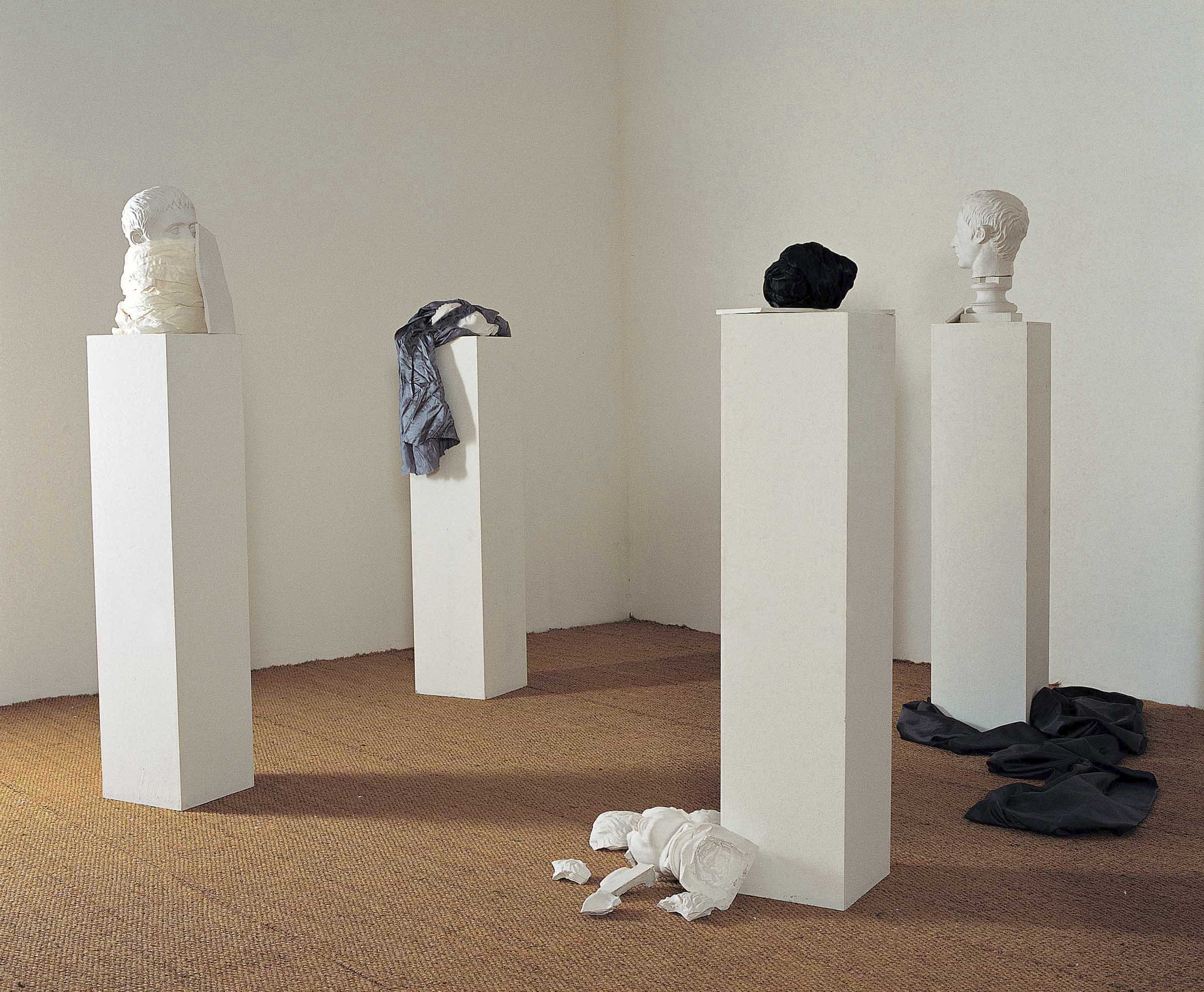
Casa di Lucrezio, 1981-82
GPO-0481
House of Lucretius
Two whole and two fractured plaster casts, fabrics, fragments of carved plaster tablet, white plinths
Two casts h 42 cm each, four plinths 120 x 30 x 30 cm each, overall dimensions variable
Institut d’art contemporain, Villeurbanne, Dépôt du Nouveau Musée/Collection Souvenir
Gift of CIC Lyonnaise de Banque, 1993, inventory no. D.2008.012
1. The four plinths form the vertices of a square rotated diagonally with respect to the axes of the room;
2. The two whole casts are placed on two plinths that are not adjacent (that is, they are on a diagonal axis) so that they face the immediately subsequent plinth in a clockwise direction; overall, their location institutes a circular dynamic; a fragment from the plaster tablet is propped up against each of the two casts;
3. The dark grey cloth on the ground must be unfolded outwards with respect to the plinths (not towards the subsequent plinth featuring black cloth rolled up in a ball on top of the plinth); it must not be stretched but, rather, remain wavy;
4. The cast with white cloth: the cloth is wrapped around the cast so that it covers the eyes;
5. The light grey cloth is wrapped around the plaster fragments 3/4 of the way; at the end a fragment of a cast is placed on the wrapped cloth; the other end of the cloth drops down to the ground along the plinth;
6. The black cloth must be folded into a very compact ball at the centre of the plinth and flanked by a fragment of the tablet; the fragments of the cast must be arranged at the foot of the plinth, as if the cast had fallen to the ground.
The theme of the Casa di Lucrezio was developed in a total of nine variants made between 1981 and 1984 (from GPO-0452 to GPO-0458, GPO-0481, GPO-0517). The common denominator between the works is the fragmentation of a plaster tablet bearing a drawing of a labyrinth carved on a pillar in Lucretius’s house in Pompeii,1 matched with a series of possible semblances of the Latin poet, evoked by the plaster cast of a classical head and a piece of draped cloth. The cast of the ancient carving is broken each time into an increasing number of fragments, thereby accentuating its labyrinthine component.2. The gradual subdivision of the drawing also determines a complementary multiplication of the poet’s faces, which along with the various positions of the cast and the variations in the colour of the cloths gradually expands the question as to the possibility of determining an ungraspable figure.
The eighth version of the Casa di Lucrezio is distinguished from the others by the choice of the cast – in this case a Roman head, inspired by the four busts of the Salle des Statues in the Musée des Beaux-Arts in Dijon, where the work was exhibited for the first time – and by the cloths in colours ranging from white to black. The four episodes making up this variant are installed so that the complementary pairs of the casts, respectively whole and broken, are diagonally opposite each other. Counter-clockwise they are as follows: 1. a whole cast wrapped in a white drape up to the eye level, set down on the plinth together with a fragment of the labyrinthine carving; 2. the pieces of a broken up head wrapped in light grey cloth and set down on the plinth; 3. a whole cast and a portion of the drawing placed on top of the plinth, while an anthracite cloth is arranged on the ground; 4. a cast of the head exploded on the ground, a piece and a fragment of the plaster tablet wrapped in black cloth set atop the plinth.
In the artist's words: “The intentionality of this work lies in evoking – and not representing – the idea of the continuous becoming of a possible space, inhabited by poetry. The title leads to another place, the casts point to their place of provenance, the drawing of the labyrinth evokes not just another place – the House of Lucretius – but also the symbolic figure of the labyrinth. These are all various elements which are meant to subtract themselves from vision to instead suggest a dense void of evocation, the making of space for the chances of imagination that each one of us harbours inside”.3
1 The original drawing with the words “Labyrinthus Hic Habitat Mynotaurus” is from the Enciclopedia Einaudi, vol. 8 (Turin: 1979), p. 12, under “labirinto”, and is described as a labyrinth "on a pillar of the House of Lucretius". The Pompeiian house where the drawing was discovered was actually the domus of the duovir Marcus Lucretius Fronto, and not of the poet Titus Lucretius Carus (cf. G. Sarullo, “Labirinti a Pompei: a proposito di CIL IV 2331”, in Oebalus. Studi sulla Campania nell’Antichità 3 (Rome), 2008, pp. 203-223; I am grateful to Stefano Menichini for this information). On his part, Paolini does not remember whether his association was simply a case of poetic license or an unwitting mistake.
2 The drawing was carved on plaster tablets measuring 35 x 35 cm, which were later shattered.
3 G. Paolini interviewed by F. Pasini, in L’Illustrazione italiana V, no. 24 (Milan), November, 1985, p. 21. On the labyrinth as the inspiration for the work cf. G. Paolini interviewed by C. Grenier, in Flash Art 3 (Milan, French edition), Spring, 1984, p. 41.
• Roman head, Musée des Beaux-Arts, Dijon.
• Drawing of the labyrinth with writing from the Enciclopedia Einaudi, vol. 8 (Turin: 1979), p. 12 (entry “labirinto”).
| 1983 | Dijon, Musée des Beaux-Arts, Présence discrète, 10 January - 28 February, documentation in Plus 1 (Dijon), April, 1985, pp. 34-35, repr. (exhibition views). |
| 1984 | Villeurbanne, Le Nouveau Musée, Giulio Paolini, 20 January - 18 March, vol. Images/Index repr. pp. 120-121 (exhibition view Dijon 1983). |
| 1985-86 | Montreal, Musée d’art contemporain, Giulio Paolini, 7 July - 8 September, touring to: Vancouver, Vancouver Art Gallery, 29 November 1985 - 19 January 1986, same catalogue as for the solo exhibition in Villeurbanne 1984. |
| 1986 | Charleroi, Palais des Beaux-Arts, Giulio Paolini, 15 February - 30 March, same catalogue as for the solo exhibition in Villeurbanne 1984. |
| 1994 | Villeurbanne, Le Nouveau Musée, Toujours moderne, 9 September - 10 December, no catalogue. |
| 2001-02 | Lyon, Les Subsistances, Sculpture contemporaine. Œuvres de la Collection FRAC Rhône-Alpes de l’Institut d’art contemporain, 23 November 2001 - 20 January 2002, cited in the checklist of exhibited works, not repr. |
| 2006 | Chambéry, Musée des Beaux-Arts, Faces à Faces, 7 October 2006 - 8 January 2007, no catalogue. |
| 2008 | Saint-Étienne le Molard (Loire), Château de la Bâtie d’Urfé, Clair-obscur / Chiaroscuro. Ambition d’art bis, 20 June - 19 October, no catalogue. |
| 2014 | Lyon, École Normale Supérieure de Lyon, Lightness. Une légère tension…, 15 May - 18 July 2014, no catalogue. |
| 2014 | Villeurbanne, Institut d'art contemporain, Collection à l'étude à Villeurbanne. Expériences de l'œuvre, 19 September 2014 - 11 January 2015, no catalogue. |
| • | G. Paolini in the interview with C. Grenier, “Giulio Paolini”, in Flash Art 2 (Milan, French edition), February, 1984, p. 41; republished in Italian in Giulio Paolini. La voce del pittore – Scritti e interviste 1965-1995, edited by M. Disch (Lugano: ADV Publishing House, 1995), p. 191. |
| • | G. Paolini in the interview with F. Pasini, “La parola e la mano”, in L’Illustrazione italiana 5, no. 24 (Milan), November, 1985, p. 21; republished in Giulio Paolini. La voce del pittore, op. cit. (Lugano: 1995), p. 208. |
| • | G. Paolini in the interview with E. Pizzo, in Giulio Paolini. Casa di Lucrezio, 1981-84, visitor’s guide (Rivoli: Castello di Rivoli Museo d’arte contemporanea, 1987). |
| • | Plus 1 (Dijon), April, 1985, repr. p. 34, with entry by C. Besson, X. Douroux, and F. Gautherot (documentation of the group exhibition Dijon 1983). |
| • | Compilation: une expérience de l’exposition, edited by X. Douroux, F. Gautherot and E. Troncy (Dijon: Les Presses du réel, 1998), pp. 118-119, repr. (exhibition view Dijon 1983). |
| • | M. Disch, Giulio Paolini. Catalogo ragionato 1960-1999, vol. 1 (Milan: Skira editore, 2008), cat. no. 481 p. 493, col. repr. (incorrect installation). |
| • | J.L. Maubant, Ambition d’art, vol. Alphabet (Villeurbanne-Dijon: Institut d’art contemporain and Les presses du réel, 2008), col. repr. n. pag. (advertising page for the CIC Lyonnaise de Banque; with incorrect caption referred to another image; incorrect installation); vol. Archive, repr. pp. 23, 36, 37 (exhibition views Villeurbanne 1984), cited in the list of works from the collection p. 230. |
| • | Giulio Paolini. A come Accademia, exhibition catalogue, Rome, Accademia Nazionale di San Luca (Rome: Gangemi Editore, 2023), repr. p. 179 (exhibition view Villeurbanne 1984). |

