L’exil du cygne, 1984
GPO-0513
Pencil and collage on primed canvas, plaster casts, feathers, collage on wall
Canvas 200 x 300 cm, two casts h 250 cm each, overall dimensions 268 x 607 x 295 cm
The Olnick Spanu Collection, New York
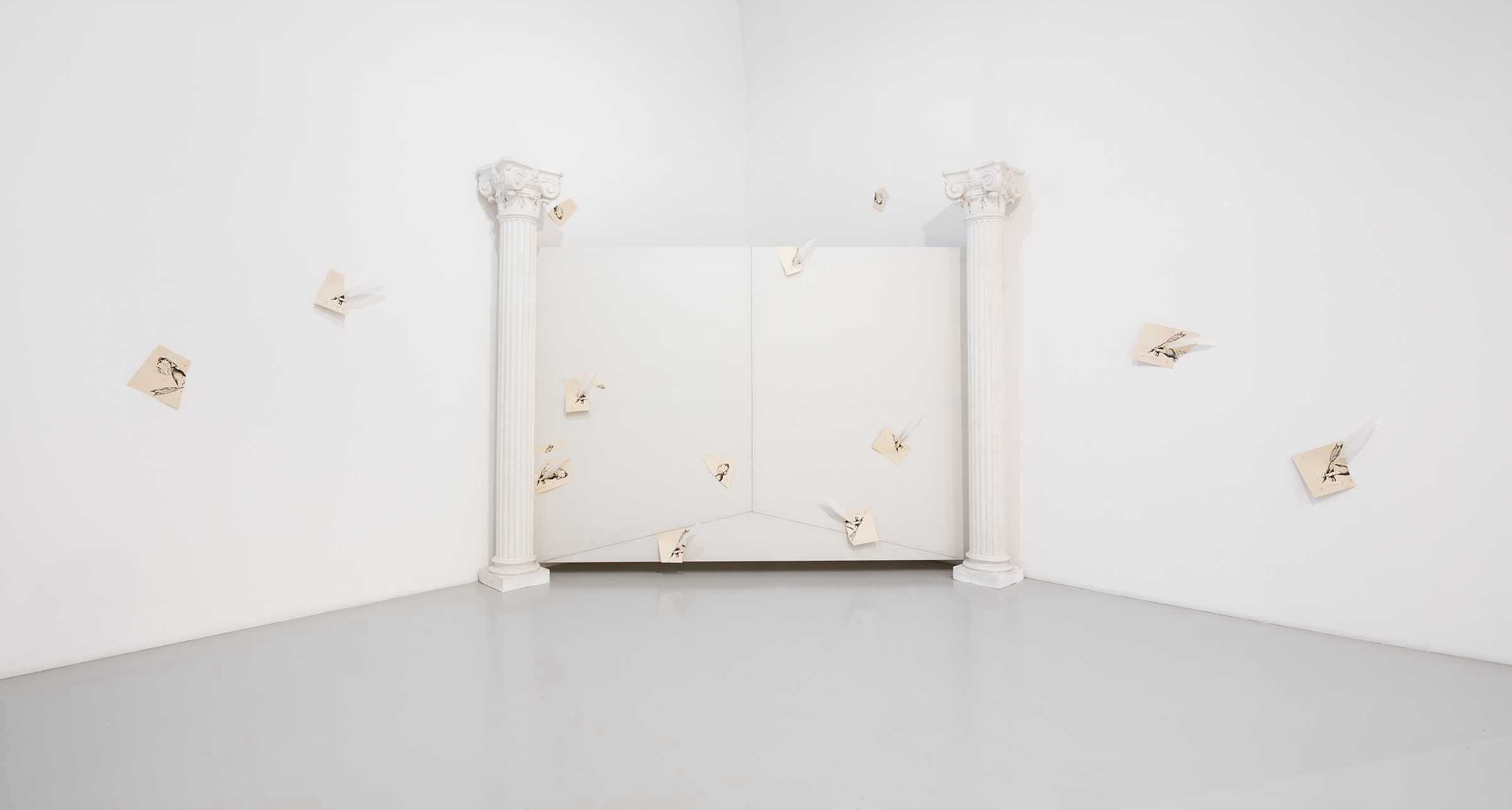
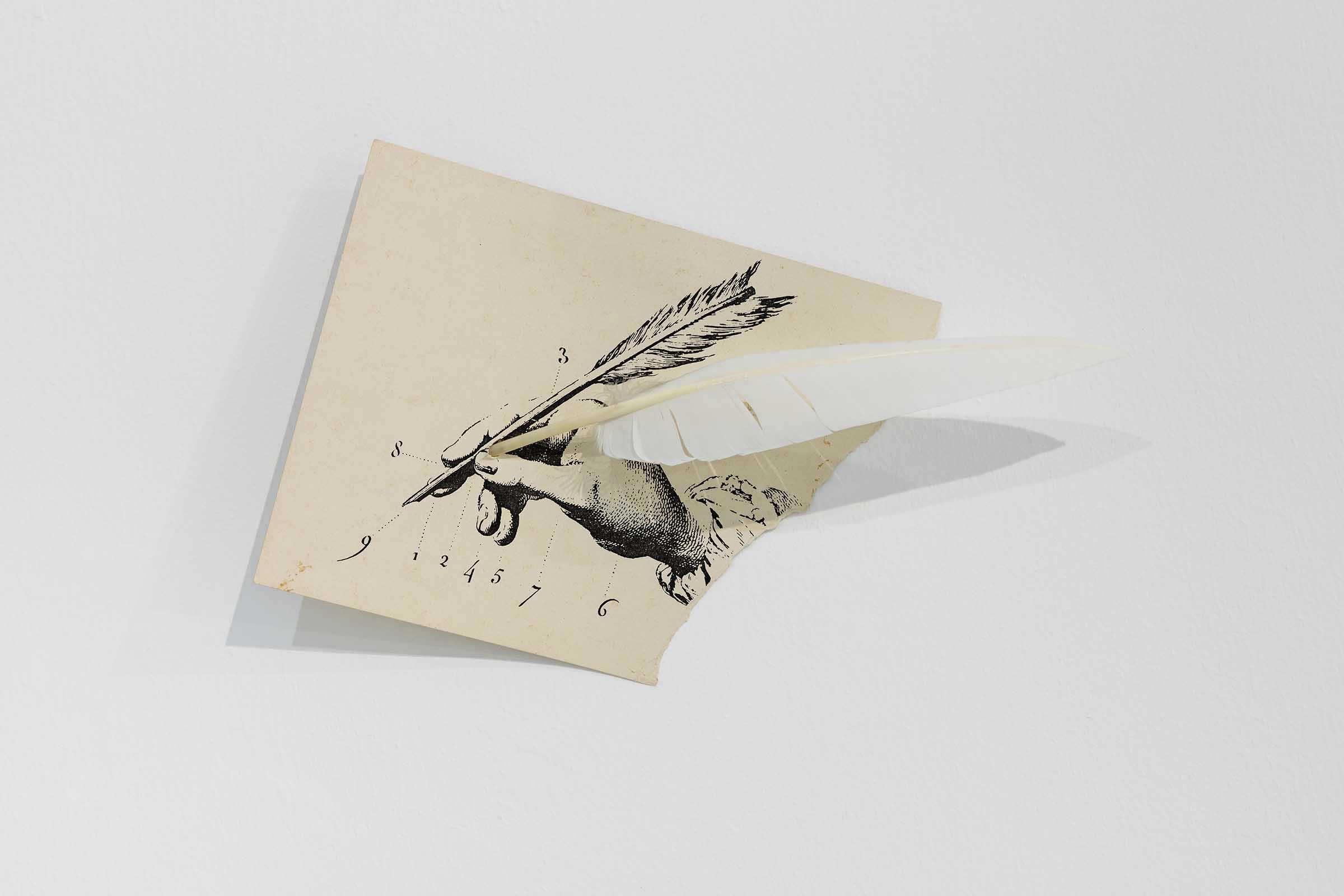
A large primed canvas, placed in a corner of the room on the bases of plaster casts of two Corinthian columns, bears the pencil drawing of the coordinates that mark the corner where it is located. Scattered on the canvas and all around the wall are the torn details of the reproduction of an eighteenth-century drawing of a hand holding a pen.1 Inserted in nine of these fragments, corresponding to the area where the pen is reproduced in the drawing, is a white feather that seems to make them twirl inside and outside the space of the work.
Whereas the perspectival drawing announces the empty space of a stage – the moment that precedes a representation – the fragments of the image of the hand intent on writing or drawing allude to something unexpressed. The silence (or the void) of both situations suggests the "exile" of perceivable signs, evoked through the homophony between the French words signe” (sign) and “cygne” (swan), as well as through the twofold meaning of the feather (both the pen of the poet-artist and the attribute of the swan).
The plurality of meanings is further enriched by the reference, in the title, to the famous final line of the sonnet Le vierge, le vivace et le bel aujourd'hui... (1887) by Stéphane Mallarmé, in which the swan, ideal symbol of the poetic flight, recognizes its exile, that is, its condition as a castaway in a frozen lake, condemned to motionlessness and impotence, to express, in a figurative sense, the insufficiency of the language with respect to the dimension of the absolute. Whereas beyond the space of the representation the pencil drawing and the feather-pen announce an ideal vision, on this side of the threshold the perspectival solution is an optical illusion and the feather-pen does not end up tracing any drawing.
The first formulations of the theme of L’Exil du cygne date back to a work made in 1982 (GPO-0466) and to the print edition with the same title executed in early 1984 (GPE-0046). The subsequent developments include four other homonymous versions, made from 1984 to 1993 (GPO-0514, GPO-0610, GPO-0652, GPO-0712).
1 The reproduction is from Diderot's Encyclopédie, in which the drawing with nine numbers didactically illustrates the "true way to hold a pen" while writing (L’Art d’écrire, pl. III, p. 126).
Image of the hand from Denis Diderot, Jean-Baptiste D’Alembert, Encyclopédie, ou Dictionnaire raisonné des sciences, des arts et des métiers. Recueil de planches sur les sciences, les arts libéraux et les arts méchaniques, avec leur explication. Seconde livraison, en deux parties. Première partie 23 (Paris: 1763), plate III (“Art d’Ecrire”).
| 1984 | Venice, Giardini di Castello, Biennale di Venezia: XLI Esposizione Internazionale d’Arte. Arte allo specchio, 10 June - 9 September, general catalogue: cited in the checklist of exhibited works p. 61, repr. p. 61; catalogue Arte allo specchio: cited in the checklist of exhibited works p. 54, not repr. |
| 1986 | London, Hayward Gallery, Falls the Shadow. Recent British and European Art. 1986 Hayward Annual, 9 April - 15 June, not repr. |
| 1986 | Los Angeles, Margo Leavin Gallery, Giulio Paolini, 29 November 1986 - 10 January 1987. |
| 1987 | Nagoya, Institute of Contemporary Arts, Giulio Paolini, 31 October - 20 December, col. repr. p. 45 (exhibition view). |
| 2016-17 | Milan, Galleria Christian Stein, Giulio Paolini. Fine, 10 November 2016 - 29 April 2017, cited in the checklist of exhibited works p. 153, col. repr. pp. 42-43 (exhibition view), 44 (detail), entry by M. Disch p. 153; exhibited at the venue in Pero. |
| 2017 | Cold Spring, Magazzino Italian Art, Margherita Stein: Rebel Without a Cause, from 24 June, no catalogue. |
| • | Arte allo specchio. XLI Esposizione Internazionale d’Arte. La Biennale di Venezia, edited by M. Calvesi (Venice: La Biennale di Venezia, 1984), repr. p. 103 (with exhibition view Venice 1984). |
| • | D. Zacharopoulos, “Arte povera aujourd’hui”, in Flash Art 4 (Milan, French edition), Summer, 1984, col. repr. p. 51 (exhibition view Venice 1984). |
| • | Paolini. Melanconia ermetica, exhibition catalogue, Paris, Galerie Maeght Lelong, 1985, repr. p. 30. |
| • | G. Celant, The Knot Arte Povera (Turin: Umberto Allemandi & C., 1985), repr. pp. 156-157; Italian edition: Arte Povera (Turin: Umberto Allemandi & C., 1989), repr. pp. 162-163; French edition: Arte Povera (Villeurbanne: Art Edition, 1989), repr. pp. 170-171. |
| • | Giulio Paolini, exhibition catalogue, Stuttgart, Staatsgalerie Stuttgart, 1986, vol. 1, repr. p. 55. |
| • | Implosion. A postmodern perspective, exhibition catalogue, Stockholm, Moderna Museet, 1987, repr. p. 30. |
| • | A. Vettese, “Giulio Paolini”, in Flash Art, no. 143 (Milan, Italian edition), March-April, 1988, repr. p. 59. |
| • | F. Poli, “Note di lettura”, in Id., Giulio Paolini (Turin: Lindau, 1990), p. 33, repr. no. 114 (in general on the theme of L'exil du cygne); republished in Giulio Paolini. Von heute bis gestern / Da oggi a ieri (Graz/Ostfildern-Ruit: Neue Galerie im Landesmuseum Joanneum and Cantz Verlag, 1998), p. 55, not repr. |
| • | M. Disch, “Giulio Paolini. Hors-d’œuvre”, in Id., Giulio Paolini. La voce del pittore – Scritti e interviste 1965-1995 (Lugano: ADV Publishing House, 1995), p. 121, not repr. |
| • | D. von Drathen, “Giulio Paolini. Der blinde Blick des Sehers”, in Künstler. Kritisches Lexikon der Gegenwartskunst 33, no. 7 (Munich: Weltkunst-Bruckmann Verlag, 1996), p. 7, repr. p. 12; republished in D. von Drathen, Vortex of silence. Proposition for an art criticism beyond aesthetic categories (Milan: Edizioni Charta, 2004), pp. 226-227, not repr. |
| • | Giulio Paolini. Early Dynastic, exhibition catalogue, Rome, Studio d’Arte Contemporanea Pino Casagrande (Milan: Skira editore, 2001), repr. p. 43. |
| • | L.V. Masini, L’arte del Novecento. Dall’Espressionismo al Multimediale, vol. XI: L’Arte come idea (Florence-Rome: Giunti and Gruppo Editoriale Espresso, 2003), col. repr. no. 2843 p. 557. |
| • | Intra-muros, exhibition catalogue, Nice, Musée d’Art moderne et d’Art contemporain, 2004, col. repr. p. 201 (exhibition view Nagoya 1987). |
| • | M. Disch, Giulio Paolini. Catalogo ragionato 1960-1999, vol. 2 (Milan: Skira editore, 2008), cat. no. 513 p. 524, col. repr. (flipped horizontally). |
| • | G. Bonomi, La disseminazione. Esplosione, frammentazione e dislocazione nell’arte contemporanea (Soveria Mannelli: Rubbettino Editore, 2009), p. 114, repr. |
| • | I. Bernardi, “Sulla soglia. Giulio Paolini e la Biennale di Venezia”, in Crocevia Biennale, edited by F. Castellani and E. Charans (Milan: Scalpendi Editore, 2017), p. 242, not repr. |
| • | P. Repetto, “Oltre il visibile”, in Giulio Paolini. O.D.E., exhibition catalogue, Monforte d’Alba (Cuneo), Castello di Perno (Alba: Fondazione Mancini Carini, 2022), pp. 42-43 (in general on the group of works titled L’exil du cygne), col. repr. p. 49 no. 21. |
| • | Giulio Paolini. A come Accademia, exhibition catalogue, Rome, Accademia Nazionale di San Luca (Rome: Gangemi Editore, 2023), col. repr. pp. 272-273 (exhibition view Milan 2016). |

