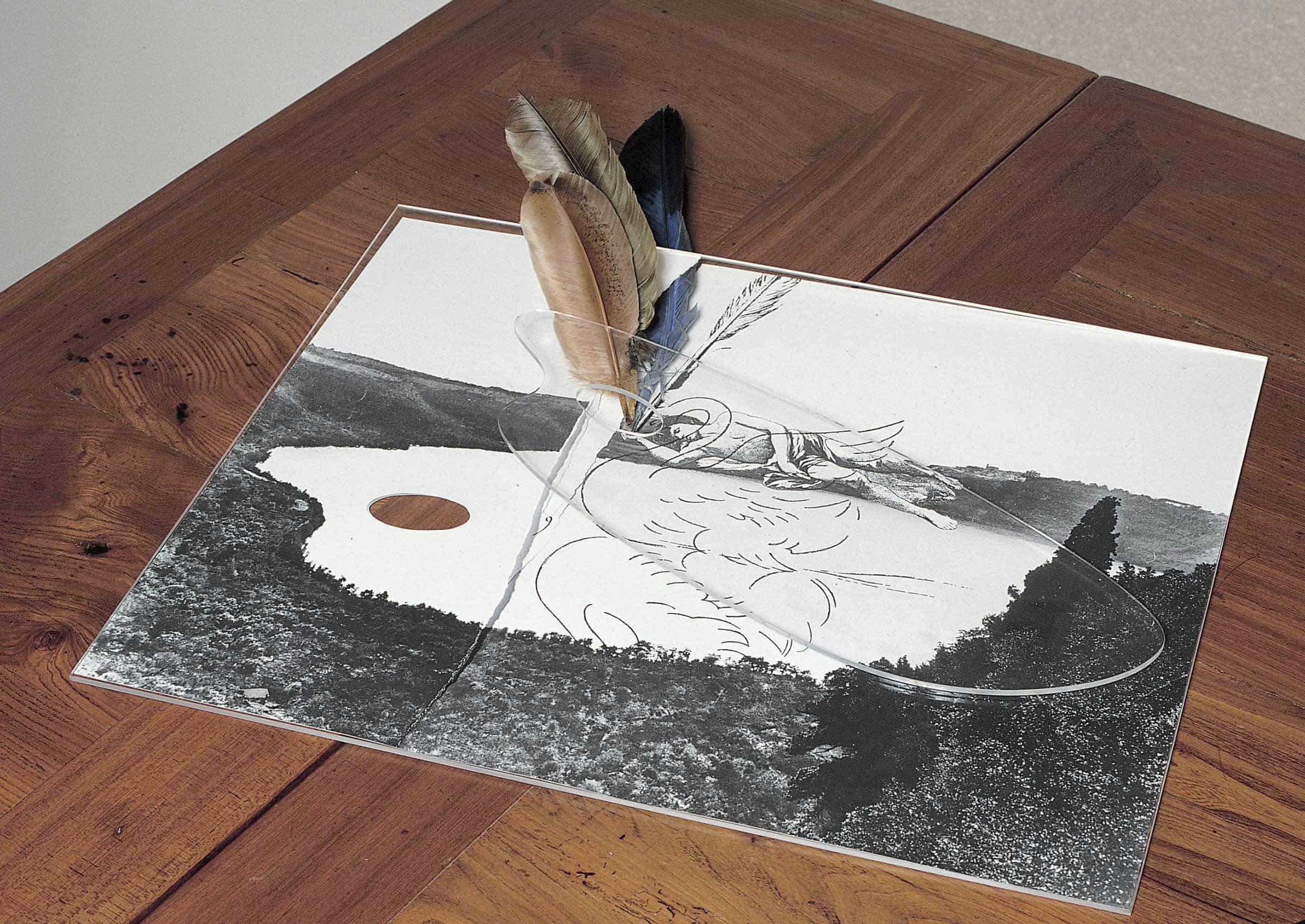
L’exil du cygne, 1983-89
GPO-0652
Photo print, plexiglas shape, plexiglas sheet, feathers
Dismantled work
A photograph of a collage by the artist entitled L’exil du cygne (1982-83, GPC-0638) is held down by a plexiglas oval shape placed across the image and featuring a cut-out, thereby echoing the lake-palette reproduced in the image. Inserted in the hole in the oval sheet are several multicoloured feathers that recall the feather-pen present in the collage.
The latter image reproduces the cut-out figure of sleeping Narcissus – from Echo and Narcissus (ca. 1627) by Nicolas Poussin – inserted on the shores of Lake Nemi, transformed into a palette by way of an oval cut-out. Drawn on the body of water is the profile of a swan and its reflection. A vertical tear, which is corroborated by the image of an antique feather-pen located in the area corresponding to Narcissus' hand and the swan's beak, holds a torn fragment in which the number nine appears: it alludes to the nine Muses and is the symbol of completeness.
The title refers to the final line of the sonnet Le vierge, le vivace et le bel aujourd'hui... (1887) by Stéphane Mallarmé, in which the swan, ideal symbol of the poetic flight, recognizes its exile, that is, its condition as a castaway in a frozen lake, condemned to motionlessness and impotence, to express, in a figurative sense, the insufficiency of the language with respect to the dimension of the absolute.
While the swan drawn on the body of water harkens back to Mallarmé's poem, the feathers – the attribute par excellence for the swan – allude to the poet's pen, or, in a broader sense, to the hand of the artist-painter (similar to the palette).
The first formulations of the theme of L’Exil du cygne date to a work made in 1982 (GPO-0466) and the print edition with the same title published in early 1984 (GPE-0046). Later more in-depth research into the theme was expressed in four homonymous versions, made between 1984 and 1993 (GPO-0513, GPO-0514, GPO-0610, GPO-0712).
• Image of a pen with the number “9” from Denis Diderot, Jean-Baptiste D’Alembert, Encyclopédie, ou Dictionnaire raisonné des sciences, des arts et des métiers. Recueil de planches sur les sciences, les arts libéraux et les arts méchaniques, avec leur explication. Seconde livraison, en deux parties. Première partie 23 (Paris: 1763), plate III (“Art d’Ecrire”).
• Sleeping Narcissus: Nicolas Poussin, Echo et Narcisse, c. 1630, oil on canvas, 74 x 100 cm, Musée du Louvre, Paris; reproduction from L’opera completa di Poussin. Classici dell’arte 72 (Milan: Rizzoli, 1974), plate X, no. 49.
• Landscape: Fratelli Alinari, Nemi – Prov. di Roma. Panorama del Lago e della piccola borgata di Genzano, c. 1890, photograph, 21 x 27 cm, Archivi Alinari, Florence (ACA-F-006861-0000).
| 1990 | Bologna, Galleria Comunale d’Arte Moderna, Villa delle Rose, Giulio Paolini. Hotel de l’Univers, 27 May - 29 July, cited in the checklist of exhibited works no. 1 p. 17, repr. p. 23. |
| 1992-93 | Milan, Galleria Christian Stein, Giulio Paolini, 27 October 1992 - 24 February 1993. |
| • | M. Bertoni, “Giulio Paolini. Dove Vedo”, in Critica e Documentazione 7, supplement to the bimonthly journal Segno 132 (Pescara), April, 1994, repr. pp. 28-29 (exhibition view Bologna 1990). |
| • | M. Disch, Giulio Paolini. Catalogo ragionato 1960-1999, vol. 2 (Milan: Skira editore, 2008), cat. no. 652 p. 670, col. repr. |
| • | Giulio Paolini. A come Accademia, exhibition catalogue, Rome, Accademia Nazionale di San Luca (Rome: Gangemi Editore, 2023), col. repr. p. 211 (exhibition view Bologna 1990). |

