L’ospite, 1999
GPO-0833
The Guest
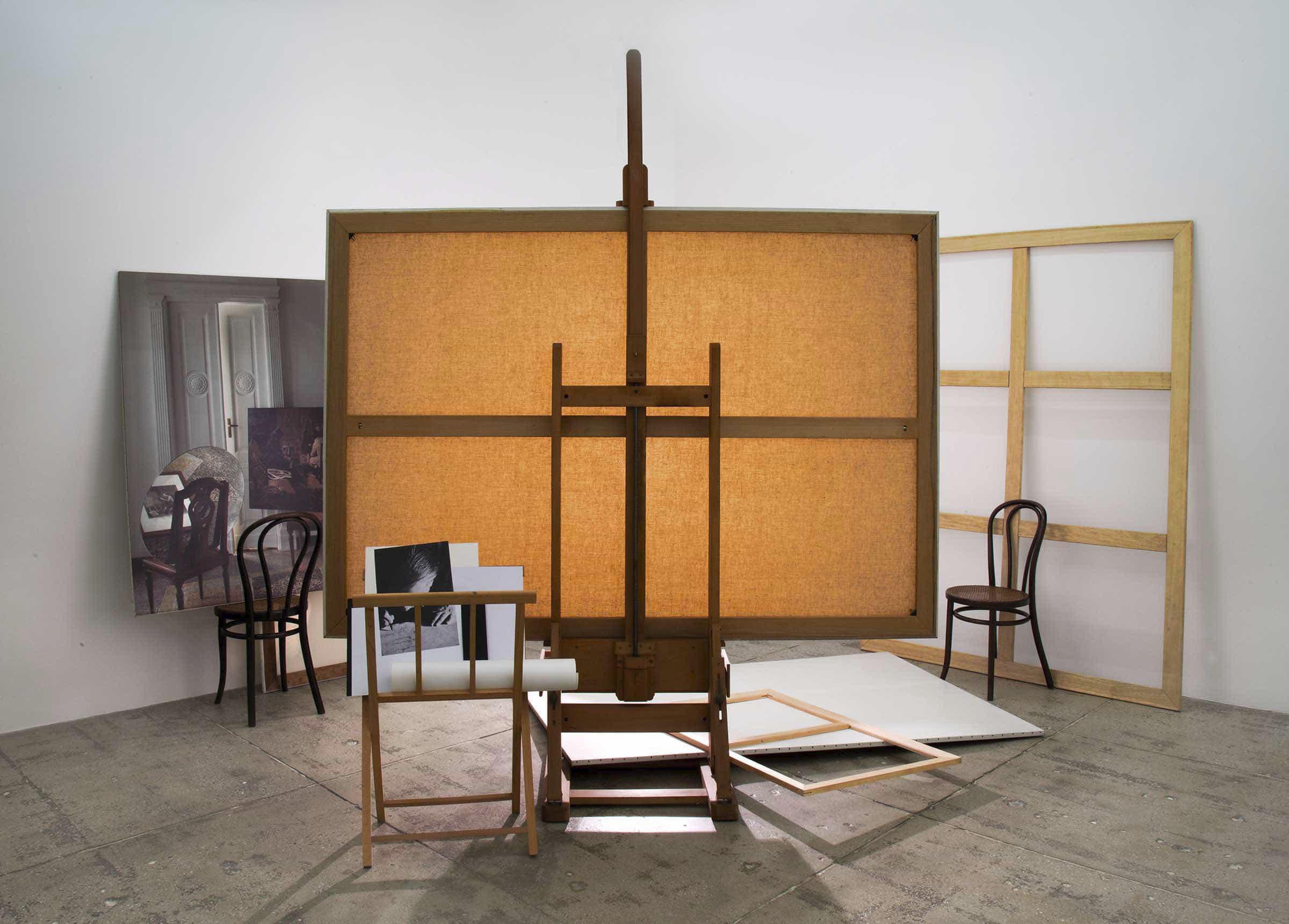
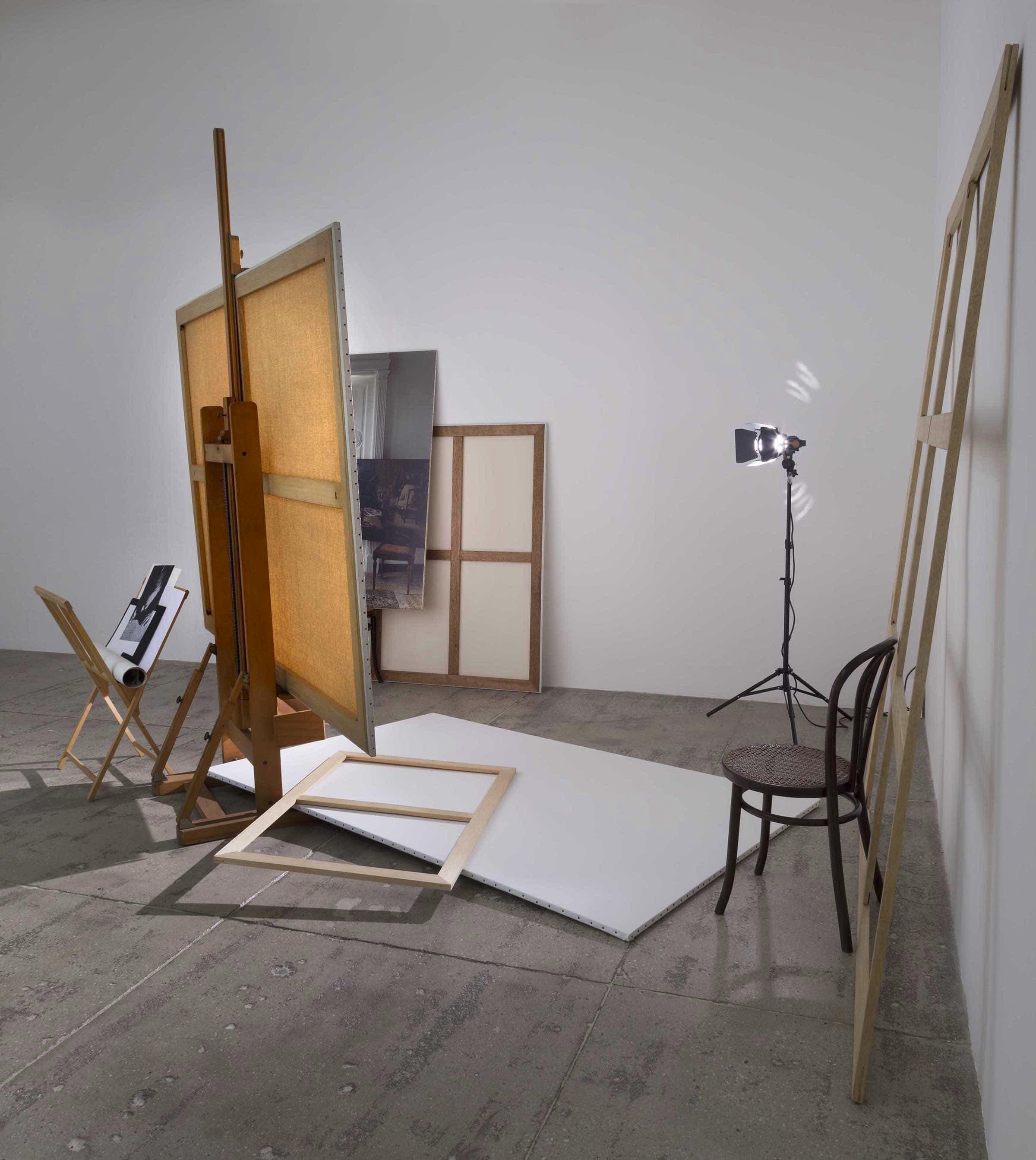
Colour photo print mounted on canvas, chairs, easel, primed canvases, stretchers, wooden print rack, xerox reproduction and other paper elements, floodlight
Photo print 153.5 x 108 cm, three canvases: 160 x 240 cm, 140 x 210 cm, 155 x 110 cm, two stretchers: 224 x 174 cm, 80 x 120 cm, overall dimensions ca. 320 x 390 x 343 cm
Glenstone Foundation, Potomac, Maryland
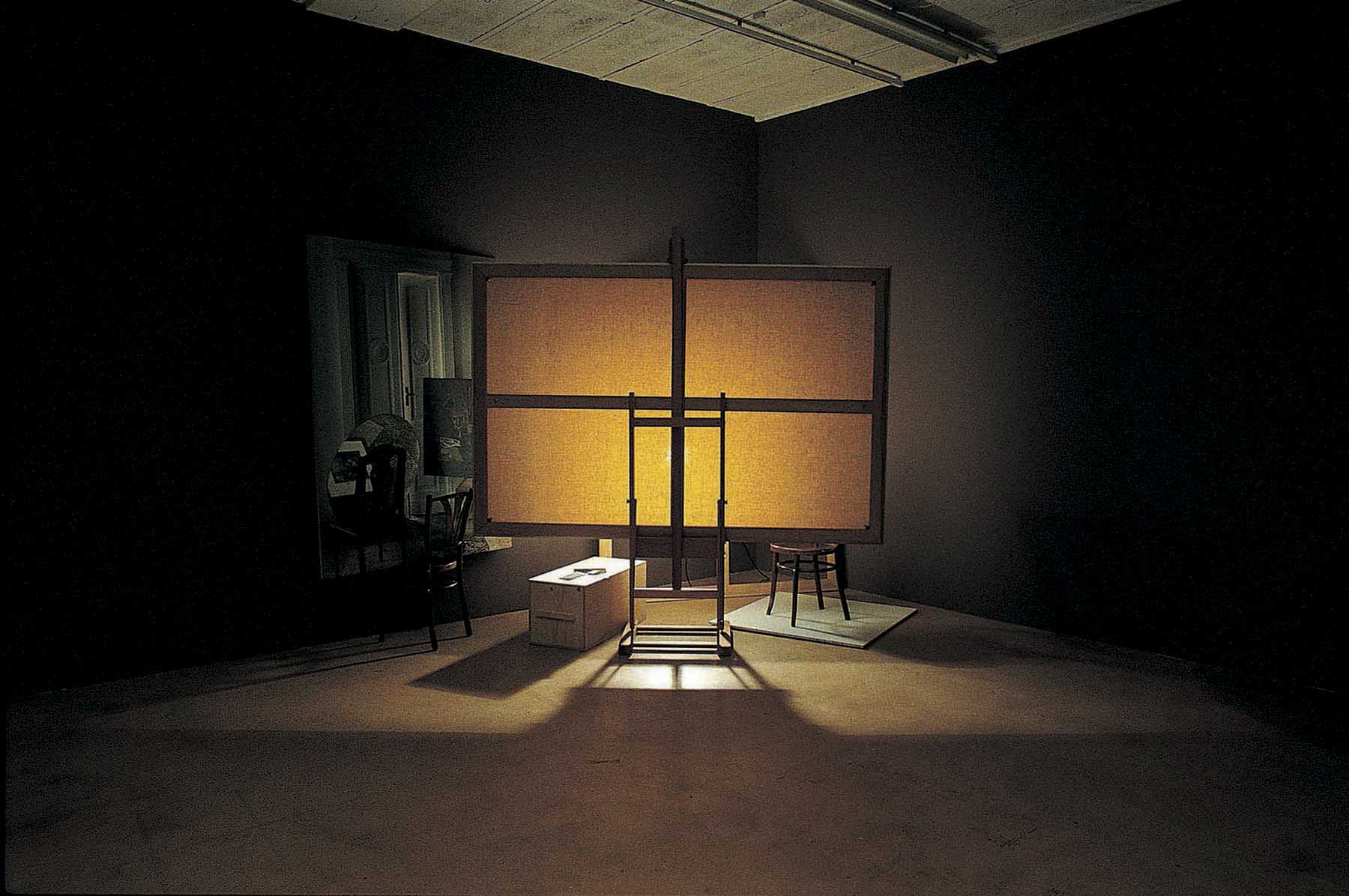
• 1999, Geneva, Centre d’art contemporain: Borges’ portrait, arranged on a crate, was signed and initialed by the artist with the place and date of the opening of the exhibition (“Genève, 22.6.1999”, Geneva is the city where the Argentine writer was laid to rest). Based on the artist’s original intentions – which he abandoned after 2010 – the “guest” who differed each time would have implied variations in the type of support and in the subject of the portrait, depending on the venue and the exhibition itself. For instance, in 2008 Paolini stated as follows: “Hypothetically: in Genoa, a photograph of Paul Valéry (as concerns Nuit gênoise); in Turin, one with Italo Calvino…”.
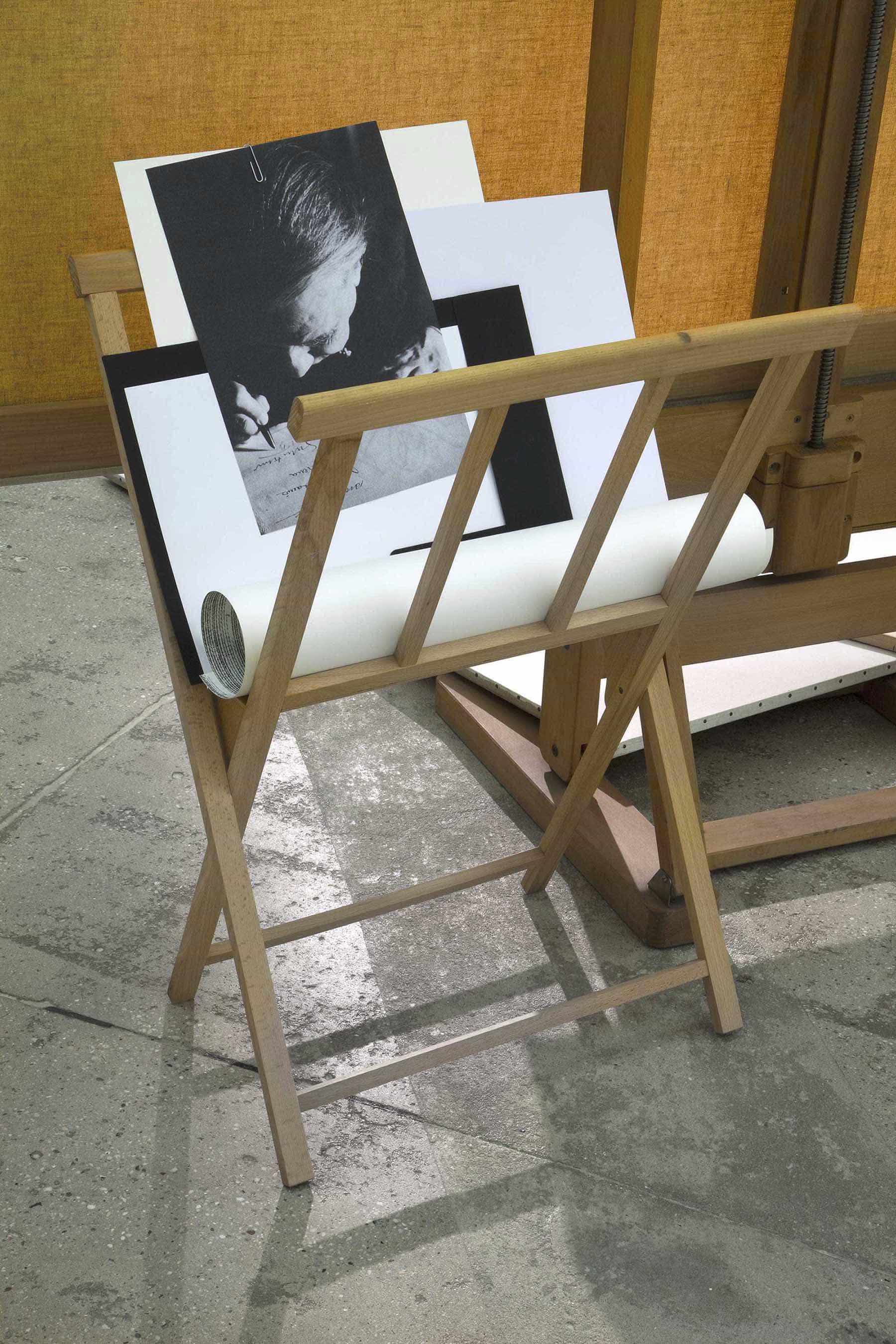
• 2013, Rome, MACRO: the crate was replaced with a portfolio (set down before the large canvas on the easel), including three blank sheets, a black folder, a reproduction of Borges while signing one of his works held down on a larger blank sheet by a metal clip, and another reproduction (unidentified) rolled up in the manner of a scroll. The idea behind these elements is to make Borges’ presence more “at random” and less isolated. (The paper elements are interchangeable depending on the situation and what is available). The artist also added a second, smaller stretcher (80 x 120) laid on top of the canvas on the floor, and a third canvas (155 x 110 cm), reversed and propped up against the wall, next to the chair with the photograph.
The work installed in a room in semidarkness evokes an “artist’s studio”, half hidden from the viewer’s gaze by a large canvas, propped up against an easel turned towards the rear of the room and illuminated by a spotlight. Behind this “screen”, two chairs echo the ones represented in the photograph mounted on canvas, propped up against the chair turned towards the wall. Lying on the ground, at the foot of the easel, is a primed canvas and a stretcher, while another canvas and a second stretcher are propped up against the walls. In the foreground with respect to the viewer is a print rack. Emerging from it, among other paper elements, is a portrait of Jorge Luis Borges intent on signing one of his manuscripts.
The photograph mounted on canvas reproduces a situation that was installed by the artist in the entrance hall of his own home, opposite a door that had been left ajar, with two chairs turned so that one faced the viewer and the other was specular. Standing on the chair to the right is the painting by Angelo Garino Nota intima (1887), while the chair to the left holds an oval mirror that reflects the engraving, set down on the floor out of view, portraying William Hogarth while painting the Comic Muse.1
The title refers to the role that is attributed to the author by Paolini: since in his universe of thinking the work is an entity offered up to the viewer's gaze in its very making or announcing of itself, the author has no choice but to withdraw in order to reserve the field for the work and its hypothetical becoming. After leaving the scene – as indicated by the door left ajar in the photograph – the author becomes the "guest" of something that pre-exists, for which he claims no right except for that of witnessing its possible revelation.
Borges, intent on “signing” the work, certifies the authenticity of the scene – or of the work in fieri in the studio of L’ospite, of which the author, along with us, is an anonymous and silent witness.
The work is part of a group of six variants, made between 1989 and 2007 (GPO-0643, GPO-0676, GPO-0708, GPO-0719, GPO-0833, GPO-0XXX [2007]), which are distinguished by the toning, the print in positive or in negative, and the arrangement of the photograph mounted on canvas.
1 This is the final state (1764) of the self-portrait entitled William Hogarth Painting the Comic Muse, in which the English artist is intent upon painting the Comic Muse, portrayed while holding the mask of a satyr in one hand and associated with the word "Comedy" etched on the base of the column to the right; Hogarth's own treatise on beauty (The Analysis of Beauty) lies at the foot of the easel. Both Garino's painting and Hogarth's engraving are part of Giulio Paolini's private collection.
- Alicia d’Amico, Jorge Luis Borges, 1963, gelatin silver print; reproduction from Emir Rodriguez Monegal, Borgès par lui-même (Paris: Éditions du Seuil, 1970), p. 12.
• View of the entrance hallway of Giulio Paolini’s home taken by Paolo Mussat Sartor, 1988.
• William Hogarth, William Hogarth Painting the Comic Muse, 1764, etching, final state, 75 x 60 cm, Giulio Paolini Collection.
• Angelo Garino, Nota intima, 1887, oil on canvas, 95 x 140 cm, Giulio Paolini Collectio
| 1999 | Geneva, MAMCO Musée d’art moderne et contemporain, Giulio Paolini. Salles d’attente, 22 June - 23 December, no catalogue. |
| 2013-14 | Rome, MACRO Museo d'arte contemporanea Roma, Giulio Paolini. Essere o non essere, 29 November 2013 - 9 March 2014, cited in the checklist of exhibited works p. 154, col. repr. p. 139 (exhibition view), entry by M. Disch pp. 138-139; in the exhibition guide col. repr. p. 37 (exhibition view Geneva 1999), entry by M. Disch pp. 36-37. |
| 2015 | New York, Marian Goodman Gallery, Giulio Paolini, 6 February - 12 March, cited in the checklist of exhibited works p. 165, col. repr. pp. 34-35, 37, 39 (exhibition views, with details), referred to in the text by M. Disch p. 42. |
| • | M. Disch, Giulio Paolini. Catalogo ragionato 1960-1999, vol. 2 (Milan: Skira editore, 2008), cat. no. 833 p. 858, col. repr. (exhibition view Geneva 1999). |
| • | L. Violo, “Giulio Paolini. Siamo tutti comparse”, in Wannenes art magazine 6, no. 2 (Genoa), October, 2016, col. repr. p. 26 (exhibition view New York 2015). |
| • | A. Soldaini, G. Paolini, “In dialogo”, in Giulio Paolini. A come Accademia, exhibition catalogue, Rome, Accademia Nazionale di San Luca (Rome: Gangemi Editore, 2023), p. 92, col. repr. (exhibition view Rome 2013). |

