A come Accademia (III), 2023
GPO-1154
A as in Academy (III)
Grey platform, white plinths, plaster casts, digital print on acrylic fabric, red ink on photo enlargement, primed canvas, crumpled drawing, passepartout, music stand, black and red ink on passepartout, fragments of xerox reproductions, plexiglas sheets
Platform 8 × 160 × 240 cm, three plinths: 200 × 50 × 50 cm, 70 × 50 cm, 50 × 50 × 50 cm, one cast 115 × 40 × 58 cm, one cast 37 × 20 cm, fabric 283 × 395 cm, photo enlargement 50 x 50.5 cm, canvas 40 x 40 cm, crumpled drawing Ø 15 cm, one passepartout 50 x 50 cm, one passe-partout 50 x 70 cm, music stand 131 x 91 cm, two plexiglas sheets 50 × 70 cm each, overall dimensions 380 x 210 x 243 cm
Collection of the artist
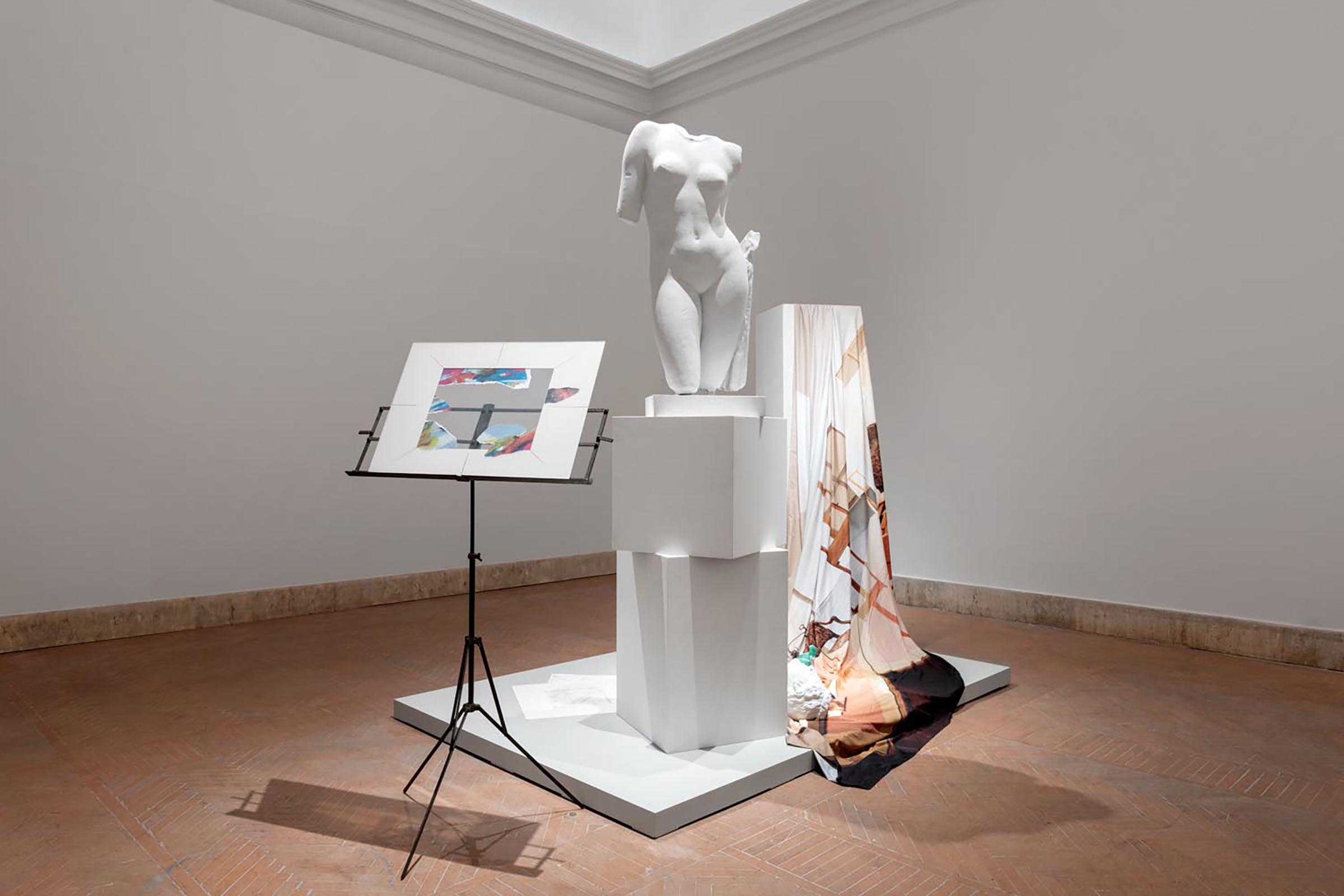
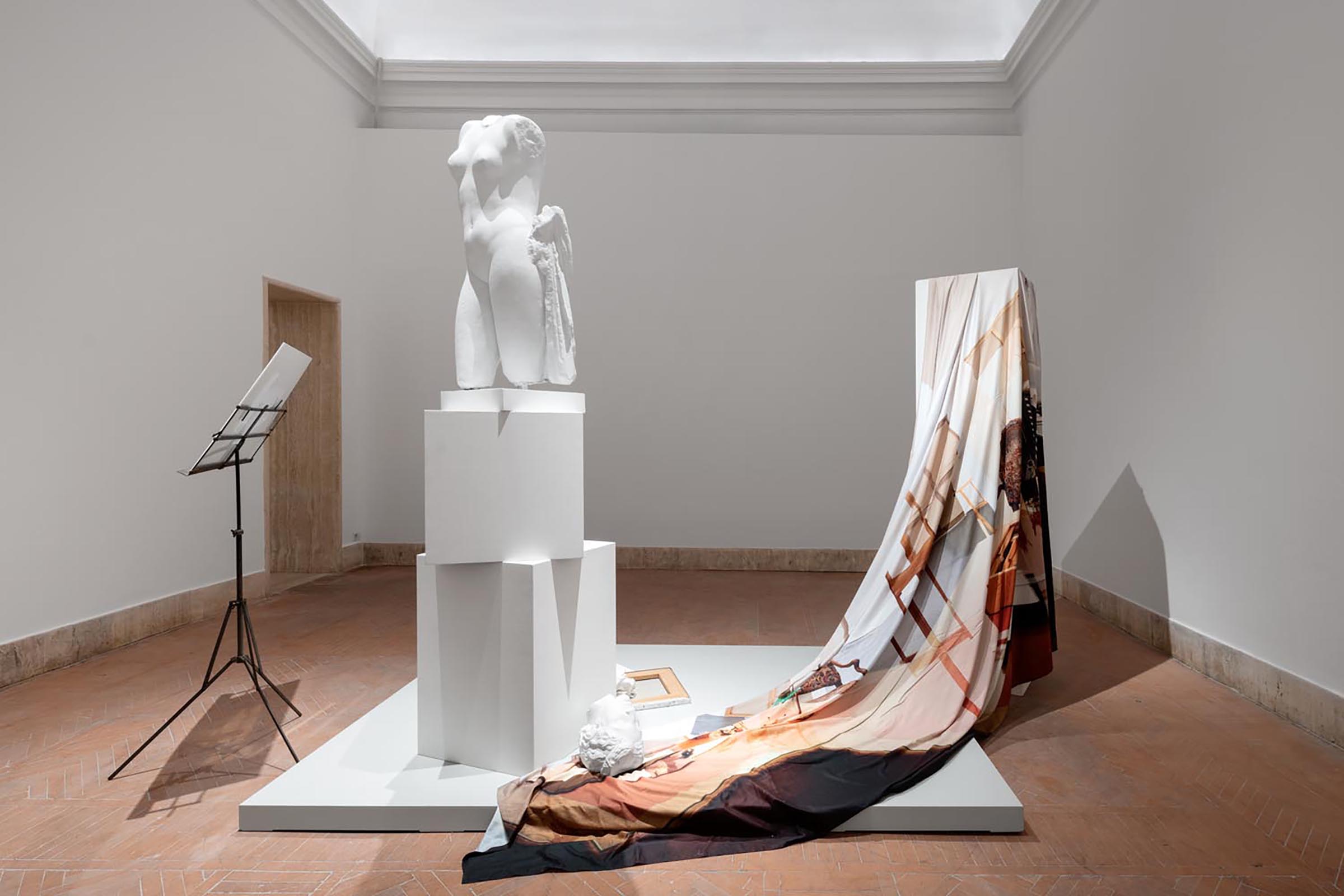
Two plinths of different heights, placed one atop the other so that they are askew, act as a support for the plaster cast of the Venus of Phidias. From another taller plinth a piece of fabric with a photographic reproduction of the artist's studio drapes to the floor. Arranged on a platform below are several elements in the artist's repertoire: an overturned canvas, a plaster cast of the head of Aphrodites (like Venus, related to the classical idea of beauty), the project for a work from 1987 (GPO-0611), and a white passepartout. A short distance away on a music stand is a second passepartout held between two plexiglas sheets; sketched on the passepartout are the median axes in black and the diagonal axes in red; inside the cut-out are several torn fragments of photographic reproductions (colour proofs, night-time and daytime skies) that "seemingly echo the figures of the assemblage".1
The objects and materials arranged on the platform allude to an artist's studio: ‘a place of election' that can host the becoming of an artwork, also announced by the fragments of images in the cut-out of the passepartout on the music stand. The framing itself seems to suggest the limits within which an image or a painting can be manifested, while the drawing on the passepartout recalls the squaring of Disegno geometrico (1960, GPO-0001), the potential container of all past, present, and future images.
As the title tells us, the work is the third version of the theme A come Accademia, developed in 2010 and returned to in 2023, on the occasion of the solo exhibition at the Accademia Nazionale di San Luca in Rome, where the three versions converse with the academic surroundings, recalling the figure of the author, the idea of the model, and the artist's studio, respectively (cf. GPO-1005, GPO-1153, GPO-1154).
Moreover, the assemblage of materials mounted on the platform reformulates, with some variations and omissions, the work titled Expositio, made in 2019 (GPO-1091).
1 G. Paolini interviewed by A. Soldaini, “In dialogo”, in Giulio Paolini. A come Accademia, exhibition catalogue, Rome, Accademia Nazionale di San Luca (Rome: Gangemi Editore, 2023), p. 99.
• Phidias, Venus, h 115 cm.
• Head of Aphrodite, unknown source.
• View of Giulio Paolini’s studio taken by Paolo Mussat Sartor, 1997.
| 2023 | Rome, Accademia Nazionale di San Luca, Giulio Paolini. A come Accademia, 20 April - 15 July, cited in the checklist of exhibited works p. 304, col. repr. pp. 54-57 (exhibition views), referred to in texts by A. Soldaini pp. 36-38, F. Guzzetti pp. 73-74. |
| • | G. Paolini, “A come Accademia”, in Giulio Paolini. A come Accademia, exhibition catalogue, Rome, Accademia Nazionale di San Luca (Rome: Gangemi Editore, 2023), p. 20. |
| • | G. Paolini in the interview with A. Soldaini, “In dialogo”, ibid., p. 99. |
| • | G. Paolini in the interview with G. dalla Chiesa, “Giulio Paolini. Una conversazione”, in art a part of cult(ure), online journal, 23 May 2023. |

