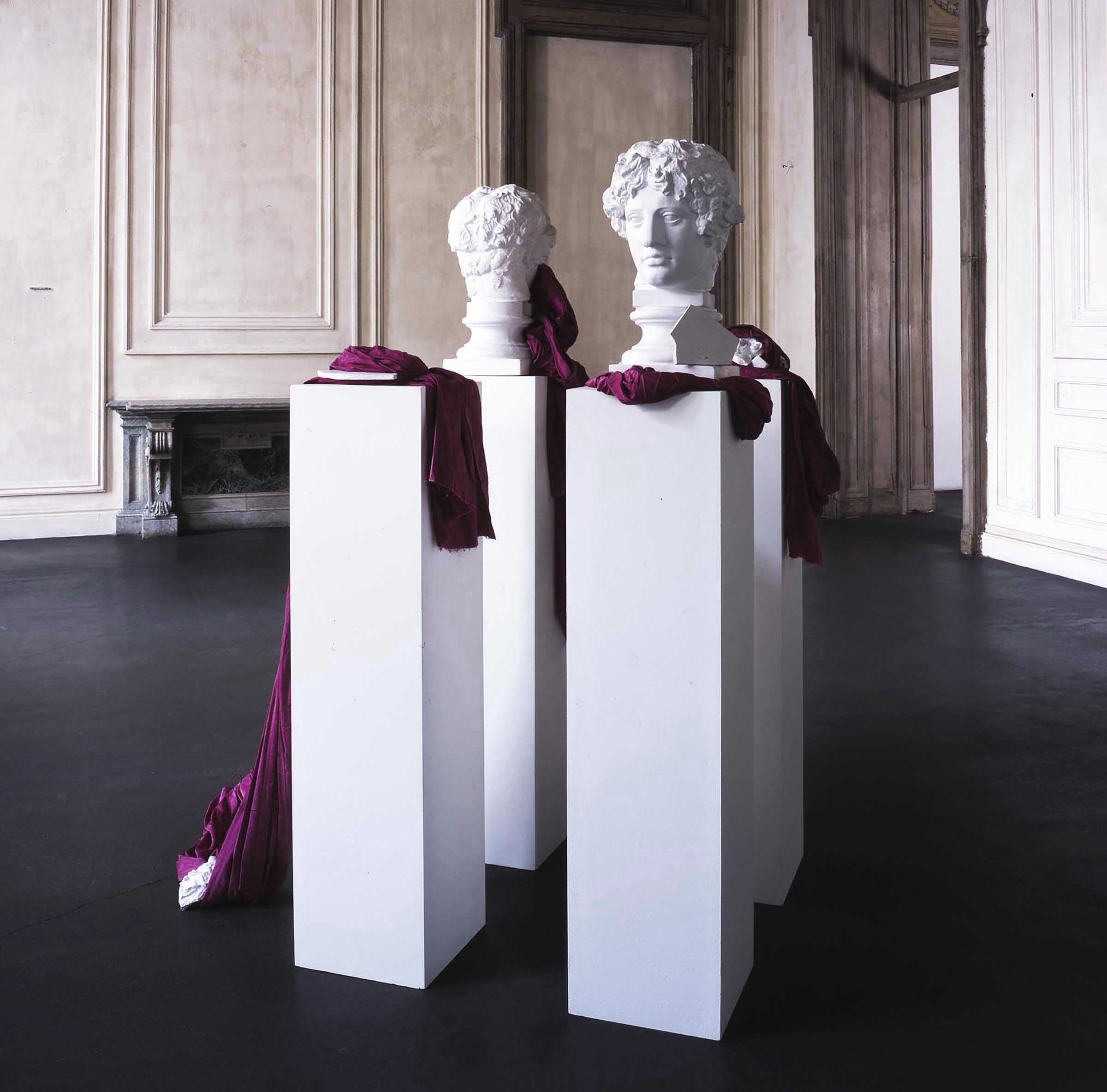
Casa di Lucrezio, 1981
GPO-0454
House of Lucretius
Two whole and two fractured plaster casts, fabrics, fragments of carved plaster tablet, white plinths
Two casts h 47 cm each, four plinths 120 x 30 x 30 cm each, overall dimensions variable
Castello di Rivoli Museo d’Arte Contemporanea, Rivoli-Turin
Acquired in 1986, inventory no. C-PAOG-001
The ideal installation of the work includes the diagonal opposition of two pairs of heads, respectively whole and in fragments, or, in a different spatial situation, the alignment of the plinths along the two opposite sides of the room.
• 1984, Turin, Christian Stein gallery-cum-house: the work is installed at the centre of the room, with the four plinths arranged to form a square area, which is staggered with respect to the sides of the room; the two whole heads are arranged along a diagonal axis and turned so that they face each other (the reproduction of this installation in the catalogue of the exhibition The European Iceberg published in 1985 shows that it was made before the presentation of the work in the exhibition Ouverture at the Castello di Rivoli, in December 1984. This installation model was repeated several times for the presentation of the work as part of the collection of the Castello di Rivoli in the 1990s and 2000s).
• 1984-1987, Rivoli, Castello di Rivoli: installation up against two opposite walls (two elements on each side).
• 2008, Rivoli, Castello di Rivoli: installation up against a single wall (two pairs, each of which at one end of the wall), along with all the other works by the artist in the museum's permanent collection.
• 2011, Moscow, Multimedia Art Museum: installation with the four plinths close together; the two whole heads are turned outwards (the installation was not curated by the artist; though it reproduced the usual one for the work in the permanent collection of the Castello di Rivoli, there were some mistakes).
• 2013, Turin, Palazzo Chiablese: installation with four plinths forming a square area, parallel to the sides of the room (the furnished and in itself rich environment suggested to the artist a less "imposing", more "silent" installation with respect to one in an empty room, where it is the work that dominates). The two whole heads along a diagonal axis are turned outwards. On the ground, caught in the falling drapery, is a single plaster fragment (of the head). On the plinth where the fragments are entirely wrapped in the cloth there is no fragment of the tablet on the ground: the largest fragment, from the face, is left in sight, with the cloth wrapped around it at eye level (as if to cover the figure's sight). In a whole head, the clearly visible fragment of the tablet, with part of the carved drawing, is up against the head on the left side; in the other head, it is up against the left. In the whole head with the legible fragment from the tablet the cloth is folded behind the tablet (it does not wrap the head). In the whole head with the smallest fragment from the tablet, the cloth is folded under the head, without creating too much volume, and without protruding too much.
• 2017, Rivoli, Castello di Rivoli: the drapery falling to the ground is extended for its entire length, like a long train, and catches one plaster fragment.
The theme of the Casa di Lucrezio was developed in seven variants made in the same year (from GPO-0452 to GPO-0458), followed by two other versions made in 1982 and in 1984 (GPO-0481, GPO-0517). The common denominator between the works is the fragmentation of a plaster tablet bearing a drawing of a labyrinth carved on a pillar in Lucretius’s house in Pompeii,1 matched with a series of possible semblances of the Latin poet, evoked by the plaster cast of a head of Apollo and a piece of draped cloth. The cast of the ancient carving is broken each time into an increasing number of fragments – starting from the two broken parts in the first work – thereby accentuating its labyrinthine component.2 The gradual subdivision of the drawing also determines a complementary multiplication of the poet’s faces – starting from two heads and two cloths in the initial version – which along with the various positions of the cast and the variations in the colour of the cloths gradually expands the question as to the possibility of determining an ungraspable figure.
The third version is defined by the fragmentation into four parts of the carved tablet and by the presence of four casts of a classical head, two whole and two in pieces. The whole heads, each of which set on a plinth, reproduce two configurations staged in the previous version, while the fragments from the broken heads introduce two new variants: in one case the plaster fragments are wrapped around the dark fuchsia drapery so it forms a bundle set down on the plinth, while in the other, the broken cast of the head is lying on the ground, on the cloth that drops down along the sides of the plinth.
In the artist's words: “The intentionality of this work lies in evoking – and not representing – the idea of the continuous becoming of a possible space, inhabited by poetry. The title leads to another place, the casts point to their place of provenance, the drawing of the labyrinth evokes not just another place – the House of Lucretius – but also the symbolic figure of the labyrinth. These are all various elements which are meant to subtract themselves from vision to instead suggest a dense void of evocation, the making of space for the chances of imagination that each one of us harbours inside”.3
1 The original drawing with the words “Labyrinthus Hic Habitat Mynotaurus” is from the Enciclopedia Einaudi, vol. 8 (Turin: 1979), p. 12, under “labirinto”, and is described as a labyrinth "on a pillar of the House of Lucretius". The Pompeiian house where the drawing was discovered was actually the domus of the duovir Marcus Lucretius Fronto, and not of the poet Titus Lucretius Carus (cf. G. Sarullo, “Labirinti a Pompei: a proposito di CIL IV 2331”, in Oebalus. Studi sulla Campania nell’Antichità 3 (Rome), 2008, pp. 203-223; I am grateful to Stefano Menichini for this information). On his part, Paolini does not remember whether his association was simply a case of poetic license or an unwitting mistake.
2 The drawing was carved on plaster tablets measuring 35 x 35 cm, which were later shattered.
3 G. Paolini interviewed by F. Pasini, in L’Illustrazione italiana V, no. 24 (Milan), November, 1985, p. 21. On the labyrinth as the inspiration for the work cf. G. Paolini interviewed by C. Grenier, in Flash Art 3 (Milan, French edition), Spring, 1984, p. 41.
• Head of Ephebos on modern bust, second quarter 1st century AD - first half 2nd century AD, white marble, Musei Reali – Museo di Antichità, Turin.
• Drawing of the labyrinth with writing from the Enciclopedia Einaudi, vol. 8 (Turin: 1979), p. 12 (entry “labirinto”).
| 1984-85 | Rivoli, Castello di Rivoli, Ouverture, 19 December 1984 - February 1985, cited in the checklist of exhibited works no. 75 p. 131, col. repr. pp. 62-64 (exhibition view, with details). |
| 1986 | Rivoli, Castello di Rivoli, Ouverture II, from June, col. repr. p. 65 (exhibition view, detail). |
| 1986-87 | Rivoli, Castello di Rivoli, Markus Lüpertz, Giulio Paolini: figure, colonne, finestre, 19 December 1986 - 29 March 1987, cited in the checklist of exhibited works no. 52 p. 117 (erroneously dated “1981-84”), repr. p. 132 (exhibition view, detail). |
| 1987 | Erice, “La Salerniana”, ex Convento di San Carlo, Incrocio: un racconto, 6 June - 12 July, cited in the checklist of exhibited works p. 69 (erroneously dated “1981-89”), repr. p. 60 (exhibition view Rivoli 1986-87). |
| 2008-09 | Rivoli, Castello di Rivoli Museo d’Arte Contemporanea, Una stanza tutta per sé, 2 April 2008 - 18 January 2009, no catalogue. |
| 2011 | Moscow, Multimedia Art Museum, Arte Povera in Moscow. Works from the collection of the Castello di Rivoli, 24 May - 10 July 2011, cited in the checklist of exhibited works p. 127, col. repr. pp. 87 (installation view at Castello di Rivoli, Rivoli, unknown date), 170-171, 173 (exhibition views), with anonymous commentary p. 140. |
| 2013 | Turin, Palazzo Chiablese, temporary installation of works belonging to the Castello di Rivoli, 21 March - 10 May, no catalogue. |
| 2017-19 | Rivoli, Castello di Rivoli Museo d’Arte Contemporanea, from 25 July 2017, as part of the installation of the collection. |
| 2022 | Rivoli, Castello di Rivoli Museo d’Arte Contemporanea, exhibited in the Chinese room, from 30 July, as part of the installation of the collection. |
| • | G. Paolini in the interview with C. Grenier, “Giulio Paolini”, in Flash Art 2 (Milan, French edition), February, 1984, p. 41; republished in Italian in Giulio Paolini. La voce del pittore – Scritti e interviste 1965-1995, edited by M. Disch (Lugano: ADV Publishing House, 1995), p. 191. |
| • | G. Paolini in the interview with F. Pasini, “La parola e la mano”, in L’Illustrazione italiana 5, no. 24 (Milan), November, 1985, p. 21; republished in Giulio Paolini. La voce del pittore, op. cit. (Lugano: 1995), p. 208. |
| • | G. Paolini in the interview with E. Pizzo, in Giulio Paolini. Casa di Lucrezio, 1981-84, visitor’s guide (Rivoli: Castello di Rivoli Museo d’arte contemporanea, 1987). |
| • | The European Iceberg. Creativity in Germany and Italy Today, exhibition catalogue, Toronto, Art Gallery of Ontario (Milan: Nuove Edizioni Gabriele Mazzotta, 1985), col. repr. p. 153 (installation view at the gallery-cum-house of Christian Stein, Turin, erroneously dated “1981-82”). |
| • | E. Pizzo, in Giulio Paolini. Casa di Lucrezio, 1981-84, visitor’s guide (Rivoli: Castello di Rivoli Museo d’arte contemporanea, 1987), n. pag. (erroneously dated “1981-84”), col. repr. (installation view at Castello di Rivoli, Rivoli, 1986, detail), b/w repr. (exhibition view Rivoli 1984). |
| • | Colección Sonnabend, exhibition catalogue, Madrid, Centro de arte Reina Sofía, 1987, col. repr. p. 235 (installation view at the gallery-cum-house of Christian Stein, Turin, erroneously dated “1981-84”; the version of the work reproduced in the catalogue is not the one that was exhibited); French edition: Collection Sonnabend, exhibition catalogue, Bordeaux, capc Musée d’art contemporain, 1988, col. repr. p. 251 (with correction of the collection of the reproduced version). |
| • | Eighty. Sculpture des années 80 / Sculpture of the 80’s ([Belgium]: Eighty Publications, 1990), col. repr. p. 155. |
| • | La Collezione (Rivoli-Milan: Castello di Rivoli Museo d’arte contemporanea and Edizioni Charta, 1994), commentary by G. Verzotti p. 112 (erroneously dated “1981-84”), col. repr. (installation view at Castello di Rivoli, Rivoli, 1994). |
| • | Il mito e il classico nell’arte contemporanea italiana 1960-1990, exhibition catalogue, Sarzana, Fortezza Firmafede (Milan: Edizioni Gabriele Mazzotta, 1995), repr. p. 18 (exhibition view Rivoli 1986-87, detail, erroneously dated “1981-84”). |
| • | M. Unterdörfer, Die Rezeption der Antike in der Postmoderne: der Gipsabguss in der italienischen Kunst der siebziger und achtziger Jahre (Weimar: VDG Verlag und Datenbank für Geisteswissenschaften, 1998), pp. 36, 169, cat. no. 43 p. 143 (erroneously dated “1981-84”), repr. no. 27 p. 216 (detail). |
| • | Arte povera in collezione (Rivoli-Milan: Castello di Rivoli Museo d’Arte Contemporanea and Edizioni Charta, 2000), catalogue entry by M. Disch p. 212, col. repr. p. 213 (installation view at Castello di Rivoli, Rivoli, 1994). |
| • | Castello di Rivoli Museo d’Arte Contemporanea. La Residenza Sabauda – La Collezione, edited by I. Gianelli and M. Beccaria (Turin: Umberto Allemandi & C., 2003), commentary by G. Verzotti pp. 287-288 (erroneously dated “1981-1984”), col. repr. p. 289 (installation view at Castello di Rivoli, Rivoli, 1994). |
| • | L.V. Masini, L’arte del Novecento. Dall’Espressionismo al Multimediale, vol. XI: L’Arte come idea (Florence-Rome: Giunti and Gruppo Editoriale Espresso, 2003), col. repr. no. 2850 p. 558 (installation view at the gallery-cum-house of Christian Stein, Turin, erroneously dated “1981-82”). |
| • | Mentalgrafie. Viaggio nell’arte contemporanea italiana / Mentalscapes. A Journey through Italian Contemporary Art, exhibition catalogue, Tel Aviv, Tel Aviv Museum of Art (Milan: Skira editore, 2007), col. repr. p. 25 (installation view at Castello di Rivoli, Rivoli, 1994). |
| • | M. Disch, Giulio Paolini. Catalogo ragionato 1960-1999, vol. 1 (Milan: Skira editore, 2008), cat. no. 454 p. 465, col. repr. (installation view at Castello di Rivoli, Rivoli, 1994). |
| • | Castello di Rivoli Museo d’Arte Contemporanea. La Residenza Sabauda – La Collezione (Milan: Skira editore, 2008), p. 409, col. repr. pp. 410 (installation view at Castello di Rivoli, Rivoli, 1994), 416-417 (exhibition view Rivoli 2008). |
| • | Castello di Rivoli Museo d’Arte Contemporanea. La storia e le collezioni, edited by C. Christov-Bakargiev and M. Beccaria, Rivoli, Castello di Rivoli Museo d’Arte Contemporanea (Turin: Umberto Allemandi & C., 2023), vol. I, p. 72 (referred to in the text by F. Belloni), not repr.; vol. II, pp. 820 (referred to in the text by M. Beccaria), col. repr. p. 818. |
| • | Arte Povera. Dialoghi / Dialogues, exhibition catalogue, Paris, Tornabuoni Arte (Florence: Forma Edizioni, 2024), col. repr. p. 183 (installation view at Castello di Rivoli, Rivoli, 1994). |

