Casa di Lucrezio, 1981
GPO-0458
House of Lucretius
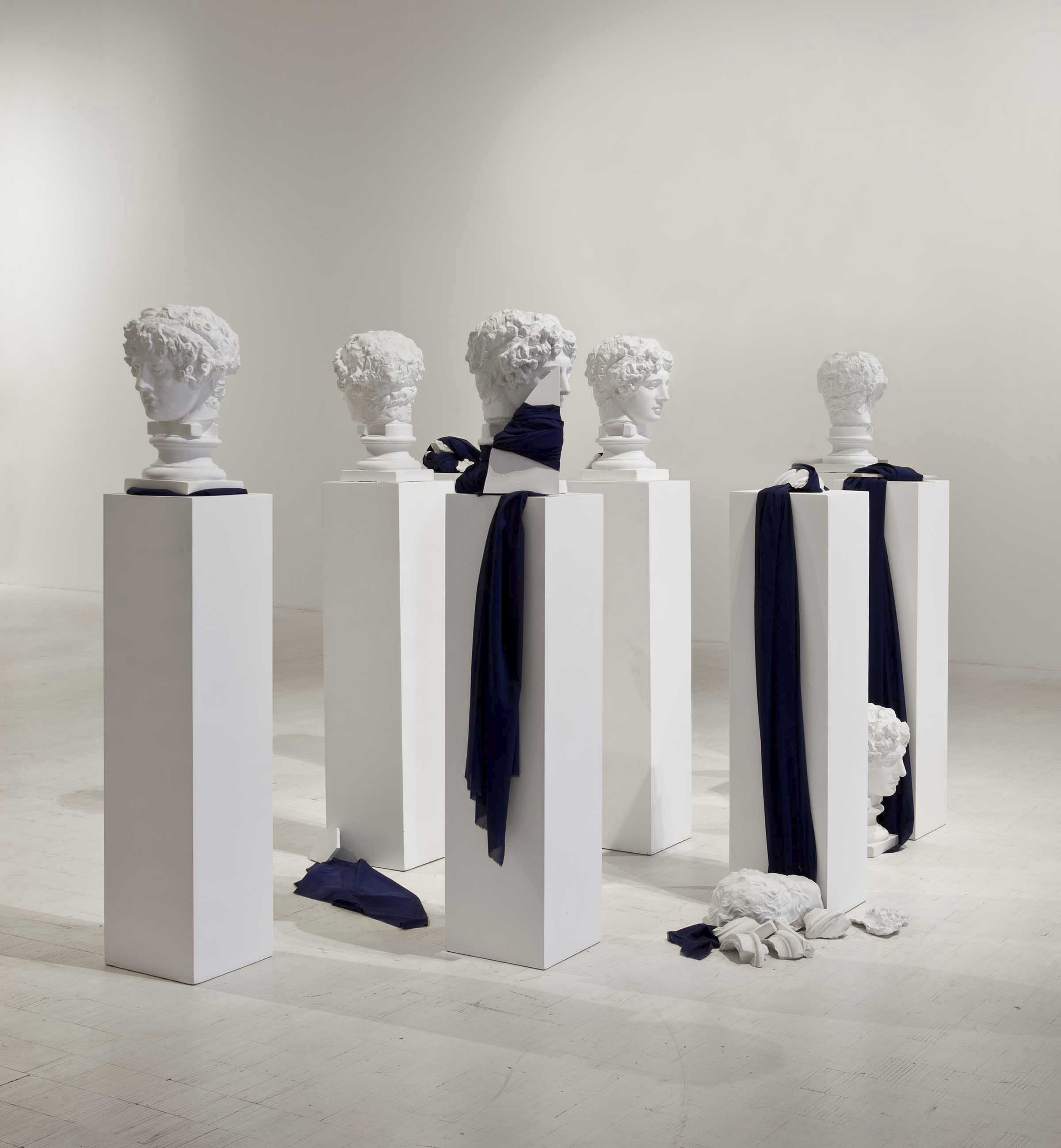
Six whole and two fractured plaster casts, fabrics, fragments of carved plaster tablet, white plinths
Six casts h 47 cm each, eight plinths 120 x 30 x 30 cm each, overall dimensions variable
Noire Collection
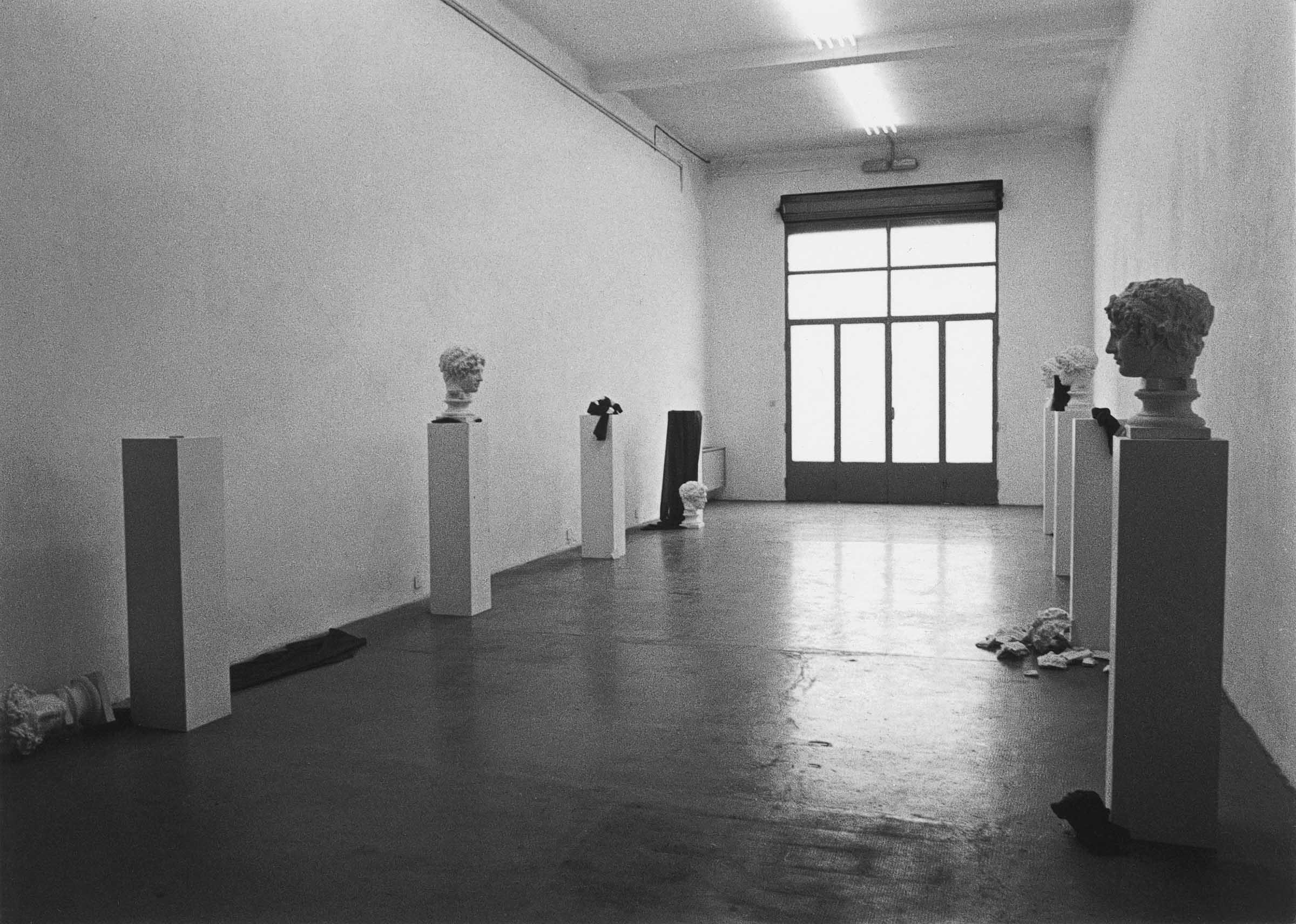
In a relatively large room – with a sufficient amount of space all around – the eight plinths must be grouped at the centre, in two rows of four each, while in a smaller room (or a long rectangular one) they can be arranged up against two opposite walls (four on one side and four on the other).
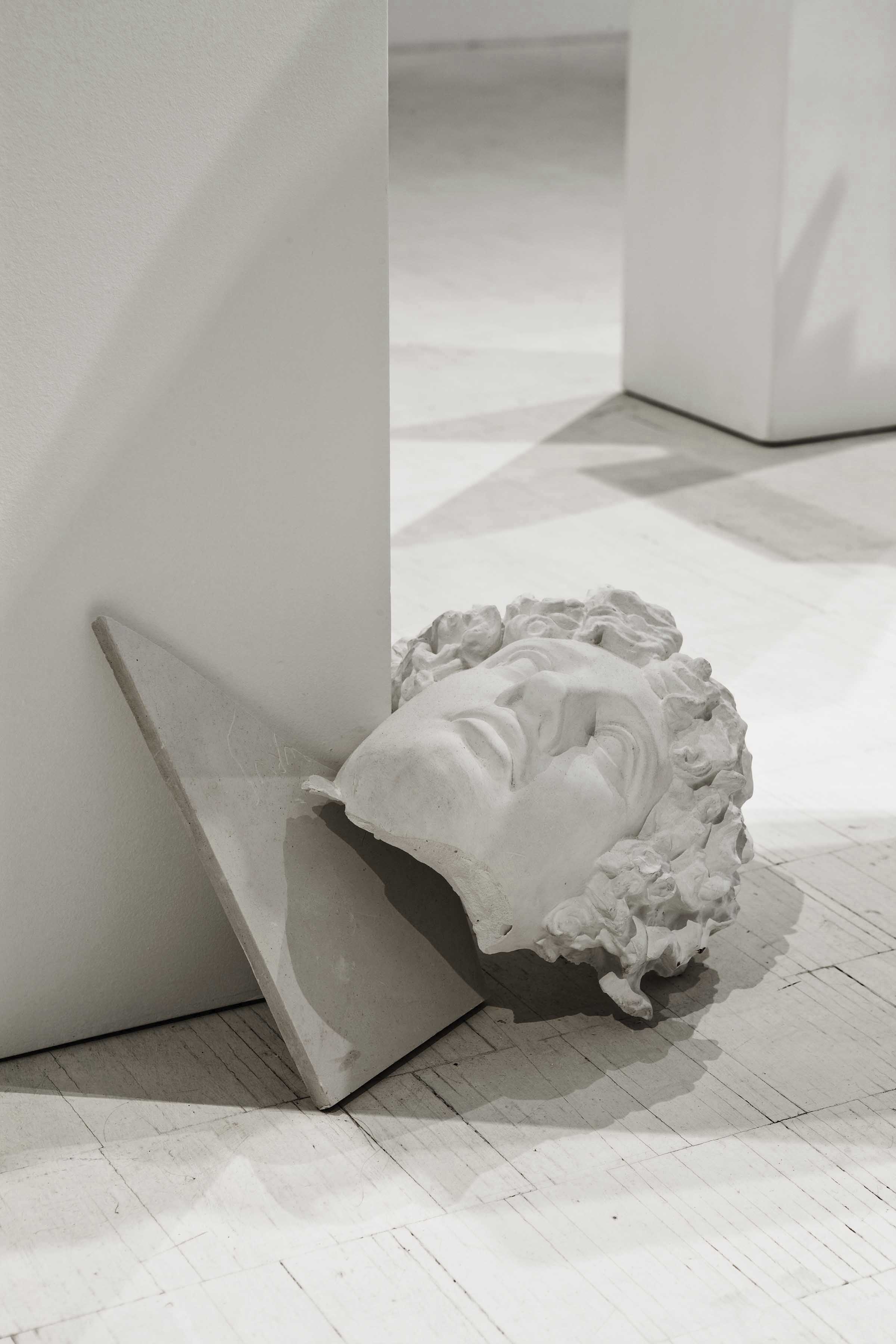
The theme of the Casa di Lucrezio wascvdeveloped in seven variants in the same year (from GPO-0452 to GPO-0458), followed by two other versions made in 1982 and in 1984 (GPO-0481, GPO-0517). The common denominator between the works is the fragmentation of a plaster tablet bearing a drawing of a labyrinth carved on a pillar in Lucretius’s house in Pompeii,1 matched with a series of possible semblances of the Latin poet, evoked by the plaster cast of a head of Apollo and a piece of draped cloth. The cast of the ancient carving is broken each time into an increasing number of fragments – starting from the two broken parts in the first work – thereby accentuating its labyrinthine component.2 The gradual subdivision of the drawing also determines a complementary multiplication of the poet’s faces – starting from two heads and two cloths in the initial version – which along with the various positions of the cast and the variations in the colour of the cloths gradually expands the question as to the possibility of determining an ungraspable figure.
In the seventh version the design of the labyrinth is broken up into eight parts, corresponding to eight different faces for the poet, wearing a dark blue cloth here. Added to the composition of casts, cloths, and fragments experimented with in the previous – and potentially unlimited – versions is a new pose, in which the cast of the head is lying on the ground, along with an unfolded cloth, while the fragment from the tablet is set atop the plinth.
In the artist's words: “The intentionality of this work lies in evoking – and not representing – the idea of the continuous becoming of a possible space, inhabited by poetry. The title leads to another place, the casts point to their place of provenance, the drawing of the labyrinth evokes not just another place – the House of Lucretius – but also the symbolic figure of the labyrinth. These are all various elements which are meant to subtract themselves from vision to instead suggest a dense void of evocation, the making of space for the chances of imagination that each one of us harbours inside”.3
1 The original drawing with the words “Labyrinthus Hic Habitat Mynotaurus” is from the Enciclopedia Einaudi, vol. 8 (Turin: 1979), p. 12, under “labirinto”, and is described as a labyrinth "on a pillar of the House of Lucretius". The Pompeiian house where the drawing was discovered was actually the domus of the duovir Marcus Lucretius Fronto, and not of the poet Titus Lucretius Carus (cf. G. Sarullo, “Labirinti a Pompei: a proposito di CIL IV 2331”, in Oebalus. Studi sulla Campania nell’Antichità 3 (Rome), 2008, pp. 203-223; I am grateful to Stefano Menichini for this information). On his part, Paolini does not remember whether his association was simply a case of poetic license or an unwitting mistake.
2 The drawing was carved on plaster tablets measuring 35 x 35 cm, which were later shattered.
3 G. Paolini interviewed by F. Pasini, in L’Illustrazione italiana V, no. 24 (Milan), November, 1985, p. 21. On the labyrinth as the inspiration for the work cf. G. Paolini interviewed by C. Grenier, in Flash Art 3 (Milan, French edition), Spring, 1984, p. 41.
• Head of Ephebos on modern bust, second quarter 1st century AD - first half 2nd century AD, white marble, Musei Reali – Museo di Antichità, Turin.
• Drawing of the labyrinth with writing from the Enciclopedia Einaudi, vol. 8 (Turin: 1979), p. 12 (entry “labirinto”).
| 1981 | Brescia, Banco (Galleria Massimo Minini), Giulio Paolini. Casa di Lucrezio, from 27 November. |
| 2011-12 | Milan, Triennale di Milano, Arte Povera 1967-2011, 25 October 2011 - 29 January 2012, cited in the checklist of exhibited works p. 681, not repr. |
| 2017 | Florence, Palazzo Vecchio, Ytalia. Energia Pensiero Bellezza. Tutto è connesso, 2 June - 1 October, cited in the checklist of exhibited works p. 215 (erroneously titled “La casa di Lucrezio”), col. repr. pp. 107, 108, 109 (exhibition views), referred to in the text by L. Conte p. 195. |
| 2024-25 | Catania, Fondazione Puglisi Cosentino, I miti dell’arte contemporanea, 1 November 2024 - 31 May 2025, col. repr. pp. 88-89, 93, 96-97, 98-99 (exhibition views), 90-91 (detail), referred to in the text by F. Poli p. 9 and in the text p. 92. |
| • | G. Paolini in the interview with C. Grenier, “Giulio Paolini”, in Flash Art 2 (Milan, French edition), February, 1984, p. 41; republished in Italian in Giulio Paolini. La voce del pittore – Scritti e interviste 1965-1995, edited by M. Disch (Lugano: ADV Publishing House, 1995), p. 191. |
| • | G. Paolini in the interview with F. Pasini, “La parola e la mano”, in L’Illustrazione italiana 5, no. 24 (Milan), November, 1985, p. 21; republished in Giulio Paolini. La voce del pittore, op. cit. (Lugano: 1995), p. 208. |
| • | G. Paolini in the interview with E. Pizzo, in Giulio Paolini. Casa di Lucrezio, 1981-84, visitor’s guide (Rivoli: Castello di Rivoli Museo d’arte contemporanea, 1987). |
| • | Il modo italiano, exhibition catalogue, Los Angeles, Los Angeles Institute of Contemporary Art, 1984, vol. 1, repr. p. 23 (detail). |
| • | M. Disch, Giulio Paolini. Catalogo ragionato 1960-1999, vol. 1 (Milan: Skira editore, 2008), cat. no. 458 p. 469, repr. (exhibition view Brescia 1981). |
| • | L. Violo, “Giulio Paolini. Siamo tutti compares”, in Wannenes art magazine 6, no. 2 (Genoa), October, 2016, col. repr. pp. 22-23 (exhibition view Milan 2011). |
| • | Vedere l’invisibile. Lucrezio nell’arte contemporanea, exhibition catalogue, Bologna, Biblioteca Universitaria, 2017, p. 73, col. repr. p. 20 (exhibition view Milan 2011). |
| • | Ragione e furore. Lucrezio nell’Italia contemporanea, edited by F. Citti and D. Pellacani (Bologna: Edizioni Pendragon, 2020), pp. LIV, 18-20 (in general on the group of works titled Casa di Lucrezio), col. repr. no. 77 and on cover. |

