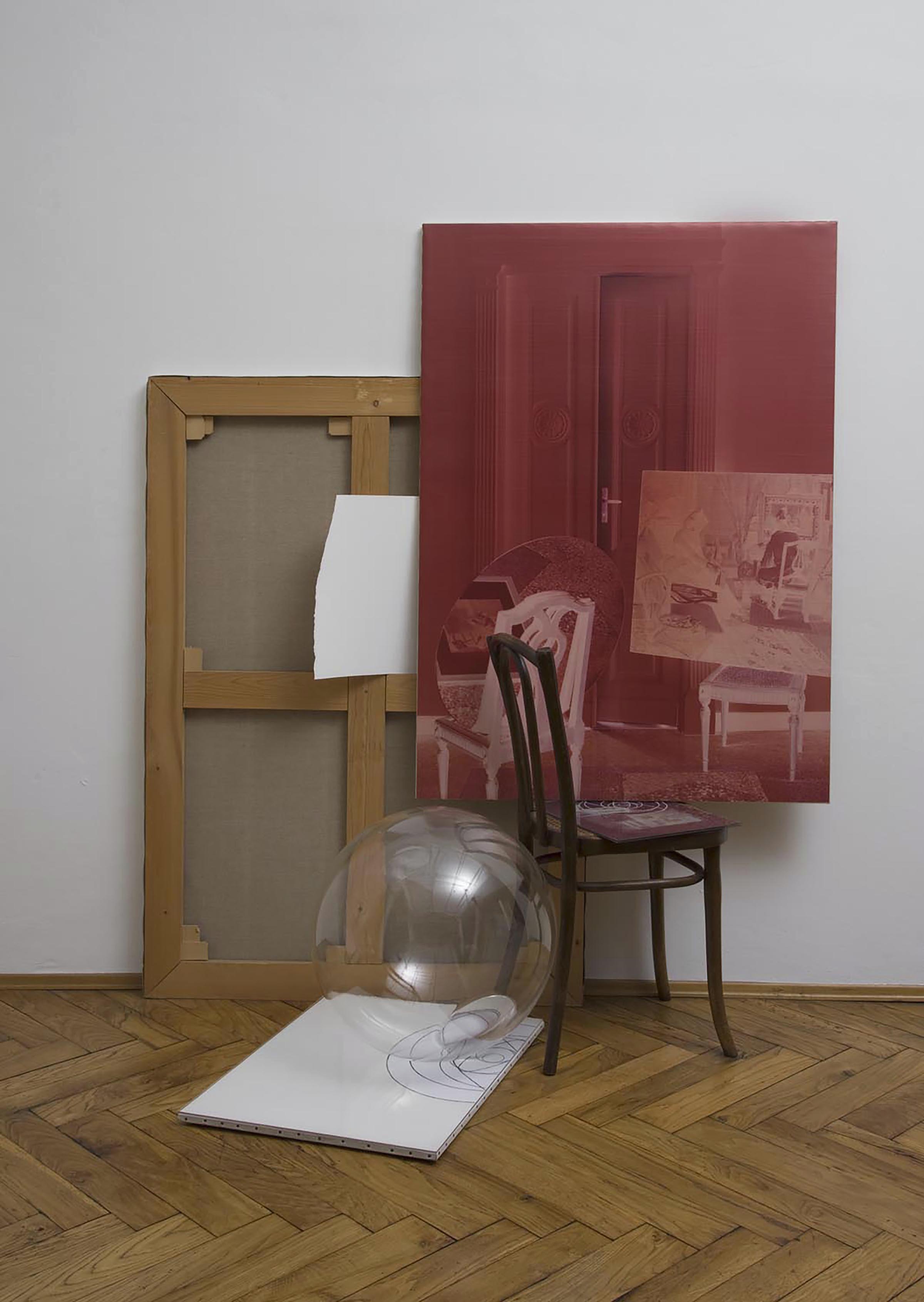
L’ospite, 2007
GPO-0958
The Guest
Photo print mounted on canvas, reversed canvas, torn sheet of drawing paper, collage on primed canvas, collage on black paper, Thonet chair, plexiglas sheet, plexiglas sphere
Photo print mounted on canvas 126 x 91 cm, reversed canvas 140 x 100 cm, primed canvas and plexiglas sheet 65 x 51 cm each, plexiglas sphere Ø 50 cm, collage on black paper 38 x 30 cm, overall dimensions 175 x 140 x 95 cm
Private collection
The work arranged close to a wall is made up of various elements that are connected by specular or complementary relationships, suggested by the photograph located at the centre.
The photograph printed in negative, featuring red toning, and mounted on canvas, reproduces a situation that was arranged by the artist in the hallway of his own home, in front of a door left ajar, with two chairs turned one towards the viewer and the other specularly. On the chair to the right is the painting Nota intima (1887) by Angelo Garino, while on the one to the left is an oval mirror reflecting the engraving laid down on the floor and off-scene portraying William Hogarth as he paints the Comic Muse.1
The photograph is set down on a chair, and recalls in specular terms, the chair with the painting reproduced in the photograph. On the seat of the chair, a collage on black paper doubles the image in the photograph. However, this image is not characterized by toning, and it is accompanied by the drawing of orbits – reproduced in negative (white on black) and round in shape – inserted in the area corresponding to the left chair in the photograph. Laid on the ground is a primed canvas – the left rear leg of the chair is on the canvas – which shows, applied in an eccentric position, half of the orbital drawing set down on the chair, reproduced in positive (black on white). The drawing is topped by a plexiglas sphere that converses with the orbital trajectories. Behind the photograph mounted on canvas and set down on the chair, a reversed canvas propped up against the wall – inserted in the horizontal cross-piece of the stretcher is a torn sheet of drawing paper – echoes the canvas with the photograph.
The work is part of a group of six variants, made between 1989 and 1999 (GPO-0643, GPO-0676, GPO-0708, GPO-0719, GPO-0833, GPO-0958), which are distinguished by their toning, positive or negative print, and the arrangement of the photograph on canvas, set each time in a scene suggested by the composition itself.
1 This is the final state (1764) of the self-portrait entitled William Hogarth Painting the Comic Muse, in which the English artist is intent upon painting the Comic Muse, portrayed while holding the mask of a satyr in one hand and associated with the word "Comedy" etched on the base of the column to the right; Hogarth's own treatise on beauty (The Analysis of Beauty) lies at the foot of the easel. Both Garino's painting and Hogarth's engraving are part of Giulio Paolini's private collection.
• View of the entrance hallway of Giulio Paolini’s home taken by Paolo Mussat Sartor, 1988.
• William Hogarth, William Hogarth Painting the Comic Muse, 1764, etching, final state, 75 x 60 cm, Giulio Paolini Collection.
• Angelo Garino, Nota intima, 1887, oil on canvas, 95 x 140 cm, Giulio Paolini Collection.
| 2011 | Asti, Fondo Giov-Anna Piras, Imaginae 1960-1990, 21 May - 23 December, col. repr. n. pag. (installation view at the home of a private collector, Turin). |
| 2026 | Milan, Gracis Modern and Contemporary Art, Paolo Mussat Sartor. Obiettivo, Arte Povera. Un viaggio nell'arte dal 1968, 29 January - 10 April. |

